
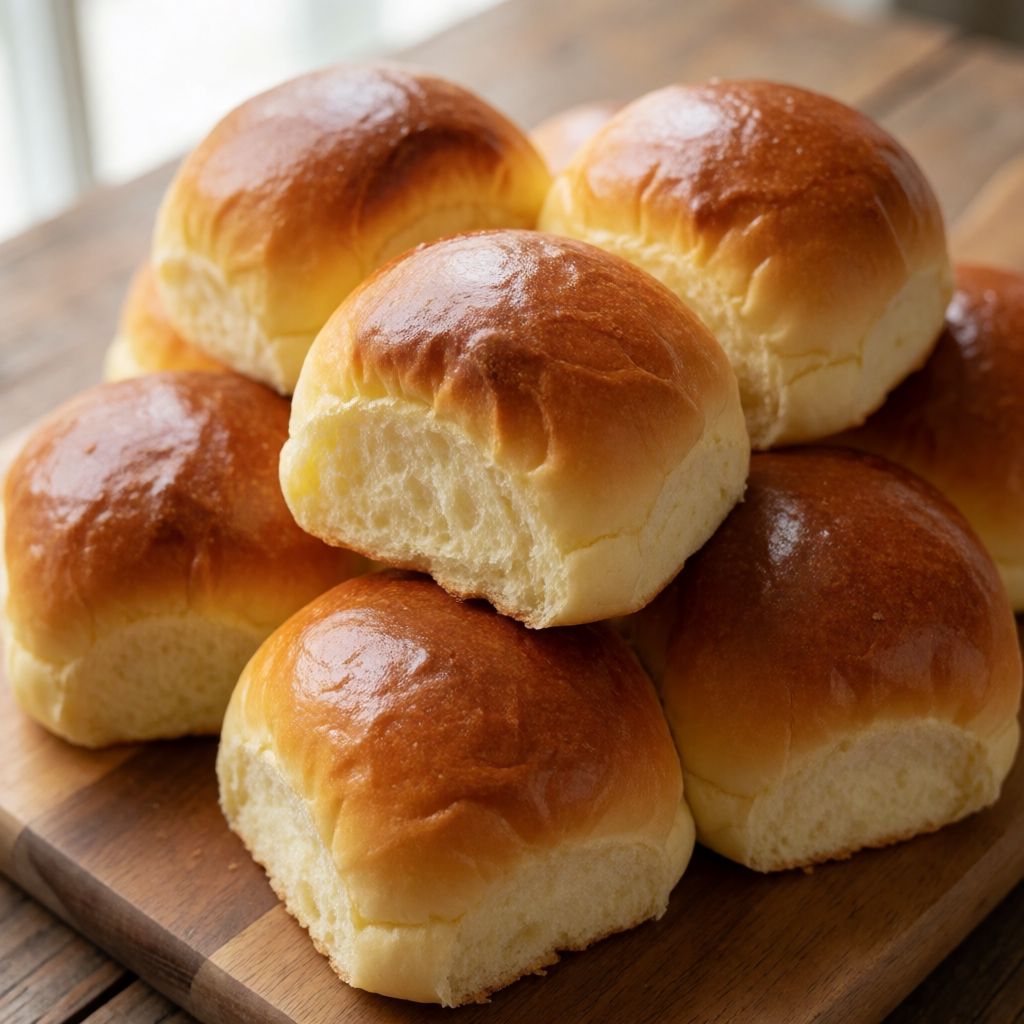
 AI photo
Brioche Buns
Soft, lightly sweet brioche buns, shaped into crescents and filled with jam or Nutella to taste.
Labels are worked out automatically from the ingredients and can be wrong. Check the packaging if it matters to you.
Ingredients
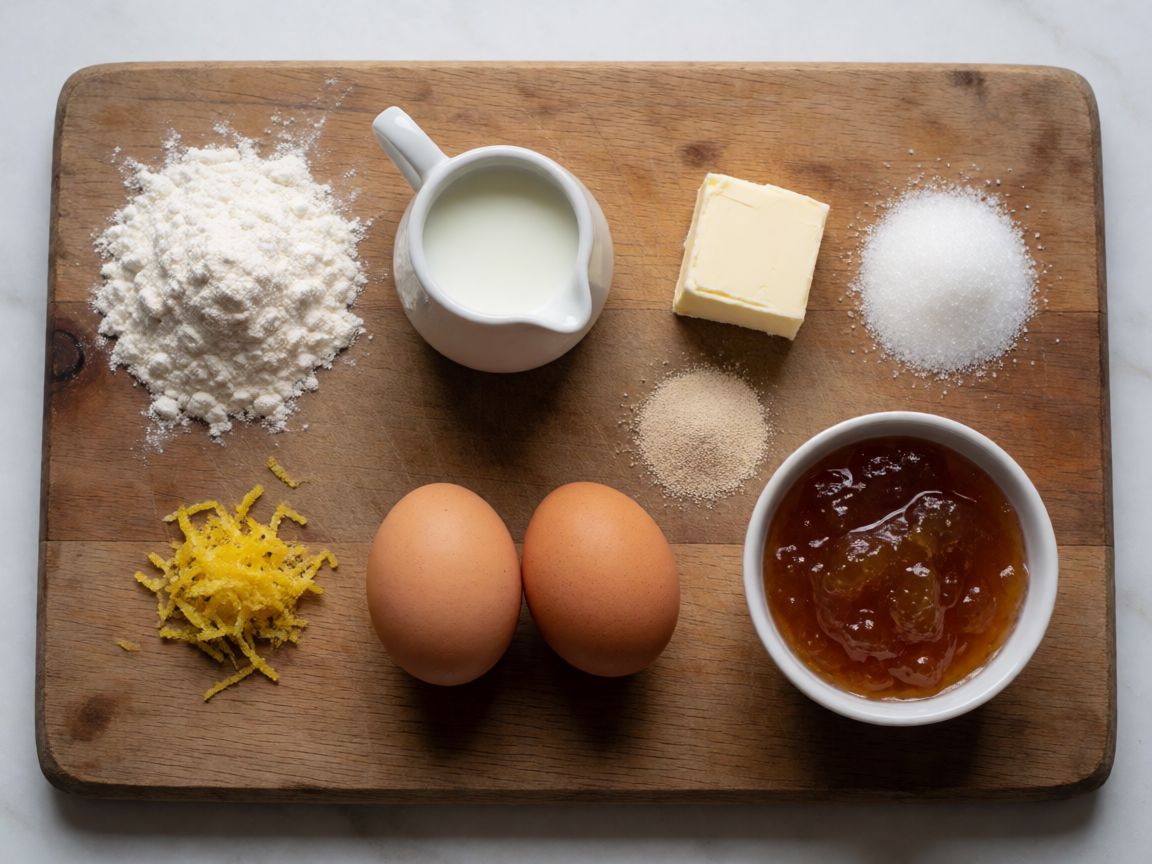
- 500 g Plain flour
- 200 g Milk
- 130 g Butter
- 100 g Caster sugar
- 3 g Yeast or 1 g dried yeast
- 2 pcs Eggs
- Lemon zest to taste
- 1 pinch Salt
- Jam to taste
- Nutella to taste










Steps
In the bowl of a food mixer, combine the milk, butter and yeast and mix on speed 1 while warming to 40°C.
Add the eggs and mix on speed 4.
1 minAdd the sugar and lemon zest and mix.
Add the flour and salt, mix on speed 5, then switch to the dough-kneading setting.
Leave the dough to rise for at least 3 hours, until doubled in size.
180 minDivide the dough into 3-4 pieces and roll each into a rectangular sheet.
Cut the sheet into narrow long triangles and add filling if you like.
Roll up the dough into a crescent shape.
Arrange the brioche buns on a baking tray lined with parchment paper.
Brush the surface of the buns with a mixture of icing sugar and milk.
Place the tray in the oven with a bowl of water, cover with cling film and leave for 10-12 hours.
Preheat the oven to 180°C and bake the brioche buns for about 20 minutes, until golden.
20 min
A brioche bun is really a croissant's softer cousin — same shape, different logic. A croissant gets its lift from layers of cold butter trapped between sheets of dough, flaking apart as it bakes. A brioche gets its richness from butter and egg worked straight into the dough itself, so instead of flaking it tears in soft, pillowy strands. That's the whole point of this recipe: you're not laminating anything, you're building an enriched dough and giving it time to become what it is.
What decides whether this works isn't the shaping, it's the temperature of that first mix and the patience afterward. Warming the milk-butter-yeast base to 40°C isn't a random number — it's the point where yeast is comfortable and butter is soft enough to blend in without turning the mix greasy and separated. Go hotter and you kill the yeast outright; go cooler and the butter sits in lumps instead of marrying into the dough. You're aiming for "warm bath", not "hot tap."
Some say you can skip the long rise and just prove it for an hour like ordinary bread dough. No — because the first 3-hour rise builds structure and flavour, but the second rise, the long cold-ish 10-12 hour one, is what makes brioche taste like brioche rather than sweet bread. That slow fermentation is where the lemon zest, butter and sugar actually integrate and where the crumb gets that faintly tangy depth under the sweetness. Rush it and you get a soft, sweet roll — pleasant, but not this.
Flour first: plain flour, not strong bread flour, and that's deliberate. Brioche doesn't need the chew and structure a baguette needs — the butter and egg already weaken and soften the gluten network, so a lower-protein flour keeps things tender rather than fighting the richness. If you only have strong flour, it'll still work, just knead a touch less once it comes together, or you'll toughen it.
Milk and butter together are your enrichment — milk for softness and a little sugar to feed the yeast quietly, butter for the actual flavour and that short, tender crumb. Use a butter you'd happily eat on toast; a bland supermarket block gives a bland bun. No butter in the house for some reason? A neutral dairy spread will get you volume, not flavour — you'll notice the gap.
Yeast at 3g fresh or 1g dried is a small amount for 500g flour, and that's the tell that this dough is meant to rise slowly, over hours, not in 45 minutes on a radiator. Rushing it with more yeast or extra warmth gives you a beery taste and a coarser crumb — the slow route is what gives brioche its fine, close texture.
Eggs bind and colour — they're doing a job sugar and butter alone can't, giving you that golden crumb and a slight custardy softness. Lemon zest is there for lift against all that fat and sugar; any citrus zest will do the same job, orange works just as well, it just shifts the flavour rather than breaking the method.
Jam or Nutella is filling, not structure — purely your choice, and either one changes nothing about how the dough behaves. Just don't overfill the triangle before rolling, or it leaks out during the long proof and burns onto the tray instead of staying tucked inside.
The icing sugar and milk wash brushed on before the long rest is doing two things: giving you that soft sheen rather than a hard crust, and acting as a light barrier while the dough proves uncovered-but-filmed overnight. Don't swap it for egg wash here — egg wash is for a shiny, bread-like crust, and that's not the texture you're after on a brioche bun.
On a British domestic oven, treat "180°C, about 20 minutes, until golden" as the honest instruction it is — ovens vary by 10-15°C either way, so the colour of the crust is your real signal, not the timer. Pull them when they're deep gold, not pale — pale means underbaked crumb inside, however long the clock says you've had them in.