
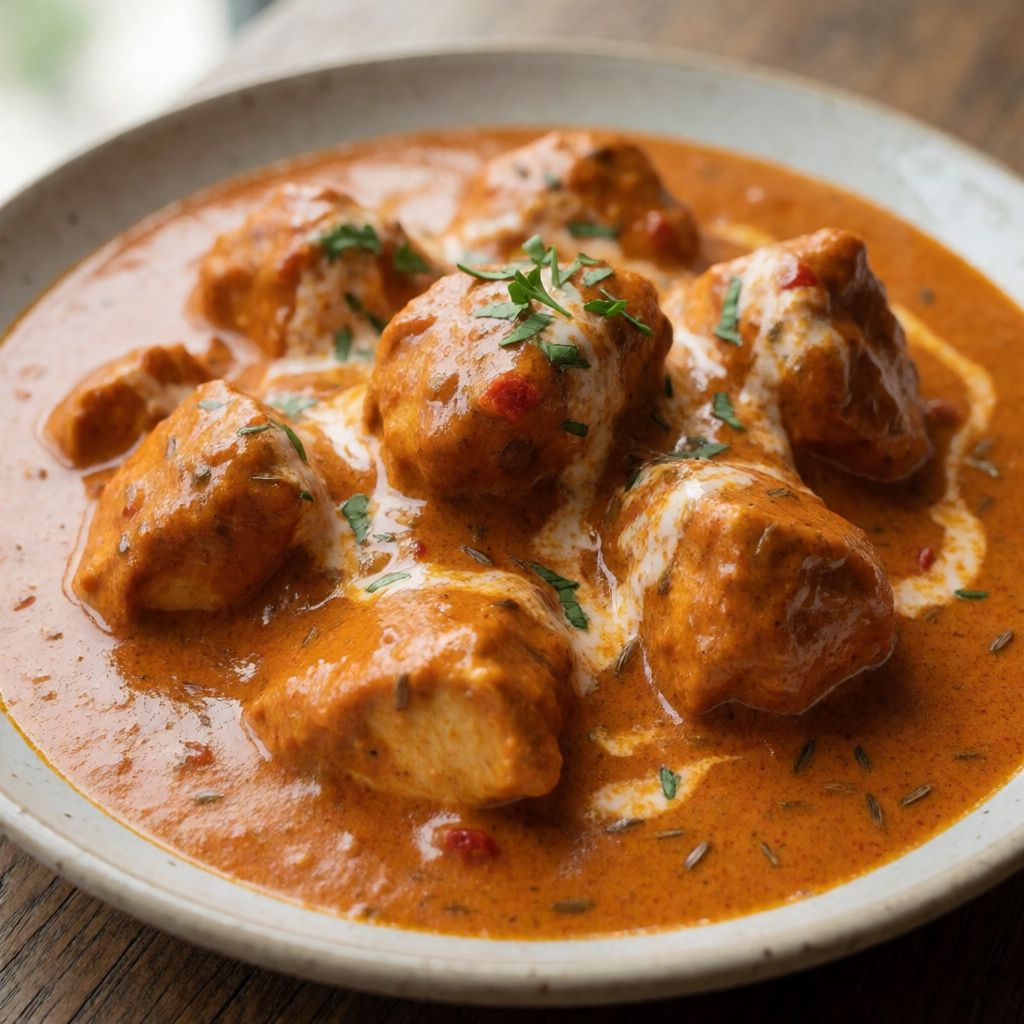
 AI photo
Butter Chicken
A creamy, spiced Indian-style chicken curry simmered in a tomato and butter sauce, served with rice.
Labels are worked out automatically from the ingredients and can be wrong. Check the packaging if it matters to you.
Ingredients
- 100 g Greek yoghurt
- ½ tsp chilli flakes
- ½ tsp cloves
- 2 tsp cumin
- 1 tsp cardamom
- 2 tsp garam masala
- 2 clove garlic finely chopped
- 1 tsp turmeric
- 1 tbsp ginger fresh
- 400 g canned chopped tomatoes
- 500 g chicken breast diced
- 1 pcs onion sliced into rings
- 50 ml whipping cream
- 50 g butter
- 2 tbsp olive oil
- salt to taste
- black pepper to taste, freshly ground
- 300 ml basmati rice cooked according to packet instructions
- 2 bunch coriander fresh



















Steps
Whisk together the yoghurt, chilli flakes, cloves, cumin, cardamom, garam masala, turmeric, ginger, garlic and chopped tomatoes until smooth.
Pour the sauce over the chicken pieces, cover and leave to marinate in the fridge for at least 30 minutes, or ideally overnight or from morning until dinner.
30 minMelt the butter with the oil in a frying pan. Fry the onion until soft.
Add the chicken, sauce and cream.
Simmer gently for 30-35 minutes, or until the chicken is tender.
33 minServe with rice, sprinkled with fresh coriander.
Butter chicken is a marinade problem disguised as a sauce problem. Everything that makes this dish work happens before the pan ever gets hot — in those hours the chicken spends sitting in yoghurt, spice and acid. The frying and simmering at the end are just finishing the job the fridge already started.
Some say the butter in the name is decoration, a bit of shine stirred in at the end. It isn't. Butter and cream are there to coat the tongue and mute the chilli and cloves, so you taste the warmth of the spice without the sting of it. Take them out and you don't get a leaner butter chicken — you get a different, sharper dish that happens to use the same spice list.
The thing that actually decides whether this works on an ordinary UK hob is patience with the marinating, not skill with the pan. Thirty minutes gives you a seasoned chicken breast in a tomato sauce. Overnight gives you yoghurt's lactic acid time to loosen the muscle fibre, so the chicken breast — a cut with almost no fat to protect it from drying out — stays moist instead of turning to string. This is the one ingredient in the list that is actually time, and it's non-negotiable if you want tender, not just cooked.
The last ten minutes are where chicken breast usually gets ruined by people convinced that "simmer gently" means "boil while you answer emails". It doesn't. You're looking for the dice to go opaque right through and give a little resistance, not flake apart — if it's falling into shreds, it went past done five minutes ago, and no amount of cream fixes that.
Start with the yoghurt. Greek yoghurt is thick because the whey's been drained off, which means more lactic acid sitting in direct contact with less liquid — that's what tenderises, not magic, chemistry. A thin natural yoghurt will marinate too, just more weakly and more wetly, so you'd want to drain it through a sieve for twenty minutes first or your sauce ends up watery before it's even hit the pan.
The spice list looks long and intimidating until you notice what each one is actually doing. Cumin and coriander-adjacent warmth form the backbone; cardamom and cloves are the "this smells like a kitchen, not a spice rack" top notes — use them whole if you've got them and can be bothered fishing them out later, ground if you can't; chilli flakes are the only dial you should feel free to turn up or down, because that's the only one that's about your tolerance, not the dish's identity. Turmeric is there for colour and a faint bitterness as much as flavour — skip it and the sauce goes pale and a little flat, nothing more dramatic than that. Garam masala, added whole rather than built spice by spice, is the shortcut version of the same backbone — a blend that already contains most of what you'd otherwise buy separately, which is exactly why it exists: it's cheaper and faster for home cooks than stocking eight jars.
Fresh ginger and garlic matter here more than in a lot of dishes, because they're going in raw, pulverised into the marinade rather than fried first — their job is to perfume the yoghurt over hours, not to hit hot oil and bloom in thirty seconds the way they would in a stir-fry. Dried ginger or garlic powder will survive the overnight soak less well; they dissolve, but they don't release the same way, so if that's all you've got, use less time and more quantity to compensate.
Chicken breast is the economical choice, not the traditional one — the dish was built on thigh and bone-in pieces that can take a longer, rougher simmer without drying out. Breast is what a British kitchen reaches for because it's lean, cheap relative to thigh in some shops, and doesn't need trimming. The marinade above is partly there to cover for that leanness. If you want more margin for error on the stove, swap in diced thigh — it forgives overcooking in a way breast simply doesn't, because it carries its own fat.
The onion rings frying in butter and oil before the chicken goes in aren't decorative either — that's where the base sweetness comes from, and it's also your one visible doneness cue in the early stage: you want them soft and translucent, going toward gold, not browned hard, because hard-browned onion turns bitter and that bitterness doesn't cook back out once the tomatoes go in. Use a neutral oil with the butter if you're worried about the butter burning alone — butter has milk solids in it that scorch at a lower heat than oil does, and the oil is there specifically to buy the butter some protection, not to dilute the flavour.
Cream at the end is for mouthfeel and to temper acidity, nothing more mystical than that — any cream that pours and doesn't split when warmed will do; UK whipping cream behaves well because it has enough fat not to curdle against the tomato's acid, whereas a very low-fat single cream is more likely to separate in the pan.