
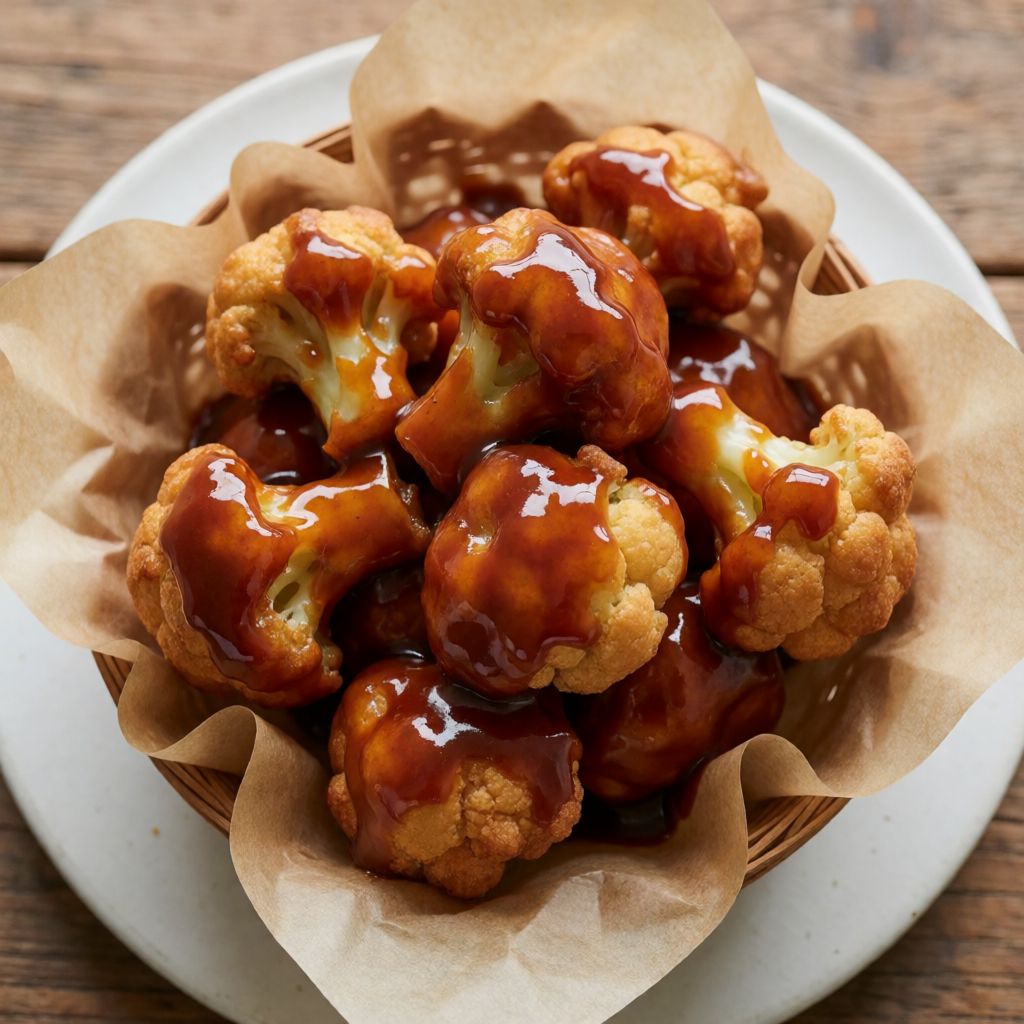
 AI photo
Cauliflower Wings in Sticky BBQ Sauce
Crispy baked cauliflower florets coated in a sticky homemade barbecue sauce.
Labels are worked out automatically from the ingredients and can be wrong. Check the packaging if it matters to you.
Ingredients
- 1 pcs Cauliflower
- 200 ml Plain flour
- 100 ml Water more if needed, to make a thick batter
- 1 tsp Smoked paprika
- 1 tsp Salt
- 3 tbsp Soy sauce
- 1 clove Garlic crushed
- 3 tbsp Maple syrup
- 2 tbsp Tomato purée
- 1 tsp Ginger fresh
- 1 tsp Smoked paprika
- 1 tbsp Apple cider vinegar
- 50 ml Water
- 1 tsp Cornflour
- 1 tbsp Sesame seeds
- 1 bunch Parsley finely chopped














Steps
Break the cauliflower into large florets and pat them completely dry.
Mix the flour, smoked paprika and salt with the water into a thick batter and coat the florets in it.
Place the cauliflower on a baking tray lined with parchment, leaving space between the pieces, and bake in a preheated fan oven at 180°C for 15-20 minutes.
18 minFor the barbecue sauce, mix the soy sauce, garlic, maple syrup, tomato purée, ginger, smoked paprika, apple cider vinegar and water in a bowl, sift in the cornflour and stir well until smooth.
Pour the sauce into a frying pan over medium heat. Once warmed through, carefully add the cauliflower and turn the pieces occasionally. Simmer on low heat for about 5-6 minutes, until the sauce coats the cauliflower well.
6 minServe sprinkled with sesame seeds and finely chopped parsley, with a dip on the side.
Let's call this thing what it is: cauliflower pretending to be chicken wings, and doing a decent job of it, because the mechanism is the same — a wet coating that dries into a crust, then gets glazed in something sticky and loud. The cauliflower itself is almost incidental. It's a vehicle for crunch and for soaking up sauce; a potato wedge could do the same job, and nobody would call it blasphemy.
What decides whether this works is moisture, twice over. First, dry florets before battering — water on the surface thins the batter and stops it clinging, so you get bald patches that turn leathery in the oven instead of crisp. Second, don't crowd the tray. Steam rising off wet florets packed close together softens the batter from underneath before it's had a chance to set, and you end up with soggy-bottomed wings no amount of sauce will rescue.
Some say cauliflower "wings" need deep frying to crisp properly. No — the oven does it fine, because the batter here is a flour-and-water paste, not a tempura; it's thick enough to form a shell on its own with dry heat, it just needs room and time to lose its water, not fat to fry in. What you're watching for isn't a clock number but a colour and a texture: the batter goes from wet-pale to matte and faintly golden, and it should feel firm, not tacky, when you nudge a piece.
Flour and water make the batter, and there's nothing clever to it — plain flour, straight from the bag you'd use for a Sunday roast's Yorkshire puddings, no need for self-raising or anything fancier. The water goes in gradually because "thick batter" is a feel, not a fixed 100ml; flour varies, your bowl varies, so add water until it coats the back of a spoon and clings rather than runs. If it runs, it'll drip off the florets before the oven sets it, and you're back to bald, soggy patches.
Smoked paprika does two jobs here, once in the batter and once in the sauce, and both times it's standing in for the smoke a kazan or a real barbecue would give for free. No smoker on a UK hob, obviously, so the spice carries that flavour chemically instead. Any smoked paprika works; sweet (not hot) is right for this, since the sauce already carries heat elsewhere if you want it — this recipe doesn't, but chilli flakes are an easy add if you miss it.
Soy sauce, maple syrup, tomato purée and vinegar are the backbone of the sauce, and the balance between them is the actual recipe — salt, sweet, body, sharpness. Maple syrup isn't sacred; it's just a sweetener with some depth, so honey or golden syrup will do almost the same job, slightly less complex. Cider vinegar cuts the sweetness so the sauce doesn't just taste like jam; malt vinegar is close enough if that's what's in the cupboard, though it's sharper, so go easy.
Fresh ginger and crushed garlic are aromatics, not bulk — their job is to perfume the sauce while it thickens, not to be chewed as chunks, so fine is right. Ground ginger is an acceptable swap if fresh isn't to hand, use less, since dried is more concentrated and loses the bright top note fresh has.
Cornflour sifted into the sauce is the only thing standing between "sauce" and "glaze." Sifting matters because cornflour lumps the instant it meets liquid unevenly, and a lump means a raw starchy bite in an otherwise smooth sauce — sift it or at least whisk it into a little of the water first before it joins the rest.
Sesame seeds and parsley at the end aren't decoration for its own sake — the seeds add a dry crunch against the sticky glaze, and the parsley's freshness cuts the richness, the way you'd want something green against a heavy roast dinner. Patience is the real ingredient through all of this: rushing the drying, crowding the tray, or boiling the sauce hard are the three ways to ruin this dish, and all three come from impatience, not bad luck.