
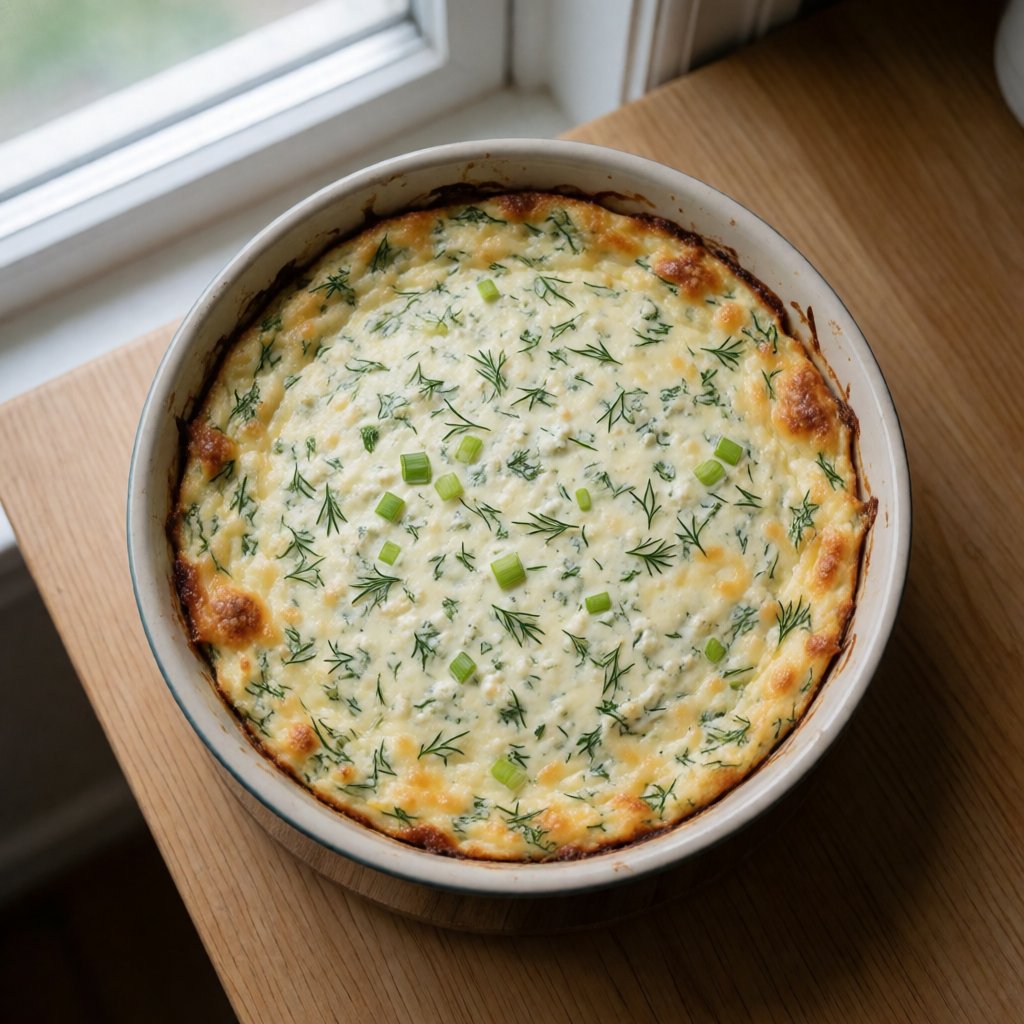
 AI photo
Savoury Cottage Cheese Bake with Herbs
A savoury curd cheese bake with fresh herbs, baked until golden and set.
Labels are worked out automatically from the ingredients and can be wrong. Check the packaging if it matters to you.
Ingredients
- 300 g Cottage cheese
- 2 pcs Eggs
- 2 tbsp Semolina
- 40 g Cheddar cheese grated
- 10 g Dill
- 10 g Spring onion
- 1 clove Garlic
- 1 pinch Salt
- 1 tsp Sunflower oil for greasing the dish









Steps
Mash the cottage cheese with the eggs, semolina, salt, garlic and herbs.
Spoon the mixture into a greased baking dish and top with the grated cheese.
Place the dish in the oven at 200°C and bake for 25–30 minutes.
30 minRemove the dish from the oven.
What was changed
The hard cheese was replaced with Cheddar cheese, the everyday hard cheese in British kitchens.
This is a savoury cottage cheese bake — think of it as a cousin of sirniki, except instead of frying little cakes in a pan you let the whole mixture set in one dish in the oven. Cottage cheese, egg, a spoon of semolina, herbs, garlic, a cap of cheddar on top. Simple ingredients, but the result depends entirely on how wet your starting cheese is and how long you let the egg do its job before you cut into it.
What decides whether it works is moisture. Cottage cheese holds a lot of whey, and if that whey stays loose in the mix, you don't get a bake — you get a puddle with curds floating in it. The semolina's whole purpose is to drink up that liquid before the heat sets the eggs. Give it even a few minutes to swell before it goes in the oven, and the texture holds together instead of weeping onto the plate.
Some say cottage cheese and curd cheese are interchangeable in any recipe that calls for "cottage cheese." No — not here. What you buy in a British supermarket tub is a wet, loose-curd cheese swimming in its own dressing, built for toast and salad, not for baking. Traditional versions of this dish use a pressed curd cheese — tvorog, quark, farmer's cheese — which is already half-dry. If all you have is the wet supermarket kind, tip it into a sieve for ten minutes first and let the excess liquid run off. Skip that step and no amount of semolina will save you.
On the ingredients, one by one. Cottage cheese is the base, and the standard here is dryness, not brand: you want curds that hold a shape on a spoon rather than cheese that slides off it. If you can find curd cheese or quark instead of cottage cheese, use that straight — no draining needed. If you're stuck with the wet supermarket tub, drain it, don't just stir harder.
The eggs bind. Two eggs for 300 g of cheese is enough to hold the structure once it sets — more and you tip into a dense omelette, less and the bake won't hold a slice. There's no substitute for egg here that does the same job without changing the dish into something else.
Semolina is the quiet worker. It swells as it absorbs whey, giving you a soft, slightly grainy crumb rather than the chewy, elastic crumb flour would give — flour develops gluten when wet, semolina doesn't, which is exactly why it's the right choice and not an arbitrary one. If you have no semolina, fine bulgur or ground rice will do the same absorbing job; plain flour works in a pinch but makes the bake denser and a touch rubbery, so use less of it than the semolina quantity calls for.
Cheddar on top needs to be a cheese that browns, not just melts into a flat puddle — any firm, mature cheese does this: cheddar, a hard Lancashire, even a strong Gruyère if that's what's in the fridge. Soft cheeses just ooze and never colour, so they miss the point of putting cheese on top at all.
Garlic, one clove, goes in raw with the mix — its sharp bite mellows as it bakes, so don't be shy with it thinking it'll stay harsh. Dill and spring onion are there for brightness, to cut through all that egg and cheese richness; any soft, mild green herb and allium will do the same work if that's what you have growing on the windowsill.
200°C is where egg proteins firmly set and the cheese on top browns rather than just weeps fat — but know your oven. Domestic ovens run hotter or cooler than the dial says, often by a surprising margin, so judge by what you see: the top turning gold-brown, the centre no longer visibly wobbling when you nudge the dish. A skewer in the middle coming out clean is your real finish line, not the clock.
And once it's out, leave it five minutes before cutting. The eggs are still finishing their set in that residual heat — cut too soon and the whole thing collapses sideways onto the plate instead of holding a neat wedge. Patience here isn't optional, it's the last ingredient, and it costs you nothing but the willpower to not reach for the knife immediately. Good with tea, milk in first if that's your way, as an easy stand-in breakfast or light supper for two — nothing to do with the Sunday roast, but it'll survive sitting next to one on the table without feeling out of place.
·