
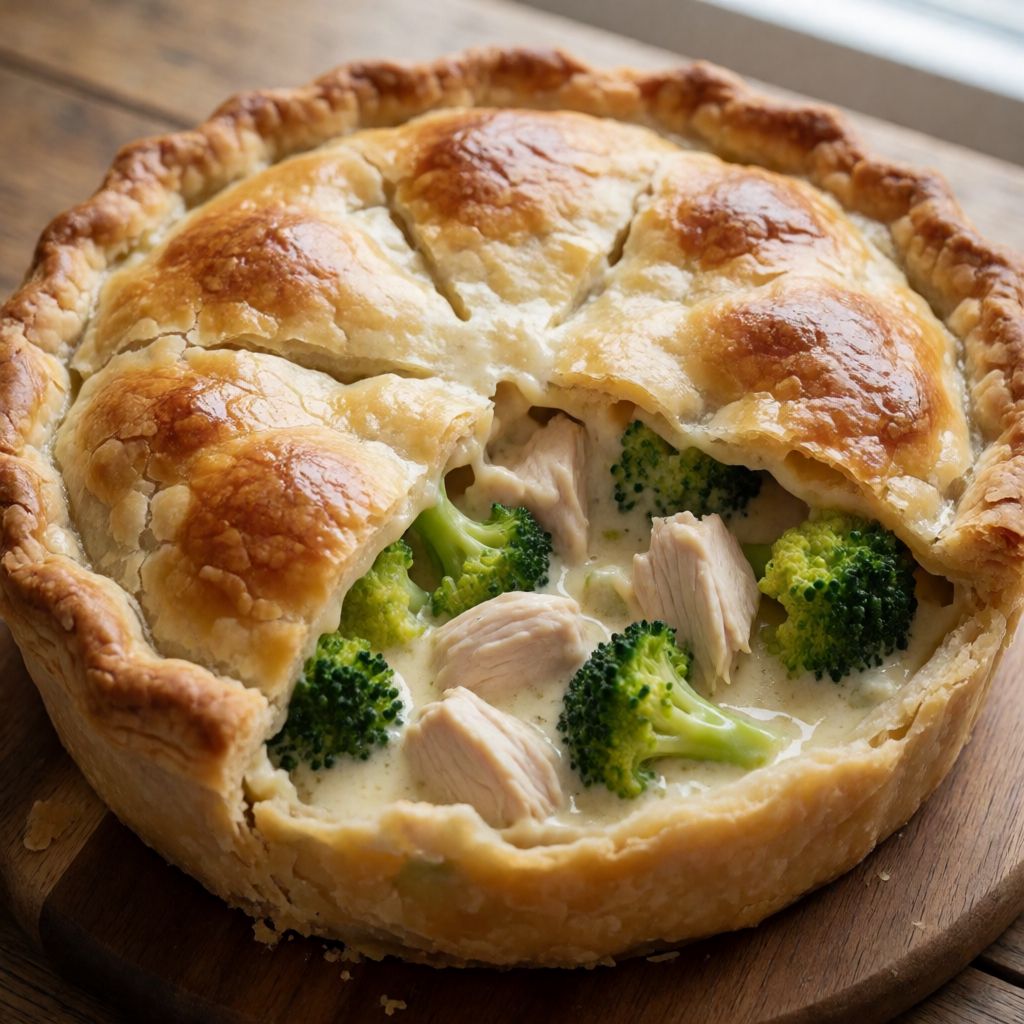
 AI photo
Chicken and Broccoli Pie
A savoury pie with chicken, broccoli, chorizo and cheddar in a buttery shortcrust base.
Labels are worked out automatically from the ingredients and can be wrong. Check the packaging if it matters to you.
Ingredients
- 50 g Wholemeal flour
- 125 g Plain flour
- 100 g Butter
- 45 ml Water
- 1 tsp Salt
- 200 g Chicken breast
- 20 g Plain flour
- 30 g Chorizo diced small
- 150 g Broccoli cut into small florets
- 4 pcs Eggs beaten
- 100 ml Milk
- 200 g Cottage cheese
- 50 g Mature cheddar freshly grated
- 1 tbsp Olive oil for frying
- Salt to taste













Steps
Mix the plain and wholemeal flour with salt, then rub in the butter until it resembles breadcrumbs.
This can also be done in a food processor.
Bring the dough together with the water and let it rest in the fridge for 30 minutes.
30 minPress the dough into a greased 24 cm tin and prick it with a fork.
Bake the base in a preheated fan oven at 175°C for 10 minutes, after which it is ready to be filled and baked.
10 minToss the chicken pieces in flour, salt and pepper and quickly fry in a hot pan with olive oil.
The chicken should not be fully cooked through at this stage.
Whisk together the eggs, milk, cottage cheese, salt and freshly ground pepper, then add the chicken, broccoli and chorizo.
Spread the filling over the pre-baked base and sprinkle with freshly grated mature cheddar.
Bake the pie in a preheated fan oven at 175°C for about 35 minutes, until the egg mixture has set.
35 min
This is a shortcrust tart doing the job a quiche usually does, but with chicken and chorizo brought in so it reads as a proper dinner, not a picnic slice. What decides whether it works is two separate bakes with two separate jobs: the case gets baked blind first so it sets into something that can hold a wet custard without turning to paste, and only then does the filling go in to set in its own, gentler bake.
Blind-baking isn't fussiness for its own sake. Pastry rolled raw into a tin, loaded straight with an egg-and-milk mixture, will steam from underneath before the top has even thought about setting — you get a pale, soggy base and a filling that's cooked but a bottom that tastes of flour and water. Ten minutes at 175°C with nothing but the pricked holes to let steam escape dries and firms the base enough that it can take the liquid filling later without surrendering to it.
The filling itself is a custard — eggs and milk and cottage cheese are all water-and-protein, and they behave exactly like a custard does. Push it too hot or too long and it curdles into something grainy and weeping, rather than setting into a clean, sliceable wobble. That's why the chicken goes in half-cooked, almost defiantly so: it finishes in the oven at the same gentle pace as the egg, so by the time the custard sets, the chicken is done too — not dry, not rubbery, not that oven-finished chicken that's had two separate rounds of heat thrown at it.
On the flour: wholemeal and plain mixed together isn't a health gesture, it's structure. Pure wholemeal pastry is heavier and can turn leathery under a wet filling; pure plain flour pastry is sandy and fragile and tends to crack when you cut through a custard-filled tart. The blend gives you a case sturdy enough to carry the filling's weight but still short enough to shatter cleanly under a knife. If you only have plain flour, use it — the pastry will be slightly less textured but it won't fail you.
The butter is rubbed in cold, not melted, because what you want is tiny flakes of fat coating the flour and keeping it separate — that's what gives pastry its shortness, its crumble, rather than a chewy bready result. Any firm, flavourless fat behaves the same way; lard does this job too and historically did it more often, butter only became the default once it got cheap and reliable enough for everyday baking.
Chicken breast toughens fast once it crosses from just-cooked into overcooked — there's no forgiving fat running through it the way there is in thigh. A hot pan and a quick fry, barely coloured, is there to seal the outside and start the process, not finish it; the custard bake does the rest at a kinder pace. If you'd rather not fuss with two stages of chicken cooking, thigh meat is more forgiving and will survive a slightly longer first fry without drying out.
Chorizo earns its place in small dice, not as a main ingredient but as a seasoning — its paprika oil bleeds into the custard around it and salts and colours the whole filling without you having to add much salt yourself, which is why the recipe only asks for salt "to taste" once the chorizo's in. Any cured, spiced sausage with fat you can render out will do a similar job; pancetta won't bring the same colour or heat, but it'll bring saltiness and fat.
Broccoli goes in raw, cut small, because it will cook through in the custard's 35 minutes at 175°C — anything bigger than a small floret risks staying raw-crunchy in the centre while the egg around it has set. If you parboil it first you lose some of that mechanism — it'll overcook by the time the custard's ready — so leave it be.
Cottage cheese alongside the eggs and milk isn't an odd addition — it adds body and a slight tang without the heaviness of cream, and it's doing double duty as bulk so the custard sets into slices rather than a loose wobble. Ricotta is the obvious substitute if that's what's in your fridge. The cheddar on top isn't melted into the filling — it sits on the surface to brown, because a custard pie with a gratin top eats differently to one that's uniformly soft, and that contrast is worth keeping.
One 24cm tin feeds this as a proper weeknight dinner for three or four with a salad alongside, or thin slices for six as part of a spread — treat the servings note loosely, this isn't a portion-controlled dish. And give the pastry its 30 minutes in the fridge before you roll it: that rest lets the gluten relax after the rubbing-in, which is what stops it shrinking stubbornly back on itself in the tin. Skip that rest and you're wrestling dough that keeps pulling away from the edges — patience here isn't optional, it's doing real work.