
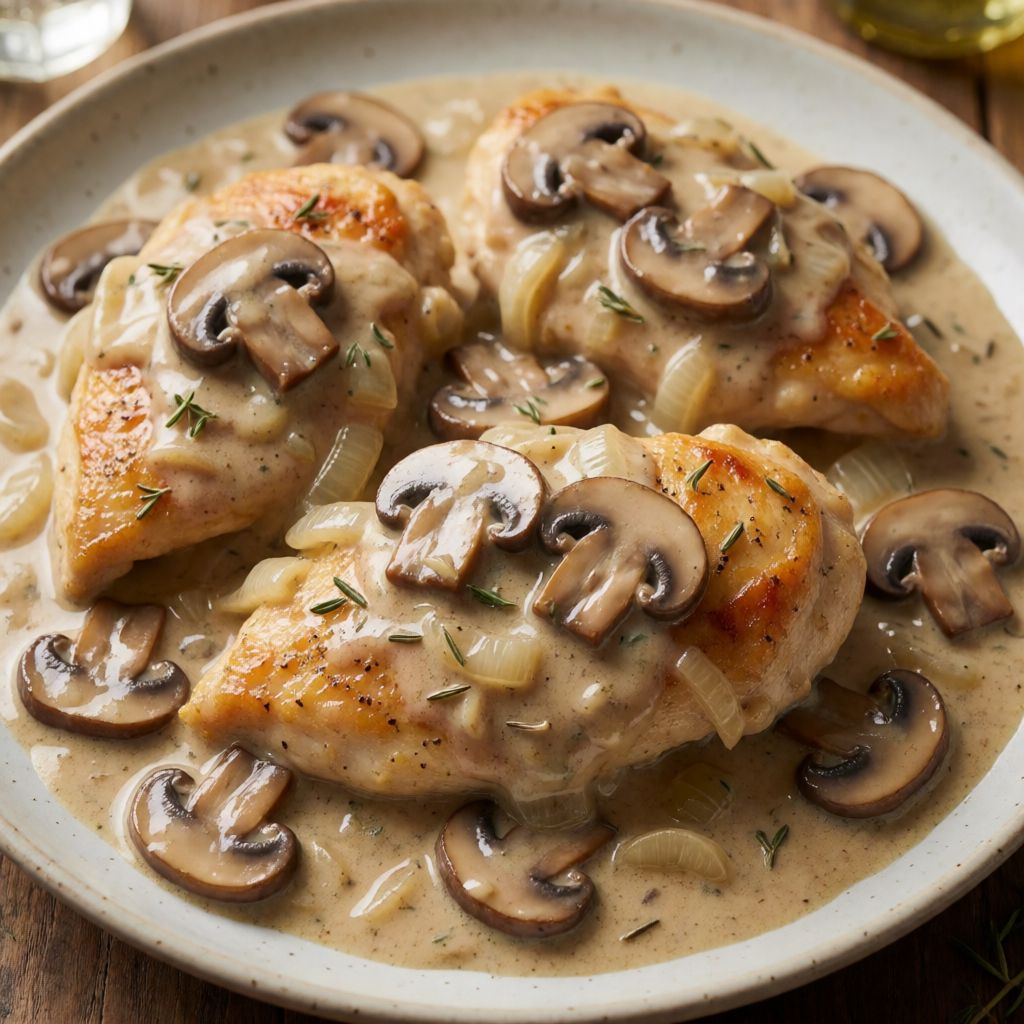
 AI photo
Chicken in Mushroom Sauce
Chicken breasts in a creamy mushroom sauce, served with roasted potatoes.
Labels are worked out automatically from the ingredients and can be wrong. Check the packaging if it matters to you.
Ingredients
- 4 pcs Chicken breast skin on
- 200 g Mushrooms quartered
- 100 g Chanterelle mushrooms
- 1 pcs Onion finely chopped
- 2 clove Garlic finely chopped
- 1 tsp Dried thyme
- 0.5 tsp Dried rosemary
- 100 ml White wine
- 100 ml Stock
- 200 ml Double cream
- 1 tbsp Cornflour
- 0.5 pcs Lemon finely grated zest, plus a little juice
- 1 bunch Parsley finely chopped
- 1 tbsp Olive oil for frying
- 10 g Butter for frying
- Salt
- Black pepper freshly ground
- 1 kg Potatoes skin on, cut into quarters
- 1 tbsp Olive oil
- 1 tsp Salt














Steps
Toss the potatoes with the oil and salt and roast in an oven preheated to 220°C for about 30 minutes, turning a few times.
30 minSeason the chicken pieces with salt and pepper. Heat a pan with the butter and oil and fry the chicken skin-side down until golden and crisp, then briefly brown on all sides. Remove the chicken from the pan.
Heat the pan over high heat, adding more fat if needed, and fry the mushrooms, stirring constantly, until golden. Reduce the heat once the mushrooms have taken on a good golden colour.
5 minAdd the onion, garlic, thyme and rosemary and cook, stirring, until the onion is soft.
3 minStir the cornflour into the cooled stock in a bowl. Add this mixture along with the cream and white wine to the pan. Mix well and return the chicken to the pan.
18 minSimmer for about 15–20 minutes, until the chicken is cooked through. Season with finely grated lemon zest, a little lemon juice, salt and pepper. Serve sprinkled with finely chopped parsley, with the roasted potatoes.
18 min
This is a Sunday-dinner dish wearing a French sauce. Chicken breast, two kinds of mushroom, cream and wine reduced down into something glossy, with a tray of roast potatoes standing in for the Yorkshire pudding. Nothing exotic in the method — it's braise-and-reduce, the same logic as a thousand British chicken-in-sauce dinners — but the whole thing lives or dies on two things: how the chicken skin is treated in the first five minutes, and whether the sauce is a sauce or just cream with stuff floating in it.
Breast is unforgiving meat. No fat running through it like thigh has, so it punishes you the moment you walk away from the pan. The skin-side-down sear at the start isn't about colour for its own sake — it's rendering out the fat under that skin so it turns crisp rather than staying rubbery, and it's building the brown crust (the fond) stuck to the pan, which is where half your sauce's flavour is going to come from before you've added a drop of cream. Some say you can just poach chicken in the sauce from raw and skip the searing — no, because then the skin never crisps, and you've thrown away that fond, so the sauce tastes like cream, not like chicken and mushroom.
Chicken breast, skin on — buy it with the skin if you can, because a skinless breast in this dish has no crust to build and nothing to render, and you'll just be poaching pale meat in cream, which is a different, sadder dish. If you only have skinless, don't panic — sear it hard and fast in the oil alone, accept there'll be less fond, and lean a little harder on the mushrooms and lemon zest at the end to make up the savoury weight you've lost.
The two mushrooms are not interchangeable with each other, but you can be relaxed about the species. The point of using two is textural: the quartered mushrooms (chestnut, button, whatever's cheap) give you bite and a dense, meaty chew, while chanterelles are delicate, almost fragile, and bring a different kind of earthiness — slightly fruity, slightly peppery. If chanterelles aren't sitting in your greengrocer's, don't go hunting — any wild or mixed mushroom works, or just double up on the quartered ones. What matters more than variety is how you fry them: high heat, don't crowd the pan, let them sit for a few seconds between stirs instead of pushing them round constantly. Mushrooms are mostly water. Stir them too much too soon and that water comes out as steam before the surface has had a chance to brown, and you get grey, boiled-looking mushrooms instead of golden ones. Some say mushrooms "shouldn't be washed, only wiped" — true in spirit, but in a London flat with supermarket mushrooms that have already been through three pairs of hands, a quick rinse and a thorough pat-dry does no harm, as long as they're properly dry before they hit the hot fat.
Onion, garlic, thyme, rosemary — this is the aromatic base, and it goes in after the mushrooms deliberately, not before. Onion added too early, alongside raw mushrooms, releases its own moisture right when you're trying to drive moisture out of the mushrooms, and you end up steaming both. Soften the onion separately and you get sweetness instead of rawness; the dried herbs here are doing a background, woodland job rather than a sharp, fresh one, which suits a cream sauce — fresh thyme or rosemary would be lovely too if you have it growing, just use roughly double the amount since dried herbs are concentrated.
White wine and stock together are there for the same reason a good gravy needs more than just meat juices — acidity cuts through the richness of the cream so the whole dish doesn't sit heavy on the tongue. Any dry white you'd actually drink a glass of works; don't buy a dedicated "cooking wine", which is usually salted and flat-tasting and a false economy. If you've genuinely got none in, a splash of cider vinegar or lemon juice stirred into extra stock gets you partway there, though you lose some of the depth. Cornflour mixed into cold stock before it goes anywhere near heat is not fussiness — mix it into a hot pan directly and it clumps into little gluey lumps that never fully dissolve, because the starch granules seize on contact with heat before they've had a chance to disperse in liquid.
Double cream is non-negotiable in the sense that single cream or so-called "cooking cream" will split under heat and reduction — not enough fat to hold itself together once it's been simmering with wine's acidity in the pan. If you want lighter, crème fraîche can work, stirred in off the heat at the very end rather than simmered, but that changes the character of the dish — tangier, less silky.
Lemon zest and juice at the end are not garnish, they're correction — cream sauces, left alone, drift towards flat and heavy, and a little acid and citrus oil (from the zest, which carries far more flavour than the juice) wakes the whole thing back up. Add it too early and the heat cooks off the fragrance; add it right at the end, off or barely on the heat, and you get the lift without losing it to steam. Parsley at the very end does the same job for colour and a clean, grassy note against all that cream and fat — chop it and add it last, because cooked parsley turns a dull khaki and loses any reason for being there.