
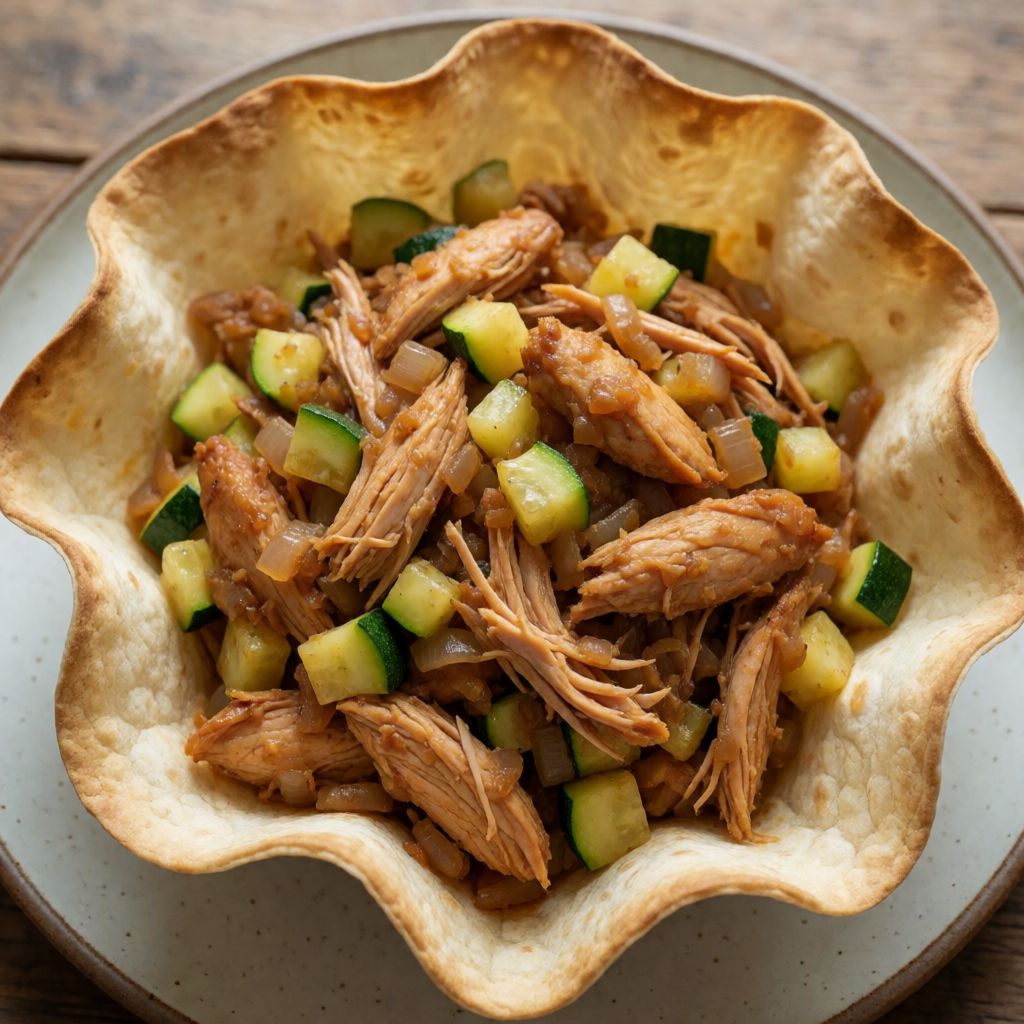
 AI photo
Taco Bowls with Chicken
Crispy tortilla bowls filled with spiced chicken, sweetcorn and tomato, topped with avocado, cheddar and lime.
Labels are worked out automatically from the ingredients and can be wrong. Check the packaging if it matters to you.
Ingredients
- 8 pcs Tortillas
- 1 pcs Onion finely chopped
- 400 g Chicken breast diced
- 2 clove Garlic finely chopped
- 1 pcs Courgette coarsely grated
- 1 tsp Cumin ground
- 1 tsp Ground coriander
- 0.5 tsp Smoked paprika
- 400 g Chopped tomatoes tinned
- 100 g Sweetcorn
- 50 g Tomato purée
- 2 tbsp Olive oil for frying
- Salt to taste
- Black pepper to taste, freshly ground
- 1 tsp Butter
- 150 g Sweetcorn
- 1 pcs Avocado sliced
- 200 g Mature cheddar
- 2 pcs Lime cut into wedges














Steps
Brush the tortillas with oil and place them in small ovenproof bowls so they form a bowl shape.
Bake in a preheated fan oven at 175°C for 8–10 minutes, until lightly golden.
Remove from the oven and let cool directly in the bowls.
They will turn crisp as they cool.
Over medium heat, fry the onion and garlic in olive oil until soft, stirring occasionally.
Add the chicken and fry well until golden brown.
Add the courgette, spices, tomato purée, chopped tomatoes and sweetcorn, and bring to the boil.
Simmer uncovered for 20 minutes.
Season with salt and pepper to taste.
Before serving, fry the sweetcorn in a pan with butter until lightly crisp.
Serve the taco bowls with the chicken filling, avocado, fried sweetcorn, mature cheddar and lime to squeeze over.
This is a Tex-Mex invention wearing a tortilla as a cup, and the whole dish turns on one bit of physics: a hot, oiled flour disc shrinks and sets as it cools, and if you force it into a bowl shape while it's still pliable, it will hold that shape once it hardens. That's it. That's the "bowl". No special mould, no deep-fryer, no drama — just a muffin tin or any small ovenproof bowl standing in as a mould, and gravity plus starch doing the work while you're not looking.
What decides whether it works isn't the filling — chicken mince in a tomato-cumin sauce is forgiving, hard to ruin — it's the shell. Oil it too thin and it scorches at the folds before it sets; too thick and it stays soft and leathery, a tortilla wearing a costume, not a bowl. And resist the urge to pull it from the oven and fill it straight away: it's still soft in that first minute out, only bluffing at being crisp. The actual crisping happens as it cools and the moisture left in the dough flashes off into the air around it. Pull it early, fill it with hot wet chicken, and you've built a bowl that collapses under its own dinner within five minutes — structurally sound in theory, soggy in practice.
Some say you need a deep-fryer and a proper taco mould for this. You don't — a flat-bottomed oven tray with a few upturned shot glasses, or a muffin tin, gives the same cup shape, just less uniform. Uniform is for restaurants plating twelve identical ones. You're feeding four people who will eat the filling faster than they'll admire the symmetry of the bowl.
Tortillas: buy the plain flour kind, not the thick wrap-style ones — those are often reinforced to survive rolling and won't fold into a neat cup, they'll crack at the pleats instead. If you've only got corn tortillas, warm them first (a hot dry pan, a few seconds a side) so they bend rather than split; corn is more brittle than flour and skipping that warming step is the single most common reason a corn-tortilla bowl ends up in three pieces at the bottom of your ovenproof dish.
Chicken breast: diced small and fried hot enough to colour rather than steam — a crowded pan drops the temperature, the meat releases water, and you get grey simmered chicken instead of browned chicken, which matters here because browning is one of the few flavour sources in a dish this quick. If breast feels dry to you generally, thigh works the same way in this recipe and is more forgiving of a slightly overcrowded pan, since the extra fat buys you some margin.
Courgette, grated coarsely: this isn't for flavour, it's for bulk and moisture that cooks into the sauce rather than staying watery on the plate — a way of stretching 400g of chicken across four bowls without anyone noticing it's been stretched. If you don't have one, a grated carrot does the same bulking job, though it brings a sweetness courgette doesn't, so taste before you add all your salt.
Cumin, coriander, smoked paprika: this trio is doing the job a whole rack of Tex-Mex seasoning blends does commercially — warmth, citrus-green lift, and a smoky note standing in for the char you'd get from an actual wood fire or chipotle. Smoked paprika specifically: the "smoked" matters more than the "paprika" here, it's replacing a cooking method you're not using (there's no open flame under this pan), so don't swap it for sweet paprika and expect the same effect — you'll get colour without the thing the colour promised.
Tomato purée and tinned chopped tomatoes together: purée is concentrated, cooked-down tomato paste giving body and a deeper, slightly caramelised tomato note, while the tinned tomatoes bring the liquid volume and acidity. Use only one and you either get a thin, sharp sauce or a thick, one-note paste — they're doing different jobs, not duplicating each other.
Butter for the second batch of sweetcorn, olive oil for everything else: that's a genuine distinction, not a style choice. Butter browns and smells of itself at a lowish heat, which is exactly the point for that last quick fry — you want the corn kernels catching a little colour and carrying that dairy-roasted smell on top of the bowl, a contrast to the olive-oil-cooked base underneath. Any neutral oil with no smell of its own — sunflower, plain vegetable oil — is the right substitute for the olive oil earlier where its own flavour isn't the point; using a strong extra-virgin there is wasted money, you're cooking the character out of it over heat anyway.
Lime at the end, not before: acid added early fights with and dulls other flavours as everything cooks down together; added at the table, squeezed by the person eating it, it cuts fresh across the finished dish instead of blending into it. This is also just patience as an ingredient — the temptation is to throw everything in together and call it done, but the sequence (soften, brown, reduce, then fresh things last) is the only thing separating a stew from a sauce that tastes like it was all tipped in at once, which, if you're honest, is often exactly what it was.