
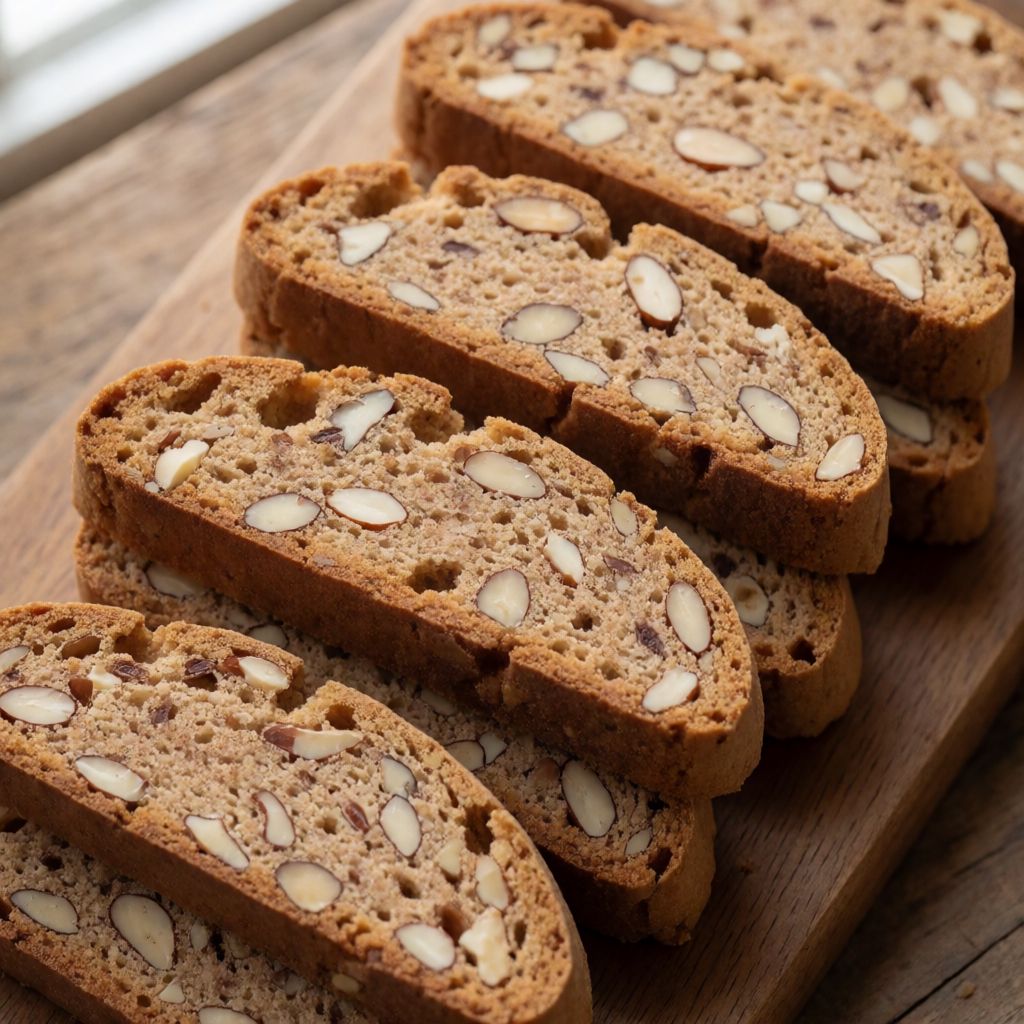
 AI photo
Chocolate Biscotti
Crunchy Italian-style biscotti spiced with cinnamon, ginger and cardamom, studded with almonds and dark and milk chocolate.
Labels are worked out automatically from the ingredients and can be wrong. Check the packaging if it matters to you.
Ingredients
- 125 g Plain flour
- 110 g Caster sugar
- ½ tsp Vanilla sugar
- 80 g Almonds chopped or whole
- 1 tsp Cinnamon
- ½ tsp Ginger
- ½ tsp Cardamom
- 1 pinch Black pepper
- ½ tsp Baking powder
- ½ tsp Salt
- 2 pcs Eggs
- 50 g Dark chocolate chopped
- 40 g Milk chocolate chopped










Steps
In a bowl, mix the plain flour, caster sugar, vanilla sugar, cinnamon, ginger, cardamom, black pepper, baking powder and salt.
Add the chocolate and almonds. Mix in one egg first, then combine the dough with the second egg.
Shape the dough into 2 long logs on a baking tray lined with parchment paper.
Bake in a preheated fan oven at 175°C for 17-18 minutes.
18 minRemove the biscotti from the oven, let cool slightly, then cut diagonally into slices about 1 cm thick.
Lay the slices back on the parchment and bake for about a further 10 minutes.
10 minLet cool on a wire rack.
Biscotti means "twice baked" — bis cotto — and that word is the whole mechanism. You're not baking a biscuit once and hoping it goes crisp. You're baking a log, letting it firm up to a cake-like state, then slicing it and baking the cut faces again. The second bake is what dries the crumb from the inside out, evenly, through every slice — which is the only way you get a biscuit hard enough to survive weeks in a tin and dunk in tea without collapsing into sludge before it's halfway to your mouth.
What decides whether this works isn't flavour, it's moisture. The first bake is deliberately short and gentle — it sets the dough into a loaf you can actually cut, but it's still soft inside, more like a dense cake than a biscuit. If you try to skip straight to crisp in one long bake, the outside burns before the centre dries, because a log that thick won't lose water evenly. Slicing it thin after the first bake exposes far more surface to the oven, which is precisely why the second bake needs only ten minutes rather than another eighteen.
Some say biscotti has to be rock-hard to be "proper" — no, because that's a texture born of commercial biscotti sold for shelf life, not a rule of the method. Yours can come out of the second bake still giving slightly in the middle of the slice if you want a less punishing dunk. Judge it by how it looks at the cut edge: pale and a little damp-looking means give it more time; dry-looking and faintly golden at the edges means it's done. Ten minutes is where to start checking, not where to stop the oven.
The spice mix — cinnamon, ginger, cardamom, a pinch of black pepper — isn't decoration, it's doing the job that vanilla alone can't: cutting the flatness of a flour-and-sugar dough baked twice. The pepper especially looks like an odd inclusion until you taste a biscotti without it — plenty of warmth from cinnamon and ginger but no lift at the back of the throat. If you don't have cardamom, leave it rather than reaching for something stronger like clove, which will dominate; a biscotti spice mix should hum, not shout, because the chocolate and almonds need room too.
Two eggs and no added fat is the real structural trick here. Biscotti has no butter, which is why it can survive a double bake without going greasy or stale-tasting the way a butter-heavy biscuit would after sitting in a tin for a fortnight. The eggs alone bind the flour, sugar and nuts into a dough firm enough to shape into a log by hand — mixing one in first, then the second, is just about controlling how wet the dough gets as you go, so you don't suddenly end up with something too slack to hold its shape on the tray.
The almonds want to be a texture, not a paste — leave some whole or roughly chopped rather than ground, because the point is a biscuit with bite and crunch inside the crunch. If you're out of almonds, any nut that holds its shape under heat works on the same logic — hazelnuts, pistachios — just avoid anything oily enough to go soft and chewy, like cashews, because that fights the whole dry, snapping texture you're building toward.
Dark and milk chocolate chopped by hand rather than chips matters more than it sounds. Chip-shaped chocolate holds its shape through baking and ends up as hard little pellets in a biscuit meant to be hard itself — not pleasant. Chopped irregularly, it melts slightly at the edges in the first bake and resets into pools through the crumb, so you get soft give against the dry snap instead of two competing hardnesses. Half dark, half milk is a balance of bitterness against sweetness; if you only have one, use more of it rather than trying to match the original ratio exactly — this isn't a recipe where 10g either way changes anything.
On shaping: two logs, not one, on a UK-size domestic tray, because one wide log won't fit your oven properly and will bake unevenly at the edges versus the centre — your oven is a flat, not a bakery deck, and a log too fat just repeats the burnt-outside-raw-inside problem from a different angle. Keep them long and modest in width rather than tall.
Patience is the actual ingredient in step 5 that's easy to skip. Cut the log too soon, straight from the oven, and it's still soft enough to crumble under the knife or drag instead of slicing clean — you'll lose biscuits to ragged edges. Let it cool slightly first; a few minutes of sitting lets the crumb firm up just enough that the knife goes through instead of tearing. That short wait before you touch the knife is doing as much work as any of the baking.