
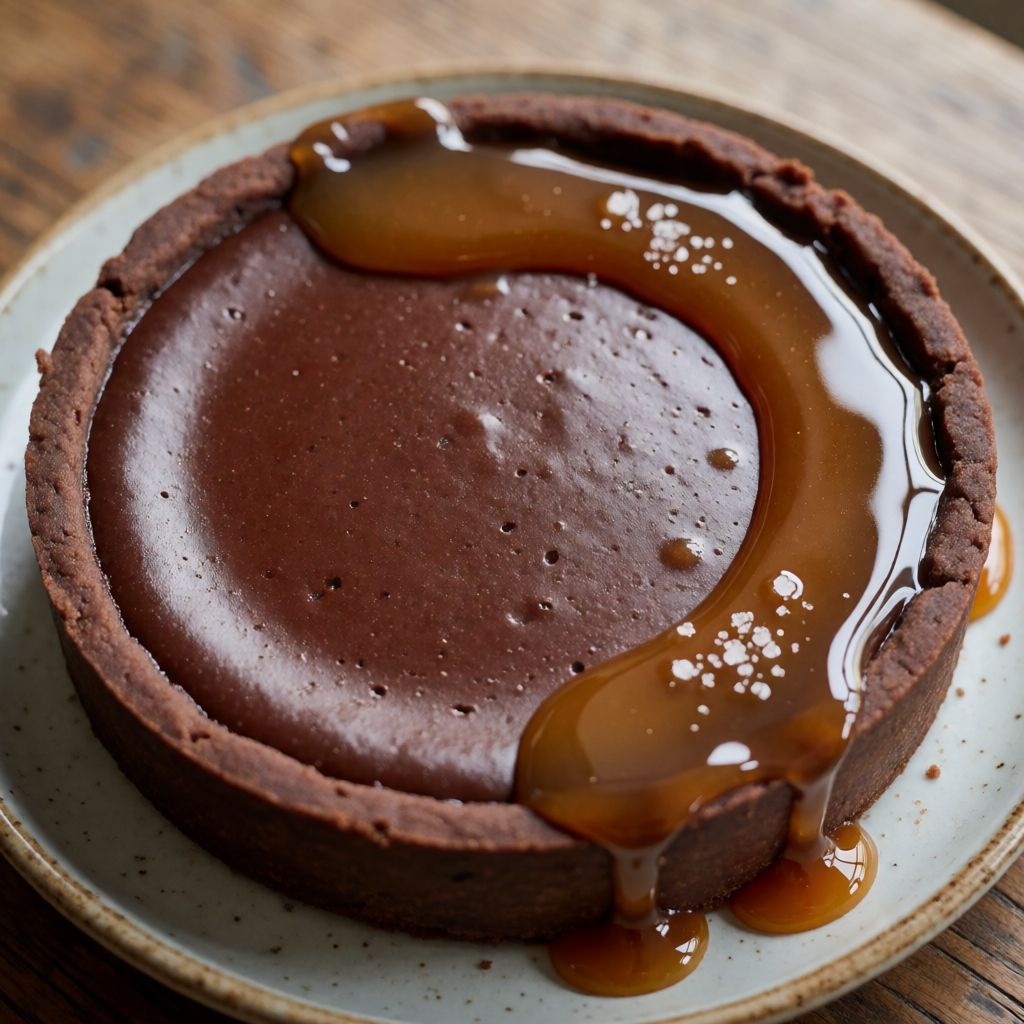
 AI photo
Chocolate Tart with Salted Caramel
A rich chocolate tart with a crisp cocoa pastry case, soft salted caramel and glossy chocolate ganache.
Labels are worked out automatically from the ingredients and can be wrong. Check the packaging if it matters to you.
Ingredients
- 220 g Plain flour
- 25 g Cocoa powder
- 50 g Icing sugar
- 1 pinch Salt
- 125 g Butter
- 1 pcs Egg beaten
- Water as needed






Salted caramel
- 200 ml Double cream
- 90 g Caster sugar
- 20 g Soft brown sugar
- 50 g Glucose syrup
- 0.5 tsp Salt




Chocolate ganache
- 200 ml Double cream
- 200 g Dark chocolate finely chopped
- 0.5 tsp Salt for sprinkling
Steps
Tart pastry: in a food processor, blend the flour, cocoa, icing sugar, salt and butter until smooth.
3 minGather the dough in a bowl with the beaten egg and cold water as needed, until a smooth dough forms.
2 minRoll the dough thinly between two sheets of baking paper and let it rest in the fridge for 30 minutes.
5 minLine a greased 24 cm tart tin with the dough, press to the edge and trim off the excess.
Prick the base, cover with baking paper, add another layer of paper on top and fill with ceramic baking beans, dried beans or similar.
2 minBake the base in a preheated fan oven at 175°C for 15 minutes.
15 minRemove the base, take off the paper and beans, and bake for a further 5 minutes. Let the base cool slightly.
5 minSalted caramel: while the pastry base bakes, make the caramel. Bring the cream, caster sugar, brown sugar and glucose syrup to the boil in a large saucepan until the temperature reaches 112°C, stirring occasionally.
5 minAdd the salt, stir and cool to room temperature.
20 minPour the caramel into the base in a layer about 0.5 cm thick and chill the tart in the fridge for 1 hour.
2 minChocolate ganache: bring the cream to the boil and pour it over the chocolate in a bowl.
2 minStir until the chocolate has melted and the mixture is smooth.
2 minCool to room temperature, then spoon the mixture over the back of a tablespoon onto the caramel in the tart.
3 minSprinkle with a little flaked salt.
Chill the tart for at least 5 hours, until the chocolate has set.
300 min
What was changed
In this recipe, the whipping cream was replaced with Double cream, the kind of cream used in British kitchens.
This is three separate technical problems stacked in one tin: a biscuit that has to be crisp under sauce, a caramel that has to stay soft under refrigeration, and a ganache that has to set hard enough to slice but still melt on the tongue. Get any one of the three wrong and the tart collapses into "nice, but" territory — soggy base, caramel that runs off the plate, ganache that cracks like a biscuit itself.
The pastry is a pâte sucrée with cocoa swapped in for some of the flour, which is why it's blind-baked twice: once weighted down so it doesn't puff and lose its floor, once bare so the base actually dries out and goes crisp rather than staying pale and bendy. Some say blind baking is just tradition, a fussy extra step — no, it's there because an unbaked disc of dough shrinks and bubbles unevenly in the oven with nothing to hold its shape; the beans are dead weight, literally, keeping the base flat while the structure sets.
The caramel is cooked to a specific point — 112°C — not because recipes like round numbers, but because that's roughly where sugar syrup with cream and glucose in it holds enough water to stay pourable and soft at fridge temperature, rather than seizing into something you'd need a chisel for. The glucose syrup isn't decoration either: it's there to stop the sucrose from recrystallising as it cools, which is the actual reason shop caramel stays glossy and yours, without it, sometimes turns grainy.
Flour and cocoa together need calling out: cocoa powder has no gluten in it, so swapping some flour for cocoa also makes the pastry a touch more tender, almost by accident. Use a plain flour, nothing self-raising — you don't want this base lifting or puffing, you want it flat and dense enough to carry caramel without buckling. Icing sugar rather than caster here because it dissolves into the fat without any graininess; caster would leave tiny sandy flecks in a dough this fine.
Butter: cold, and you're working it into flour, sugar and cocoa to a sandy crumb before the egg goes in — that's what a food processor is doing for you in three minutes of blending, something your hands would do slower and warmer, which is exactly the problem. Warm butter means the fat starts to properly cream rather than just coat the flour, and a creamed pastry dough bakes up cakey, not short. If you've no processor, rub it in by fingertips fast, lifting the mixture to keep air moving through it so your hands' heat doesn't melt the butter before it's distributed.
Water in the dough is there only to bring it together — add it a teaspoon at a time after the egg, because too much and you build gluten you don't want, giving you a pastry that shrinks back and toughens in the oven instead of staying crisp and short.
For the caramel, double cream specifically — its higher fat content means it won't split as readily when it hits sugar at a rolling boil the way single cream would. If a thermometer isn't to hand, judge it by colour and behaviour instead: it should be the colour of dark honey, not yet the colour of strong tea, and a drop in cold water should form a soft, pliable ball you can squash flat, not a hard bead that snaps. Soft brown sugar alongside the caster sugar is for depth more than mechanism — molasses in it rounds the caramel out so it isn't just sweet, it's got a back note like toffee. No glucose syrup in the cupboard? Golden syrup does the same anti-crystallising job, just slightly sweeter and darker in flavour. The half teaspoon of salt stirred in after cooking, not before, is what makes this a salted caramel rather than a plain one — adding it earlier would have no different effect on the chemistry, it's simply traditional to season at the end once off the heat, when you can taste and adjust.
Dark chocolate for the ganache — go for something you'd actually eat off a bar, because with only cream to dilute it, every flaw or blandness in cheap chocolate shows up directly in the slice. Chop it finely, not because of tradition, but because small pieces melt evenly from the heat of the poured cream alone; a few big chunks sitting in a bowl under barely-boiled cream just won't get there and you'll end up microwaving it, risking the chocolate seizing into a grainy mess instead of staying glossy.
And then there's patience, which is really the secret ingredient of the whole tart — you cool the caramel to room temperature before it goes in, you cool the ganache before it goes on, and you give the finished tart a genuinely long chill, the better part of an afternoon, because this is a dessert built in temperature-dependent layers: rush any cooling stage and the layers above either slide or melt into the one below, and you've made a chocolate caramel soup instead of a tart. A wide domestic oven and a 24cm tin off a supermarket shelf will do this perfectly well — nothing here asks for a kazan or anything you don't already have, just time you have to actually give it rather than skip.
This feeds ten in thin wedges, which given how rich it is, is about right — it's not a dessert anyone needs a large slice of, any more than you'd want a large slice of fudge.