
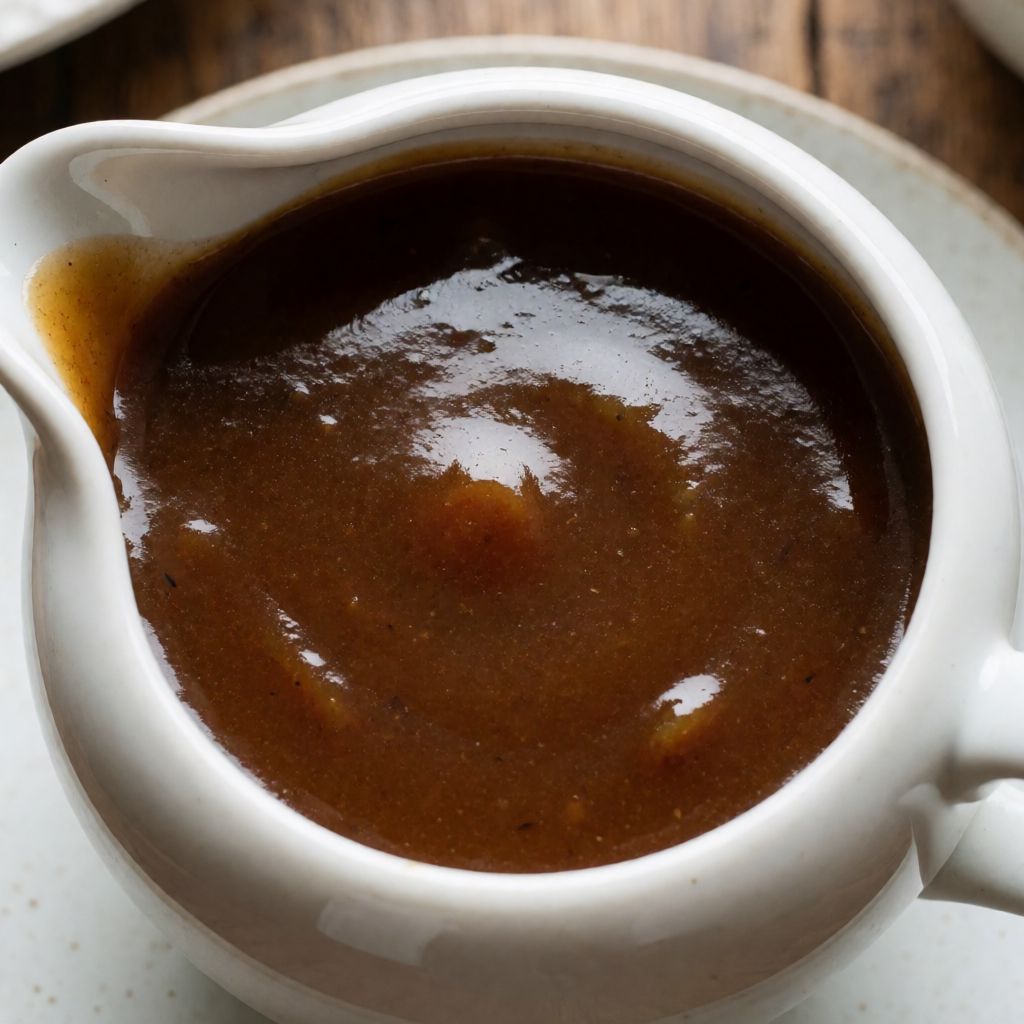
 AI photo
Christmas Gravy for Roast Duck or Goose
A festive gravy made from the giblets, vegetables and pan juices of a roast Christmas duck or goose.
Labels are worked out automatically from the ingredients and can be wrong. Check the packaging if it matters to you.
Ingredients
- 1 pcs Duck with giblets
- 4 pcs Carrot cut into large cubes
- 5 pcs Celery stalks, cut into large cubes
- 1 pcs Leek cut into large rings
- 2 pcs Red onion cut into wedges
- 4 pcs Bay leaf
- 5 pcs Thyme fresh sprigs
- 1 l Water
- 1 pinch Black pepper freshly ground, to taste
- 1 tbsp Redcurrant jelly
- 100 ml Double cream
- 1 tbsp Cornflour or as needed
- 1 pinch Gravy browning optional, for colour
- 1 pinch Salt to taste













Steps
Put the giblets, vegetables and herbs into the large roasting tin in which the Christmas duck or goose will be roasted, and fill the tin halfway with water.
Once the Christmas roast is done, strain the juices into a clean jug.
Chill the strained juices in the fridge, then skim off all the fat that sets on top.
Bring the juices to the boil in a saucepan and thicken with cornflour mixed with a little milk or cream.
Season the gravy with salt, pepper and redcurrant jelly, then let it simmer gently, stirring now and then.
Adjust the colour with a little gravy browning, season again with salt and pepper, and stir in more jelly and cream to taste.
This isn't a sauce you build in a pan from a jar of stock cubes. It's a gravy that cooks itself underneath the bird for two or three hours, which is the whole point: the roasting tin is doing double duty as both rack and stockpot. The carrot, celery, leek and onion aren't there to be eaten — they're a cradle that holds the duck or goose up out of its own fat, while slowly giving up their sugars into the water below. Everything that drips off the bird — fat, protein, collagen from the giblets — lands straight in that liquid and turns it into something far deeper than stock from a packet.
What decides whether this works is restraint at the start and patience at the end. Fill the tin halfway, not to the brim — you want the vegetables to steam-roast and caramelise a little where they poke above the waterline, not boil to mush. And once you've strained the juices, you must chill them before you touch them with heat again. Some cooks skip this, skimming hot fat off the top with a spoon — no, because fat and liquid at that temperature are already remixing themselves as fast as you lift them apart. Cold, the fat sets into a solid cap you can lift clean away in one piece. Skip that and your "gravy" is really a thin, greasy soup that coats the mouth instead of the tongue.
Look at what each ingredient is actually doing, because none of it is filler. The giblets — neck, heart, gizzard if you've got them — are the backbone of flavour here, full of connective tissue that breaks down slowly into gelatine over those two-plus hours in the tin. That gelatine is what gives the finished gravy body, that slight cling on the spoon, rather than the watery thinness you get from vegetables and water alone. If your butcher hasn't included giblets, a couple of chicken wings chopped small will do the same job — anything with skin, bone and a bit of cartilage.
Carrot, celery, leek and onion are the classic base for a reason that has nothing to do with tradition for its own sake and everything to do with what's cheap, keeps well through a British winter, and doesn't fight with poultry fat. Cut them large, into cubes and wedges, because you're not eating them — you want surface area low enough that they survive hours of slow heat without disintegrating into the liquid and clouding it. The red onion specifically brings a touch more sweetness than a white one once it's cooked this long; if you've only got white or brown onion, use it, the difference is minor.
Bay and thyme are there for aromatic lift, not bulk — four bay leaves and five sprigs sounds generous for one litre of water, but remember most of that aroma is going to cook off and dilute over a long roast; dried thyme at half the amount works if fresh isn't in the fridge, though the sprigs are easier to fish out at the straining stage, which matters when you're already juggling a hot roasting tin and a hungry table.
The double cream and redcurrant jelly are the two levers you pull at the end to fine-tune, not fixed quantities to follow blindly. Cream mellows and rounds out a gravy that's come out too sharp or too intensely savoury from the giblets; jelly brightens one that's turned flat and heavy with fat. Taste as you go and adjust both — this is exactly the kind of gravy where "to taste" is not vague cooking-writer language, it's the actual instruction, because every duck gives up a different amount of fat and juice.
On equipment: you don't need a kazan or a stockpot for this, your usual large roasting tin is the vessel the whole method depends on — it's both roasting rack and stock bath at once, which is clever because it means one less pan and one less job. A splash guard or just checking the water level once partway through roasting is sensible; a domestic oven and tin can run drier than you expect over two-plus hours, and a tin gone dry means burnt vegetables and bitter gravy, not rich gravy.
And don't rush the chilling step by sticking the jug in the freezer for twenty minutes to speed things along — the fat needs to set as a coherent layer, which happens properly in a fridge over an hour or more, not a shock-frozen crust that breaks up when you try to lift it. That patience before the final simmer is what separates a clean, meaty gravy from one that tastes of nothing but duck fat.