
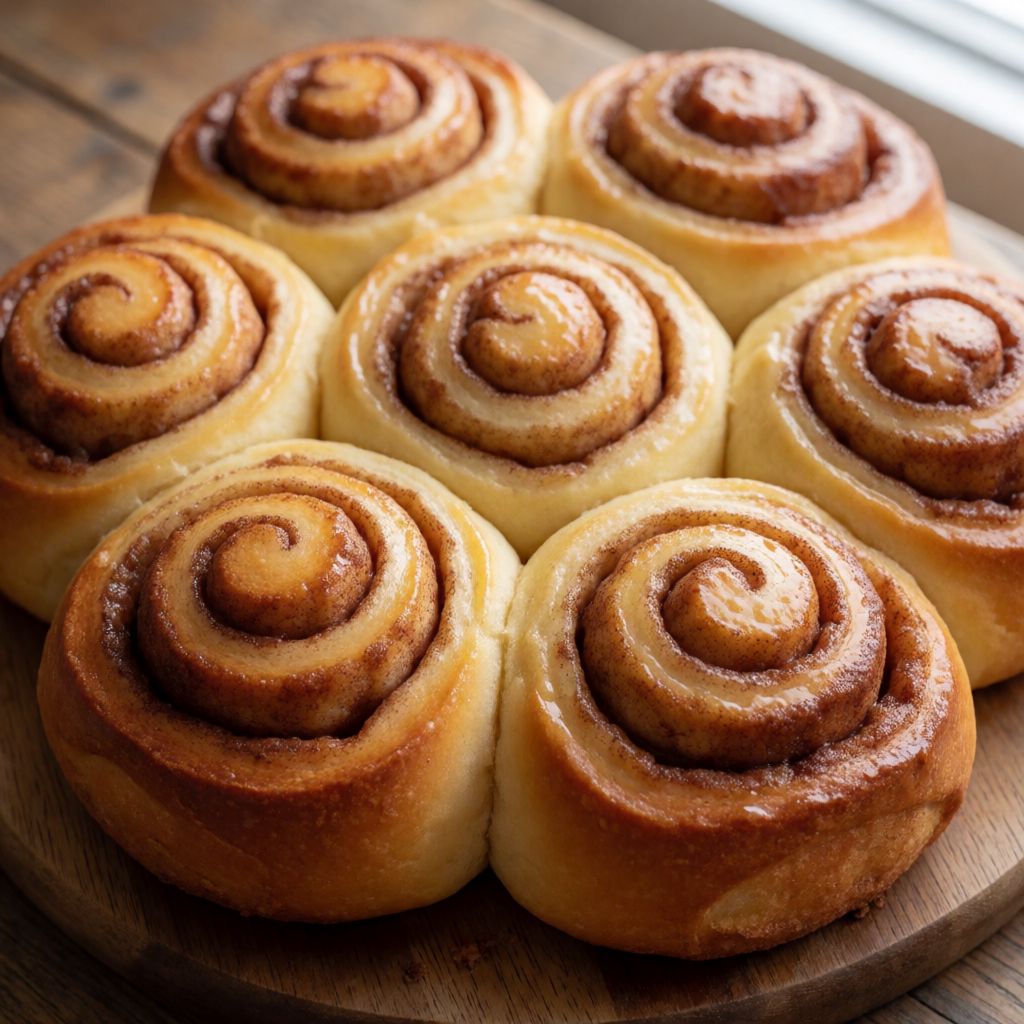
 AI photo
Cinnamon Swirl Buns
Soft yeasted cinnamon swirl buns with a cardamom-spiced dough, a buttery cinnamon filling and a light icing drizzle.
Labels are worked out automatically from the ingredients and can be wrong. Check the packaging if it matters to you.
Ingredients
- 100 ml Milk
- 50 g Butter
- 15 g Yeast
- 1 pcs Eggs
- 25 g Sugar
- 50 g Wholemeal flour
- 1 tsp Vanilla powder or seeds from half a vanilla pod
- 0.5 tsp Cinnamon
- 0.5 tsp Cardamom
- 1 pinch Salt
- 175 g Plain flour
- 75 g Butter
- 50 g Sugar
- 40 g Brown sugar or muscovado
- 0.5 tsp Cinnamon
- 100 ml Icing sugar
- 2 tbsp Water or as much as needed for the perfect icing consistency












Steps
Warm the milk and butter in a pan, stirring, until the butter has melted.
Remove from the heat and let it cool for a few minutes to about 38°C.
Crumble in the yeast, then add the egg.
In a clean bowl, mix the wholemeal flour well with the vanilla, sugar, cinnamon and cardamom.
Pour the mixture into the pan and gradually add the plain flour.
Knead the dough well until it is smooth and soft.
Let the dough rise under a clean tea towel for 30-40 minutes.
Mix the filling well.
Roll the dough into a small rectangle and spread generously with the filling.
Roll the dough into a log and cut into buns about 3 cm thick.
Place all the buns in a round tin lined with baking paper and let rise for 45 minutes.
Bake in a preheated fan oven at 175°C for 17-20 minutes.
Take the buns out of the oven and let them cool on a rack, meanwhile mix the icing.
Let the buns cool a little before covering them with the icing.
This recipe makes about 6 servings.
What was changed
Graham flour is hard to find in British shops, so the dough uses Wholemeal flour instead.
A cinnamon bun is just bread dough that's been asked to carry sugar and butter inside itself instead of just around it. That's the whole trick, and it's also the whole risk. Too wet a dough and the filling turns the middle to paste; too dry and it won't trap the caramel that's meant to pool at the base of each spiral. What decides whether these work isn't the icing on top — it's the enriched dough underneath holding its shape while sugar and butter try to melt through it twice, once in the roll, once in the oven.
The dough here is enriched: milk, butter, egg, sugar all slow the yeast down compared to a plain bread dough, but they also make it tender rather than chewy. That's deliberate — a lean dough would go tough and dry around soft filling, the texture clash would be the first thing you notice. Warming the milk and butter together isn't fussiness, it's dissolving the butter into the liquid so it coats the flour evenly later, rather than sitting in lumps that melt unevenly in the oven and leave pockets of grease.
Some say you can skip the cooling-to-38°C step, that yeast is tougher than that. It isn't dead above that, no — but above roughly 45-50°C the yeast's enzymes start breaking down, and you lose lift you can't get back by proofing longer. A finger test works fine in a flat without a thermometer: the milk should feel warm like a bath you'd actually get into, not hot enough to wince at.
On the flours: wholemeal in the enriched dough base isn't there for virtue, it's there for flavour and a bit of backbone — wholemeal has more protein structure and bran, which gives the crumb some chew against all that soft butter and sugar. Plain flour makes up the rest because too much wholemeal and the dough gets heavy, won't rise properly, stays dense under its own bran. If you've only got plain flour, use it all — you lose a bit of nuttiness, nothing more. Don't go the other way and use all wholemeal; the gluten network can't support the enrichment and the buns will squat rather than rise.
Butter in the dough and butter in the filling are doing two separate jobs and that's worth knowing before you substitute. The dough butter is for softness — folded through the structure, it keeps the crumb from going bready. The filling butter is there to melt and carry the sugar into the dough as it bakes, which is what makes that dark, slightly sticky seam in the swirl. Use a flavourless oil for the dough's butter in a pinch and you'd get an edible bun, pale and a bit greasy; but for the filling, butter's job is specifically to solidify again as it cools, holding the swirl together — oil won't do that, it stays liquid and the filling just runs out.
Brown sugar or muscovado in the filling matters more than people think: it's not just sweeter-tasting sugar, it carries molasses, which is what gives the dark, almost toffee note to the caramelised bits at the bottom of a bun. White sugar alone in the filling gives you sweetness without that particular backnote — fine, but a different bun. Cinnamon and cardamom together in the dough rather than just cinnamon is a small act of restraint-breaking: cardamom brings a citrus-green lift that stops the whole thing tasting one-note sweet-spiced, the way only-cinnamon buns can.
Yeast at 15g fresh (or the dried equivalent, check your packet — dried yeast is usually used at roughly a third the weight) needs sugar and warmth to wake up but not so much sugar early on that it struggles against osmotic pressure — which is why the sugar's split between dough and filling rather than all dumped in at once. The egg in the dough does two things: enriches, yes, but it's also partly why the crumb stays soft a day later rather than going stale and crumbly the way a lean dough would.
On the tin: a round tin lined with paper, pressed in London flat or anywhere else, is really there to stop the buns spreading apart as they prove and bake — pack them in, let them touch, and they rise up into each other rather than out and flat, which is how you get that pull-apart texture rather than six separate hard-edged rolls. If your tin's a bit big for six buns, don't panic and leave gaps — push a scrunch of foil in the space, otherwise the dough on the open side just flops sideways as it proves.
The icing is poured, not spread, which is why the water's added a little at a time — you want it to run into the gaps between buns and down the sides, not sit as a solid white cap. Too thick, it sits like fondant and masks the swirl; too thin, it vanishes into the crumb and does nothing. There's no fixed number of tablespoons for a reason: icing sugar varies batch to batch in how much it's compacted, so the water amount is a result, not a rule — add it drop by drop near the end and stop when it ribbons off a spoon rather than drips.