
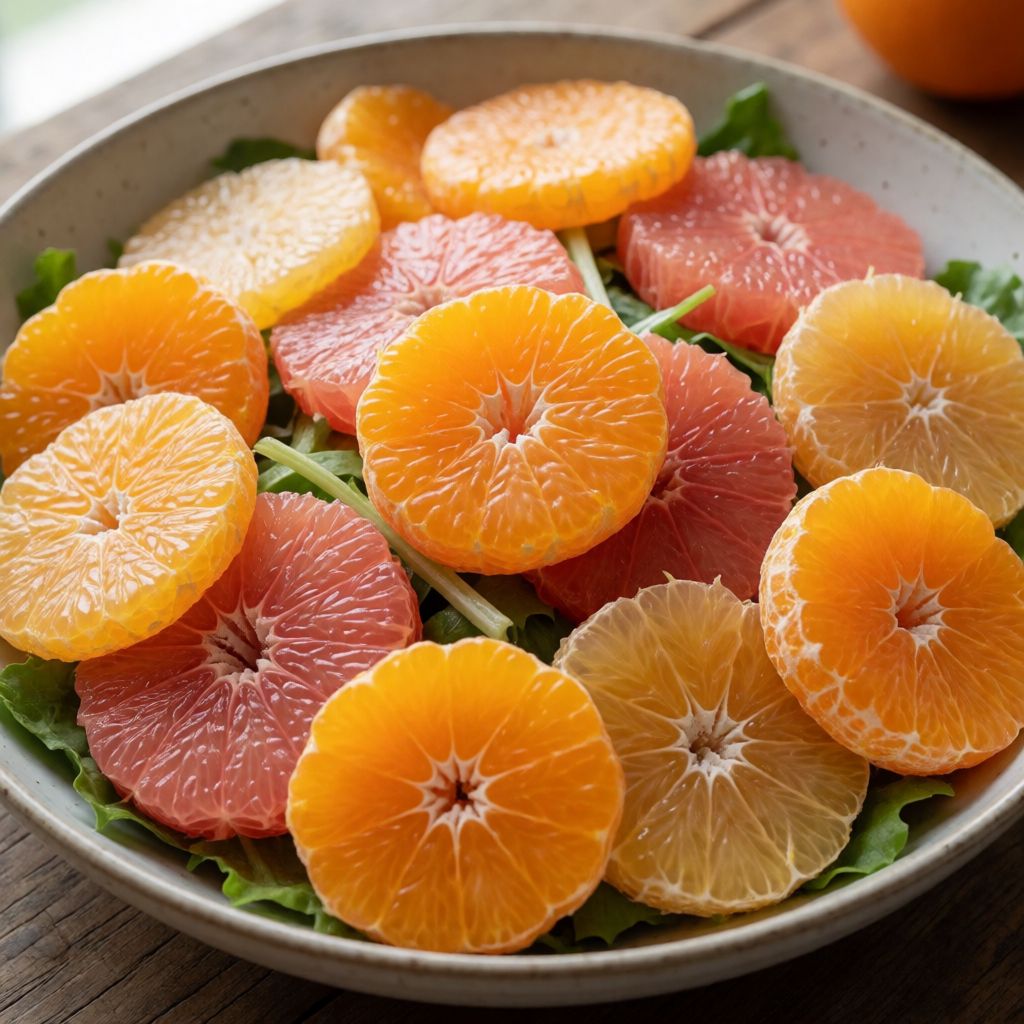
 AI photo
Citrus Salad
A bright winter citrus salad with mandarins, grapefruit and oranges over shredded red cabbage, finished with nuts and mint.
Labels are worked out automatically from the ingredients and can be wrong. Check the packaging if it matters to you.
Ingredients
- 3 pcs Mandarins
- 1 pcs Grapefruit
- 1 pcs Orange
- 2 pcs Blood oranges
- 50 g Red cabbage
- 30 g Pistachios roughly chopped
- 15 ml Hazelnuts roughly chopped
- 1 bunch Mint finely chopped, fresh
- 60 ml Orange juice
- 1 tsp Dijon mustard
- 1 tsp Honey
- 15 ml Olive oil
- Salt to taste
- Black pepper to taste, fresh











Steps
Peel all the citrus fruits and cut them into segments, slicing away the skin and white pith around each piece so only the clean flesh remains.
8 minToss the finely chopped red cabbage with the dressing.
1 minArrange the citrus segments nicely over the dressed red cabbage on a serving plate, then scatter the chopped nuts and mint leaves on top.
1 minMake the orange dressing by whisking together all its ingredients and tasting, until the honey is fully dissolved.
This isn't a salad in the lettuce-and-dressing sense. It's four citrus fruits doing the work of lettuce, dressing, and main event all at once, propped up by cabbage for crunch and nuts for the fat that citrus never has. What decides whether it works is almost entirely the knife, not the stove — there's no cook time on this recipe for a reason.
The technique that matters is the one tucked into step one: cutting away skin and pith so only clean flesh remains. People call this "peeling an orange nicely" — it's actually removing the only bitter, fibrous part of the fruit. The white pith is where all the bind-you-up tannins live; leave a sliver on and every segment tastes faintly of cardboard no matter how sweet the fruit was underneath. Do it with a knife on a board, not with your thumbs over the sink — you're aiming for a flat face on each side of the fruit so it sits still while you slice along each membrane.
Why four different citrus and not just oranges? Economics of flavour, not fashion. Oranges are sweet and flat, grapefruit brings bitterness and acid, mandarins bring perfume, blood oranges bring that faint wine-note and the colour that makes the plate look deliberate rather than accidental. Drop any one and the salad still stands — it just gets one-note.
The red cabbage is the part people skip, thinking it's garnish. It's actually the only crunch in the whole dish and the only thing standing between you and a plate that's all soft segments sliding around. Shred it fine — if it's cut thick it fights the citrus instead of sitting underneath it.
The dressing is small by volume but it's doing a specific job: mustard and honey aren't there for taste alone, they're emulsifiers, the thing that stops oil and juice separating back into two puddles the moment you stop whisking. Whisk until the honey disappears into the liquid, not until some fixed minute mark — that's the actual cue, "dissolved" is a thing you can see, a clock isn't. If you've no Dijon, any mustard with a bit of sharpness will hold the emulsion; English mustard works but bring less, it's hotter.
On the nuts: pistachio and hazelnut together give you two different fats and two different crunches — pistachio stays slightly waxy, hazelnut toasts dry. You don't need both. Any unsalted nut with some oil content substitutes fine — almonds, walnuts — just chop them roughly by hand rather than in a processor, which pulps them into dust and you lose the bite that's the whole point of putting nuts on a citrus salad in the first place.
Olive oil here should be one with no strong personality of its own — a assertive, peppery extra-virgin will argue with the citrus instead of carrying it. Any light, clean oil does the job: a mild olive oil, a neutral vegetable oil, even a light rapeseed oil, which in the UK is both local and cheap and nobody will know the difference once it's whisked with mustard and juice.
Orange juice for the dressing — just squeeze one of your own oranges over the segments as you work, rather than buying a carton. You're already cutting oranges for the salad itself; use the run-off and the squeezed-out core, and you save money and get a fresher, less sugary juice than anything from a bottle.
Mint is the one ingredient here that's purely aromatic, not structural — it brings a cold, green note against all that sugar and acid. Finely chopped, scattered at the very end so it doesn't wilt into the juice sitting in the bowl. If you've none, a few basil leaves do something similar, though it's a different direction entirely — basil is sweeter, mint is sharper.
Patience here isn't about waiting for anything to cook — there's nothing to cook. It's patience with the knife: taking the pith off properly, slicing the cabbage thin, chopping the nuts by hand instead of dumping them in a blender because you're in a hurry. Ten minutes prep means ten minutes of actual attention, not ten minutes of rushing toward a result.