
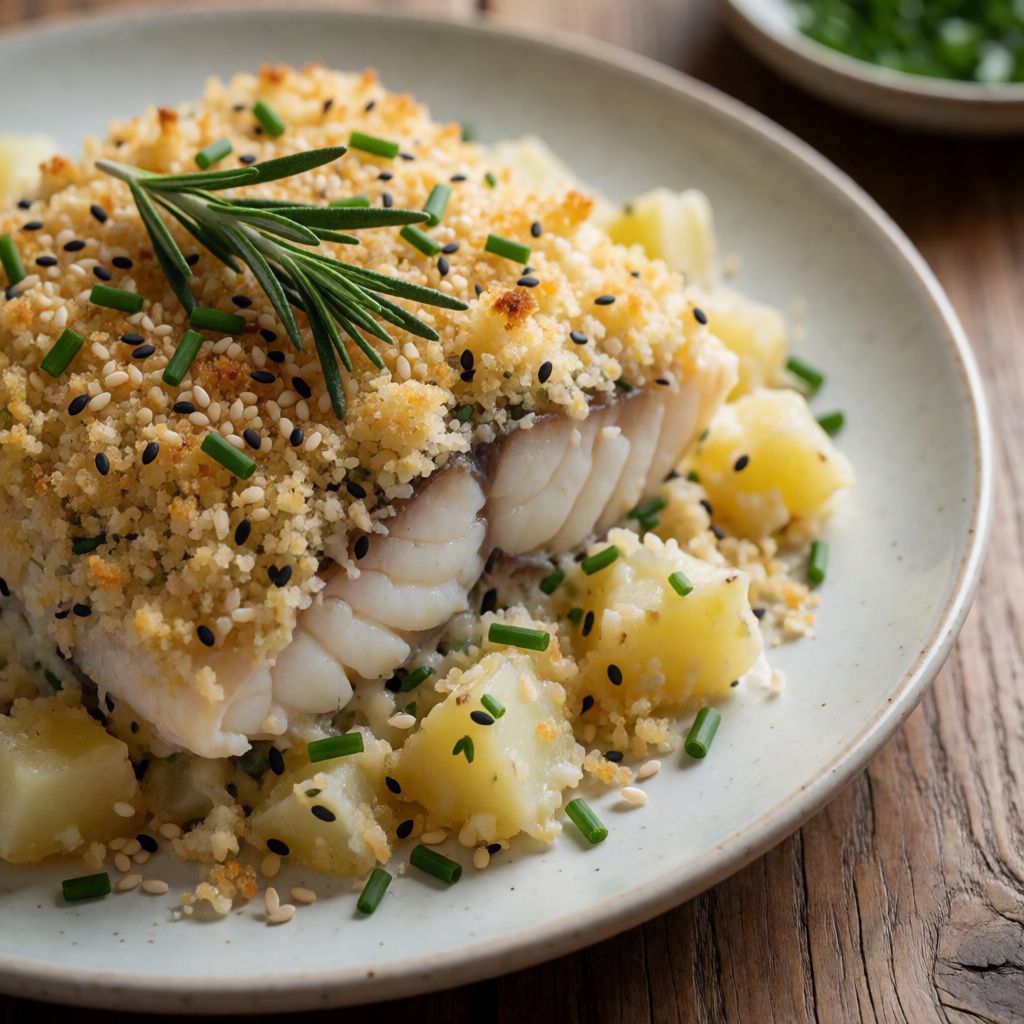
 AI photo
Cod with a Crispy Cheese Crust
A quick weeknight bake: cod mixed with cubed boiled potato under a herby, cheesy breadcrumb crust, served with a warm cherry tomato garlic sauce.
Labels are worked out automatically from the ingredients and can be wrong. Check the packaging if it matters to you.
Ingredients
- 200 g Cod
- Breadcrumbs dried
- 2 pcs Potatoes boiled and peeled
- 2 pinch Sesame Seeds
- Rosemary
- Chives
- Sage
- Thyme
- 1 pinch Curry Powder
- 1 clove Garlic crushed
- 10 pcs Cherry Tomatoes halved
- Parmesan
- Salt
- Olive Oil













Steps
Roughly chop the thyme, sage, chives and rosemary. Mix part of this with the breadcrumbs, and set the rest aside.
Add the sesame seeds, a pinch of curry powder, two pinches of salt and the Parmesan to the breadcrumbs, and mix.
Cut the boiled, peeled potatoes into cubes and add them to the cod.
Season with salt, add the breadcrumb mixture, drizzle with olive oil and mix.
Place the fish mixture in a baking dish, sprinkle with Parmesan, drizzle with oil and bake at 200°C. It's ready when the thickest part reaches 63°C inside.
Heat olive oil in a pan with the crushed garlic.
Add the halved cherry tomatoes.
Season with salt, add the reserved herbs and simmer gently.
10 minTake the cod bake out of the oven, checking that the thickest part reached 63°C, and serve with the warm tomato sauce.
This isn't fish-and-chips dressed up — it's a cod bake where the crust does the job the batter usually does, except it's doing it honestly. Breadcrumbs, Parmesan, sesame and herbs sit on top, olive oil carries heat through them, and in the oven they dry and fuse into a crust that cracks when you press it with a fork. Underneath, the cod stays moist because the crust is a lid, not a coating — it traps the steam the fish gives off instead of letting it escape into dry oven air.
What decides whether this works is one number: 63°C in the thickest part of the fish. Not twenty minutes, not "until golden" — cod turns from translucent to opaque in a narrow band, and if you chase it by eye you'll either pull it too early (the middle still raw and glassy) or leave it till it's chalky and falling into flakes that have nothing left to give. Buy a cheap probe thermometer; it costs less than the fish and saves it every time.
Some say cod needs breadcrumbs just for crunch — no, the crumbs are also insurance. Cod has almost no fat and very little connective tissue holding it together, so on its own it dries out fast and falls apart faster. The crumb-and-cheese layer holds moisture in and holds the fish together while it's cooking, which is why the potato cubes get folded in with it too — they're bulking out a protein that can't survive on its own in a hot oven without turning to string.
Cod itself: look for fillet that's firm, not sliding apart under its own weight — cod breaks down in layers along its muscle fibres, and a tired fillet will show you gaps before you even cook it. 200 g for three people sounds thin until you remember it's bulked by two whole potatoes and a crust that's roughly a third of the final mass — this is a dish built to stretch a small piece of good fish, not to showcase a big one. If cod isn't to hand or the price has jumped (it does, cod stocks are managed tightly and the price reflects that), any firm white fish that holds its shape in chunks works the same way — haddock, pollock, even a thick hake fillet.
The potatoes do double duty: bulk, and starch. Boiled and cubed cold, they hold their shape inside the mix instead of turning to mash, and their surface starch helps bind the breadcrumb mixture to the fish rather than it all sitting loose on top. Boil them the day before if that's easier — cold boiled potato cubes cleanly, hot boiled potato smears.
Breadcrumbs: dried, not fresh. Fresh breadcrumbs carry their own moisture, and moisture is exactly what you don't want in a crust that's meant to crisp, not steam. Dried crumbs are just dehydrated bread — if you've only got a stale end of loaf, grate it and leave it out on a plate for a few hours, you've made your own. Panko works too if you want more crunch and less density, since it's cut and dried differently.
Parmesan goes in twice: once mixed into the crumb for savour, once sprinkled on top before baking to form its own browned skin. Parmesan browns rather than burns at oven heat because it's low in moisture and high in fat and protein — that's the whole chemistry of why hard, aged cheeses are what people reach for on a crust, not a young soft cheese that would just melt into a puddle and slide off. If you're out of Parmesan, any hard, dry grating cheese — a mature Cheddar grated fine, Grana Padano — does the same job; a soft cheese won't.
The herb split matters more than it looks. Thyme, sage, rosemary and chives get divided — some baked into the crust, some held back raw for the tomato sauce — because baked herbs lose their sharper top notes and settle into something woodier, while the reserved ones stay bright and go into the sauce at the end, barely cooked. Put them all in at the start and you'd only taste one flat note by the time it's plated.
Olive oil here is doing a job, not flavouring one: any oil with no strong smell of its own carries heat into the crumb and helps it crisp rather than scorch — sunflower or a mild rapeseed oil will do the same work if that's what's in the cupboard, though olive oil's own low-level flavour suits this particular mix of garlic and tomato better than a neutral oil would.
A domestic oven doesn't hold heat the way old wood-fired ovens that built this style of crusted fish bake did — 200°C on a home dial can swing a fair bit either way depending on where the dish sits and whether the door's been opened. That's exactly why the thermometer check at the end isn't optional theatre — it's correcting for the oven you actually have, not the one the recipe was written for.