
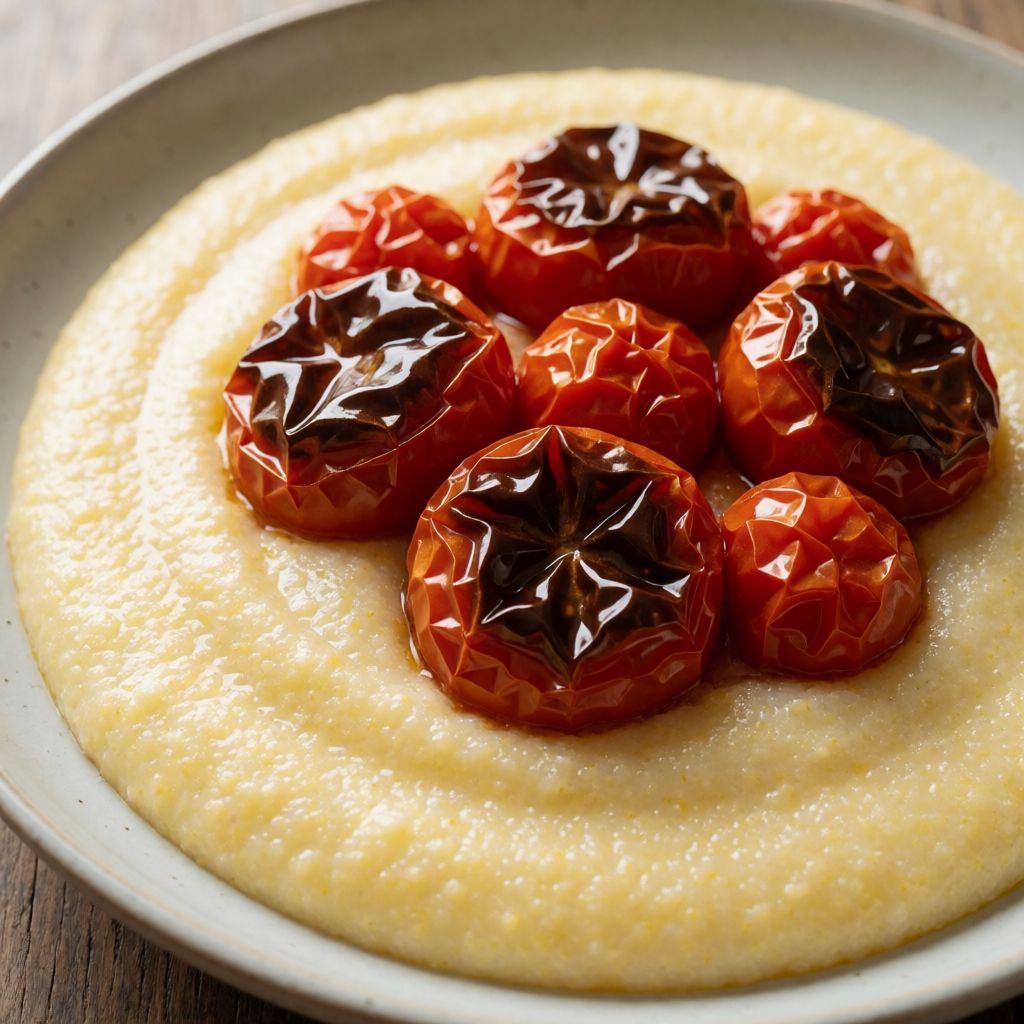
 AI photo
Creamy Polenta with Roasted Tomatoes
A creamy polenta paired with sweet roasted tomatoes, garlic, thyme and rosemary.
Labels are worked out automatically from the ingredients and can be wrong. Check the packaging if it matters to you.
Ingredients
- 350 g Tomatoes small, on the vine
- 3 clove Garlic whole, unpeeled
- 1 pcs Thyme fresh sprig
- 1 pcs Rosemary fresh sprig
- 2 tbsp Olive oil
- Salt
- Black pepper freshly ground
- 600 ml Water
- 200 ml Milk
- 200 g Polenta (cornmeal)
- 30 g Butter
- 50 g Parmesan finely grated, or another hard cheese
- ½ pcs Lemon unwaxed, zest finely grated
- ½ bunch Parsley
- 25 g Parmesan shaved into flakes













Steps
Arrange the tomatoes on the vine in a small heatproof dish lined with baking paper. Scatter over the garlic, whole sprigs of thyme and rosemary, olive oil, salt and pepper.
Roast in an oven preheated to 150°C for about 45 minutes.
Pour the juices that have collected in the dish, together with the olive oil, into a bowl.
Peel the garlic and stir the garlic into the oil and tomato juices.
Mix well.
For the creamy polenta: pour the water and milk into a saucepan and bring to the boil.
Whisk in the polenta, stirring, and bring back to the boil.
Reduce the heat to low and cover with a lid.
Let the polenta sit until it becomes soft and creamy.
Stir in the butter and freshly grated Parmesan, and season with salt, pepper and the lemon zest.
To serve: spoon the creamy polenta onto plates with the tomatoes.
Drizzle with the garlic-tomato juices and serve with Parmesan flakes and a pinch of parsley.
This is two cooking methods on one plate: slow, dry heat on the tomatoes, slow, wet heat on the cornmeal. What decides whether it works isn't skill, it's patience in both directions at once — the tomatoes need time to lose water, the polenta needs time to drink it back up.
Polenta is just ground maize cooked in liquid until the starch swells and bursts. That's the whole mechanism. Coarse cornmeal and fine cornmeal behave differently here — coarse gives you grain you can feel, almost like soft couscous; fine gives you something closer to wallpaper paste if you're not careful, smooth but featureless. Either works for "creamy," but know which one you bought, because it changes how long it sits over heat before it stops tasting of raw flour.
Some say polenta has to be stirred constantly for forty minutes or it turns to concrete. No — that's true of the old open-pot method over a wood fire, where the bottom scorches without attention. In a lidded pan on a domestic hob, at a heat so low the surface barely trembles, the starch does the work on its own; you check it every few minutes rather than babysit it the whole time. A splash more water or milk if it tightens up before it's soft — that's the fix, not more stirring.
On the hob: don't picture a gently glowing bed of embers under a kazan — picture the smallest ring on your cooker, turned down until you'd struggle to fry an egg on it. That's the heat polenta wants once it's thickened. Too high and the bubbles that escape are no longer "plop" but "spit," which means scorched starch stuck to the pan and a faint burnt smell creeping into the cream. A heavy-bottomed saucepan with a lid — or a plate set over it if the lid's missing, which happens in every ordinary flat at some point — holds the heat even and keeps the spatters in.
Tomatoes on the vine matter less for flavour than for mechanics: the vine keeps them clustered so they roast evenly and don't collapse into a puddle before the skins have had a chance to do their work. Small tomatoes work because their skin-to-flesh ratio is higher — more surface for water to escape relative to the volume of juice you're trying to concentrate. If you can only get the usual supermarket round ones, quarter them; you're compensating for size with cut surface.
Garlic unpeeled, roasted alongside: this is economy and sense together, not ceremony. Peeled garlic in a hot dish for forty-five minutes turns from sweet to acrid because the cut surface dries and scorches. Left in its skin, it essentially confits in its own moisture and the oil around it, and by the time you peel it afterwards it's soft enough to mash with a fork into the tomato juices — which is the point: the garlic becomes a seasoning, not a solid to bite into.
Milk and water together for the polenta liquid: water alone cooks the grain but leaves it thin; all milk tends to catch and skin over, and it's an unnecessary cost besides. Half and half gives you richness without the proteins in the milk scorching against the pan the way they would on their own. If you don't have milk to hand, water with a knob more butter stirred in at the end gets you close — you're replacing fat and a touch of sweetness, not reinventing the dish.
Butter and Parmesan stirred in off the heat, not on it: cheese added to a pan that's still properly hot tends to go stringy and split rather than melt smoothly into the starch — the same reason you don't bubble a cheese sauce hard. Off the heat, residual warmth is enough to melt both in evenly. The lemon zest afterwards is there to cut through that richness — polenta with butter and hard cheese is heavy by nature, and zest (not juice, which would thin the texture) lifts it without diluting anything.
Any hard cheese with a dry, aged character stands in for Parmesan — Pecorino, an aged Gouda, even a mature Cheddar at a push, since this is an ordinary British kitchen and Cheddar is probably already in the fridge. What you're looking for is saltiness and a firm texture that grates finely rather than smears. Olive oil here wants to taste of something — this isn't a dish where a neutral oil earns its place, because the oil ends up pooled with the tomato juice and eaten more or less raw on the plate.
Last thing, and it's the one people skip: let the dish rest a minute before plating. The polenta firms very slightly as it sits, which is what turns "wet" into "creamy" — spoon it out the instant it comes off the heat and it slumps thin on the plate. A minute of waiting, that's the patience this dish asks for twice: once in the oven, once in the pan.