
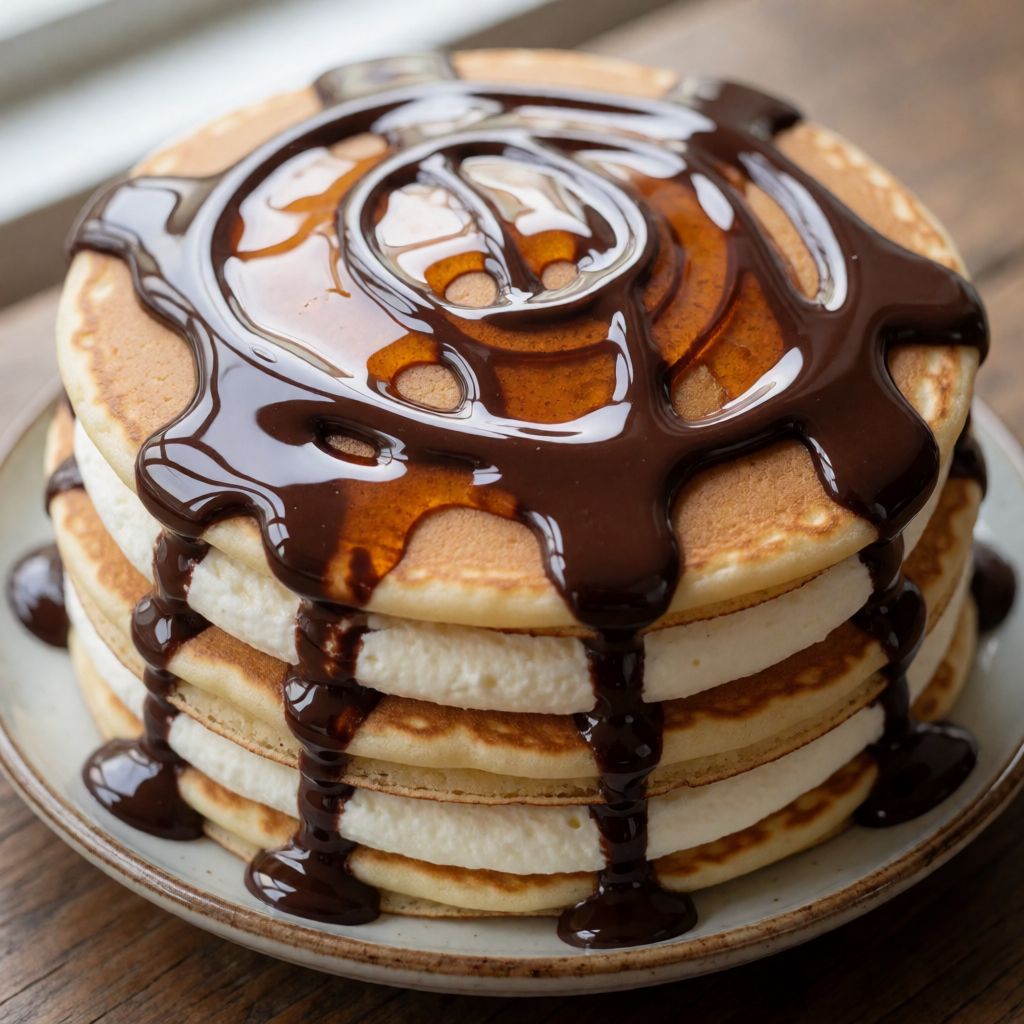
 AI photo
Pancake Cake with Chocolate and Caramel
A layered pancake cake with chocolate ganache, caramel and whipped cream.
Labels are worked out automatically from the ingredients and can be wrong. Check the packaging if it matters to you.
Ingredients
- 100 ml double cream
- 100 g dark chocolate
- 200 ml double cream
- 110 g caster sugar
- 50 g glucose syrup
- 1 pinch salt
- ½ pcs vanilla pod
- 50 g caster sugar
- ½ tsp cardamom
- 3 pcs eggs
- 300 ml milk
- 4 tbsp light ale
- 1 pinch salt
- 180 g plain flour
- 1 tbsp butter for frying
- 500 ml double cream whipped to soft peaks
- 100 g dark chocolate coarsely chopped











Steps
Heat the cream to 95°C, remove from the heat and stir in the chocolate until smooth.
Cool the chocolate mixture to room temperature, covering with cling film directly on the surface.
Chill the ganache in the fridge for at least 4 hours.
240 minBoil the cream, sugar and glucose syrup, stirring, until the temperature reaches 112°C.
Add the salt to the caramel and let it cool to room temperature.
Scrape out the vanilla seeds, mix with the sugar, cardamom, eggs, milk, ale and salt.
Sift the flour and mix the batter.
Let the batter rest for 30 minutes.
30 minFry the pancakes in butter until golden.
Cool the pancakes before assembling.
Whip the cream to soft peaks.
Place one pancake on a plate, pipe rings of caramel and ganache, spread a layer of whipped cream.
Continue layer by layer, alternating pancakes, caramel, ganache and cream, until the last pancake is placed.
Sprinkle the cake with chopped dark chocolate on top.
A pancake cake is not a cake. It's a stack — thin batter crêpes, caramel, chocolate ganache, cream, layer on layer, until you've built something that cuts like a torte but eats like nothing you'd bake in an oven. The French call the thin version a mille-crêpe; this one is its loud cousin, with salted caramel and dark ganache doing the work that jam does in a Victoria sponge. Whether it works comes down to two things that have nothing to do with the pancakes themselves: whether your ganache and caramel are actually cold and set when you pipe them, and whether your crêpes are thin and cooled flat before you stack.
People assume the "cake" part is the hard bit. It isn't. A crêpe batter with eggs, milk and a splash of ale (the ale's there for the same reason it goes in Yorkshire pudding batter — bubbles from carbonation and a slight bitterness that cuts the sweetness, not for flavour you'll name) is forgiving. What isn't forgiving is warm filling on a warm pancake: the caramel slides, the ganache melts into the cream, and twenty minutes after you plate it you have a puddle with chocolate shavings on top instead of a cake with visible rings. Cold components on cold pancakes hold their shape because nothing in the stack is trying to become liquid again.
Double cream, not single, appears three times for three different jobs, and swapping it for anything lighter will cost you in each case. In the ganache it's there to melt the chocolate smoothly without the mixture splitting — fat carries fat. In the caramel it stops pure sugar syrup from seizing into a brittle the moment it cools; the cream turns a hard caramel into a soft, spoonable one. In the final whip it needs enough fat (that's what "double" means here — over 48% butterfat) to hold soft peaks on its own, no gelatine, no stabiliser. Single cream won't whip at all; it just gets thicker and sad.
Heating cream to 95°C for the ganache isn't a number from a textbook — it's "just under boiling, where the surface starts to shiver and the first bubbles appear at the rim." Go past a rolling boil and you risk scorching, which tastes bitter under the chocolate forever. Some say you must boil it properly to "activate" something in the chocolate — no, you just need it hot enough to melt the chocolate completely and not a degree more; a full boil adds nothing and takes something away.
Dark chocolate: look for one you'd eat on its own, somewhere in the 60–70% range. Much higher and the ganache turns stiff and bitter against the sweet caramel; much lower (anything billed as "cooking chocolate" at the low end) and you'll need more of it to get the same set, which throws off the ratio to cream. If you only have chocolate chips, they work, but they're formulated to hold shape in baking and melt more sluggishly — give them longer off the heat, stirring, rather than more heat.
Glucose syrup in the caramel isn't decoration — it's an "interfering sugar," meaning it gets in the way of the sucrose crystals lining up and turning your caramel grainy. No glucose, no problem: a squeeze of lemon juice or a spoon of golden syrup in the pan does the same job of keeping the sugar amorphous rather than crystalline. The pinch of salt at the end isn't tradition for its own sake, either — plain caramel is one-note sweet, and salt widens that note into something you can actually taste through a whole slice of cake instead of it vanishing.
The eggs, milk, flour and ale combination is just a crêpe batter sized for a domestic hob, and the ale is doing a job glucose-stirring purists will tell you is unnecessary — it is not essential, but it's not magic either: a little carbonation and bitterness lighten a batter that's otherwise all egg and milk. If you've no ale, a splash of sparkling water does the lift without the flavour; plain milk alone just gives you a denser, flatter crêpe, still perfectly fine. Cardamom and vanilla go into the egg mixture, not the batter proper, because that's where the fat is to carry their aroma — add them to watery milk alone and most of the smell stays in the pan.
For stacking in an ordinary flat, you won't have a cake turntable or a kazan-sized griddle — a wide nonstick frying pan and a flat plate are the actual tools here, and that's fine. What you don't have is room for error on cooling: don't stack warm pancakes on a cold plate thinking the fridge later will fix it — it won't undo pancakes that have already gone soft and welded to the caramel beneath them. Lay them out on a rack or a clean tea towel, give them air, and only then build. This feeds eight, cut in the thin wedges the layers demand — any thicker and you're eating one slice as a meal, which, given the cream and chocolate involved, your Sunday roast guests will forgive you for exactly once.