
 AI photo
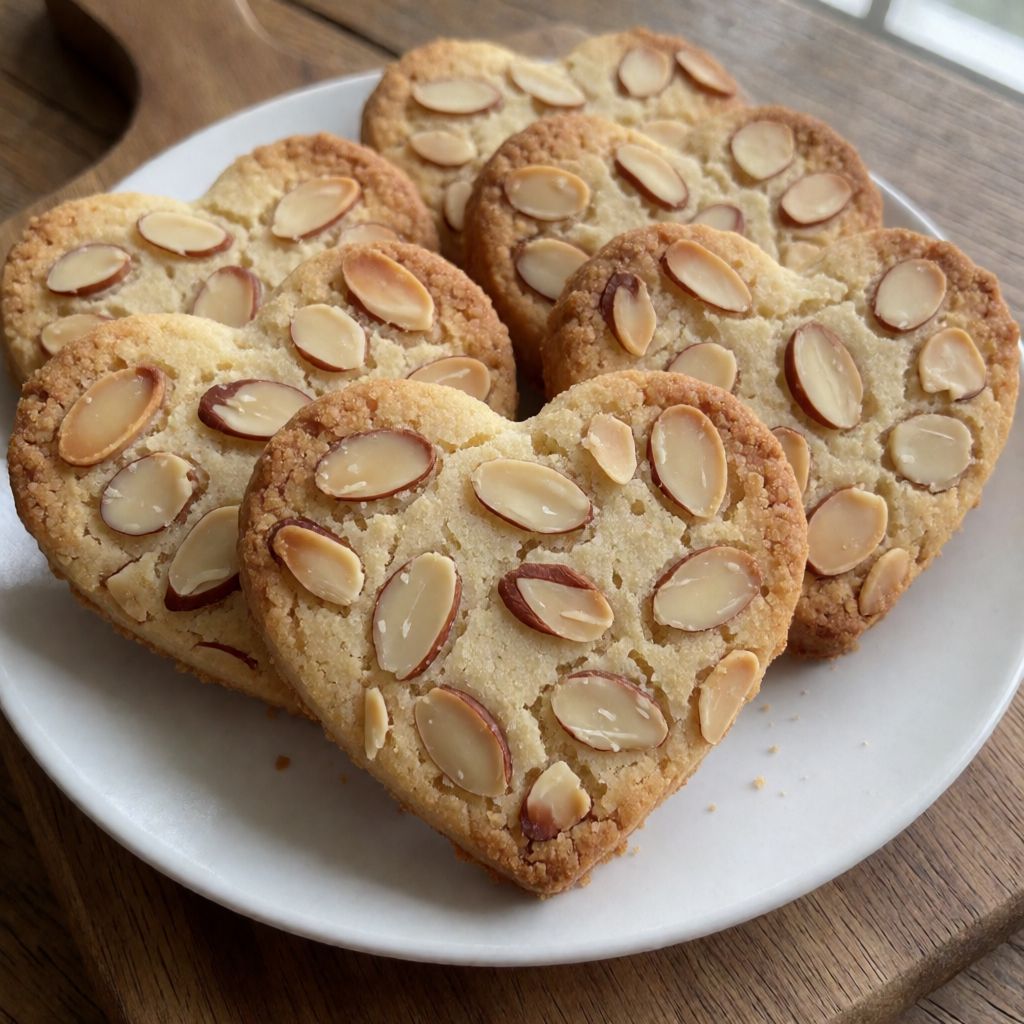
Crispy Almond Heart Biscuits
Crispy almond heart-shaped biscuits flavoured with amaretto, lovely with a cup of tea.
Labels are worked out automatically from the ingredients and can be wrong. Check the packaging if it matters to you.
Ingredients
- 360 g Plain flour
- 100 g Butter
- 80 g Ground almonds or finely chopped almonds
- 150 g Caster sugar
- 50 g Almonds
- 1 tbsp Dried yeast
- 1 pcs Egg
- 1 pcs Egg yolk
- 1 tsp Vanilla extract
- 1 tbsp Amaretto liqueur or another liqueur or milk










Steps
Cream the butter with the sugar and vanilla extract, then add the egg, egg yolk and amaretto liqueur.
Stir in the ground almonds and the sifted flour mixed with the yeast, then knead into a smooth, even dough.
Cover the dough and let it rest in the fridge for 30 minutes.
30 minRoll out the dough to about 1/2 cm thick, roughly chop the almonds and scatter them over the surface.
Cut out hearts with cutters (or shape them by hand) and place on a baking tray lined with parchment.
Bake at 170°C for 10–12 minutes, no longer: the biscuits should stay pale on top.
11 min
What was changed
Vanilla extract replaces vanillin, which British shoppers cannot find in sachet form.
This is a crisp, almond-fat shortbread cut into hearts — closer to a British shortbread cousin of Italian amaretti than to a cake. The dough is flour and butter and ground almonds worked together until smooth, chilled, rolled thin, cut, scattered with chopped almonds, and baked fast and hot enough that the middle sets before the edges catch colour.
What decides whether it works isn't the shape of the cutter, it's two things: the balance of fat, and knowing when to pull the tray out. The ground almonds aren't just flavour sitting on top of the butter — they're carrying a good third of the fat in this dough. Treat them as decoration and you'll get a dry, sandy biscuit that falls apart before it reaches the tea. Treat them as part of the fat system, and the dough stays short and snaps clean.
The second thing is the oven moment. The recipe tells you to pull them while the tops are still pale — that's not caution, that's the mechanism. Sugar in a thin biscuit keeps cooking for a minute or two after it leaves the heat, on its own residual warmth. Wait for a gold top and by the time that heat has finished working, the biscuit underneath is already past crisp into brittle-and-bitter. Pale top, patience after the oven, not in it.
Flour first: plain, not strong or bread flour. The job here is to hold everything together without building much gluten, because gluten is what makes a chewy biscuit, and chewy is the opposite of what you want from something that's meant to snap. Three hundred and sixty grams against a hundred of butter looks flour-heavy for a shortbread, but remember the almonds are quietly adding their own fat — once you count that in, the ratio is a normal short dough, just split across two ingredients instead of one.
Butter: creamed with the sugar means worked until it's pale and even, not whipped for air — you're not making a cake that needs to rise, you're coating flour particles in fat so they can't link up into gluten strands. Use it soft, straight from the counter, not melted — melted butter runs into the flour instead of coating it, and the dough spreads rather than holds its shape in the oven. If you're dairy-free, any firm block fat that stays solid at fridge temperature will do the same mechanical job; it just won't taste like butter, and in a biscuit this plain, that's the whole flavour, so choose carefully.
Ground almonds carry fat, flavour and a faint grittiness that keeps the crumb from going slick — that grittiness is texture, not a flaw. Buy them fresh or grind your own from blanched almonds just before use; nut oil turns rancid faster than you'd think, and a stale ground almond tastes of cardboard, not marzipan. No almonds in the house — any other oily ground nut will hold the dough together the same way, hazelnut is the obvious stand-in, but you'll lose the amaretti character entirely and get something closer to a hazelnut shortbread, which is no bad thing, just a different biscuit.
The whole almonds scattered on top before baking are there for crunch and because a biscuit with nothing on its face looks like it forgot something. They sit directly under the heat with nothing protecting them, which is another reason the 'stay pale' rule in the bake matters — push the colour and those exposed nuts are the first thing to burn, well before the dough underneath has even finished setting.
Caster sugar, not granulated, because it has to dissolve into the butter while you're creaming, not sit there as grit. Granulated will leave you with hard little specks that never fully melt, and you'll bite into them later wondering why the biscuit isn't smooth.
Egg plus an extra yolk, not two whole eggs: the yolk's fat tenderises, the white's protein toughens. An extra white would give you a firmer, more cake-like crumb; the extra yolk pulls the texture the other way, toward short and crumbly, which is the direction this biscuit is meant to go.
Vanilla and amaretto are both doing the same job from different angles — carrying aroma, not sugar or moisture. The alcohol in the amaretto cooks off in the oven and takes the almond scent with it into the crumb; swap it for milk if you'd rather skip the alcohol, and the dough still works, you just lose that double-almond note the liqueur was built for in the first place — amaretto was always flavoured to taste of almond even when, historically, it was often made from apricot kernels, which taste almost identical and cost less. Any liqueur with an almond or stone-fruit note is a fair swap; a liqueur that tastes of orange or coffee is not, because it'll fight the almonds rather than back them up.
On thickness and the half-centimetre: that number isn't arbitrary, it's tied directly to the 10–12 minute window. Thinner, and the biscuit crosses from pale to burnt before you can blink; thicker, and the centre is still raw dough when the top has already set. In a British fan oven, which tends to run a touch hotter and faster than the dial says, check your first tray at nine minutes rather than trust the full eleven — you can always put it back, you can't un-burn it.