
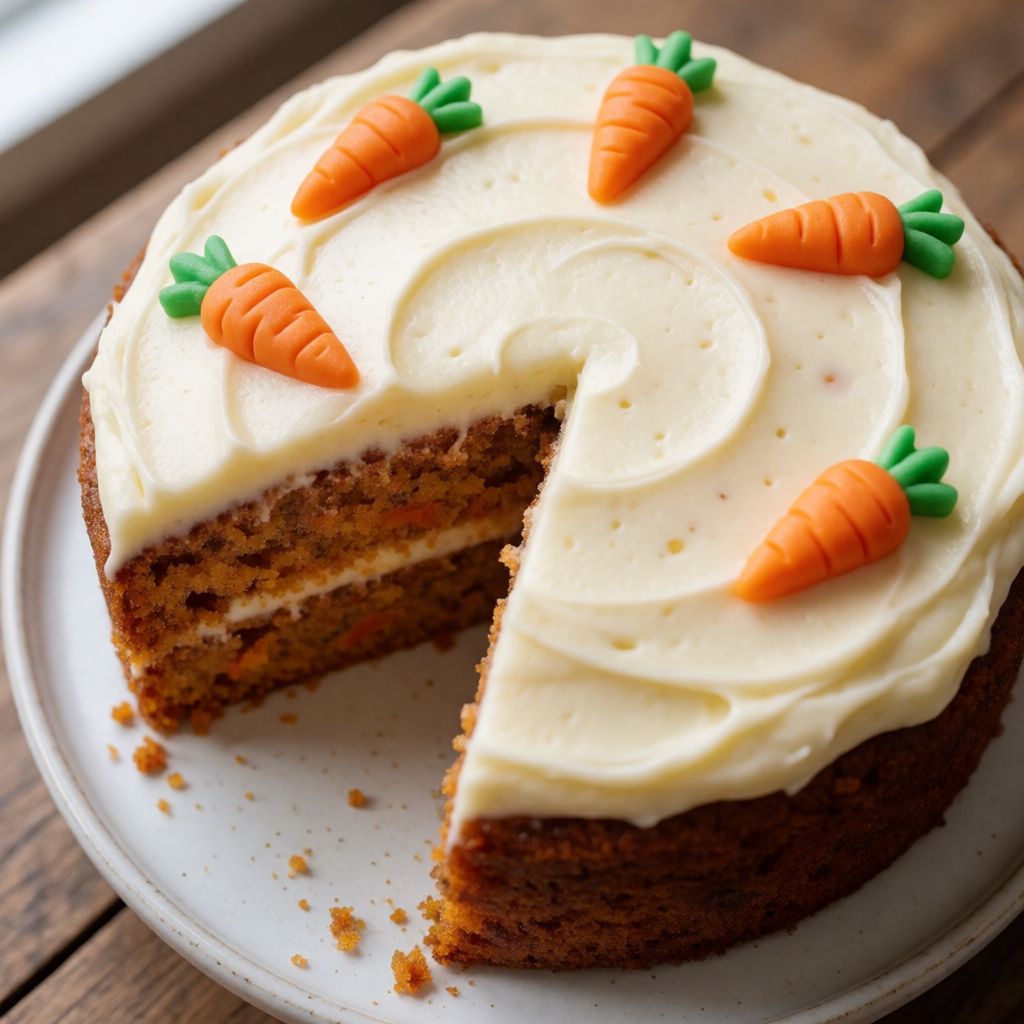
 AI photo
Easter Carrot Cake
A light almond-carrot sponge filled with lemon mousse and finished with cream, rosemary sprigs and Easter eggs.
Labels are worked out automatically from the ingredients and can be wrong. Check the packaging if it matters to you.
Ingredients
- 120 g Butter soft
- 175 g Caster sugar
- 4 pcs Eggs
- 150 g Plain flour
- 50 g Ground almonds
- 2 tsp Baking powder
- 0.5 tsp Salt
- 300 g Carrot grated
- 5 pcs Gelatine leaves
- 3 pcs Egg yolks
- 3 pcs Egg whites
- 80 g Caster sugar
- 150 ml Lemon juice
- 1 pcs Lemon finely grated zest
- 150 ml Double cream
- 200 ml Double cream
- 6 pcs Rosemary fresh sprigs
- Easter eggs to taste, for decoration













Steps
Cream the butter and sugar, then beat in the eggs one at a time, beating well after each.
Fold the ground almonds into the batter.
Mix the ground almonds, plain flour, baking powder and salt in a separate bowl and sift this into the batter.
Fold in the grated carrot.
Spoon the batter into a greased 20 cm tin and bake at 175°C fan for 45 minutes, until cooked through.
45 minLeave the cake to cool completely in the tin.
Soak the gelatine leaves in cold water for 10 minutes.
10 minSqueeze out the gelatine and melt it gently over a low heat.
Take off the heat as soon as the gelatine has melted and stir in the lemon juice.
Whisk the egg whites to stiff peaks.
Whisk the egg yolks, sugar and grated lemon zest until pale and thick, with no sugar grains left.
Stir 2 tbsp of the egg mixture into the gelatine and lemon juice, mix until smooth, then fold this back into the rest of the egg mixture.
Whip the cream to soft peaks and fold it gently into the egg mixture with a spatula, keeping as much air in as you can. Then fold a quarter of the whisked egg whites into the lemon mousse, followed by the rest, folding gently.
Slice the carrot sponge in half to make two layers.
Line the clean tin (the one the sponge was baked in) with cling film, put in the first layer, spread over half the lemon mousse, lay the second layer on top and spread over the rest of the mousse.
Chill the cake for at least 4 hours, or overnight.
240 minUnclip the tin, carefully peel away the film and move the cake onto a serving plate.
Whip the cream and spread it over the sides of the cake.
Decorate with rosemary sprigs arranged as a little Easter nest, Easter eggs and sprinkles.
This isn't really a carrot cake with icing on top — it's two things built separately and then forced to live together: a dense, almond-heavy carrot sponge, and a lemon mousse stabilised with gelatine, stacked between the layers like a filling that thinks it's a dessert in its own right. That's what decides whether it works. Get the sponge too wet and it collapses under the mousse's weight. Get the mousse too loose and it oozes out the sides when you unclip the tin eight hours later. Neither failure announces itself until you cut the first slice.
The ground almonds aren't a health gesture, whatever anyone tells you about this being "the healthy carrot cake." Almonds bind fat and moisture without building gluten the way more flour would — so the crumb stays short and a bit sandy rather than stretchy. That matters because this sponge has to hold a wet mousse on top of it for hours without sogging through. A plain flour sponge, no almonds, would drink that moisture and turn to paste by the time you cut it.
Butter should be properly soft, not melted — soft enough to take a thumbprint, still holding its shape. Melted butter won't trap air when you cream it with sugar, and that trapped air is most of what lifts this sponge, since there's no separate whisking of whites into the carrot batter. Cold butter just won't take the sugar in at all, you'll be fighting it for ten minutes and bruising your eggs when you add them. "Room temperature" on a British kitchen worktop in April is not room temperature in August — judge it by feel, not by a clock sitting on the counter.
Carrot: grate it, don't food-process it to a mush. You want fine shreds that still have some structure, because they're there for moisture and a faint vegetal sweetness, not to disappear entirely — a cake with carrot pulverised to paste bakes heavier and wetter in the centre, because the water's already released before it even goes in the oven. Any firm, not-too-woody carrot works; the supermarket bagged ones are fine, you're not hunting down anything special here.
Gelatine leaves versus powder: leaves give you a cleaner set with less chance of lumps, because they're already measured as a sheet — soak, squeeze, melt. If you only have powdered gelatine, bloom it in a little cold water first rather than throwing it straight into something warm, or you get the same stringy-lump problem people blame on "bad gelatine" when it's really bad technique. Five leaves set 150ml of lemon juice plus the egg and cream volume — don't be tempted to add more "to be safe," because over-set mousse turns rubbery and loses the point of being a mousse at all.
Lemon juice, not bottled — 150ml is roughly four to five lemons depending on the fruit, and you want the zest from one of them finely grated, not in strips, so it disappears into the yolk mixture rather than sitting as bitter flecks. Some say you can use bottled juice and nobody will know — no, because bottled juice is often cut and oxidised, and in a dish where lemon is the whole flavour of half the cake, not a background note, that difference is exactly what you'll taste.
Two batches of double cream do different jobs and shouldn't be confused: the 150ml goes into the mousse itself, whipped only to soft peaks — stiffer than that and it won't fold through the egg mixture without knocking the air back out, which is the actual reason mousses turn dense instead of staying light. The 200ml is the outer coating, whipped properly and spread on cold, set cake — this one can go firmer because it's not being folded into anything, it's just cladding.
On the oven: 175°C fan is a genuine instruction, not "medium" dressed up — at that heat the sponge sets from the outside in over roughly 45 minutes without the edges drying out before the centre with its carrot moisture catches up. Check doneness by feel, not the clock: a skewer should come out clean, the top should spring back rather than leaving a dent. Baking tins used for both the sponge and later the mousse layering is just a kitchen without a cake ring talking sense to itself — line it with cling film the second time round so the set mousse releases cleanly, because nothing rescues a mousse that's torn itself against bare metal.
Last thing: the fridge is doing real work here, not just "chilling." A domestic fridge runs around 4°C, cold enough to set gelatine but slow about it — that's why overnight beats four hours if you have the evening to spare. Build this the day before whatever you're serving it for, cut the rosemary nest and decorate in the morning, and you're not racing the cake. Racing it is how slices arrive at the table half-collapsed.