
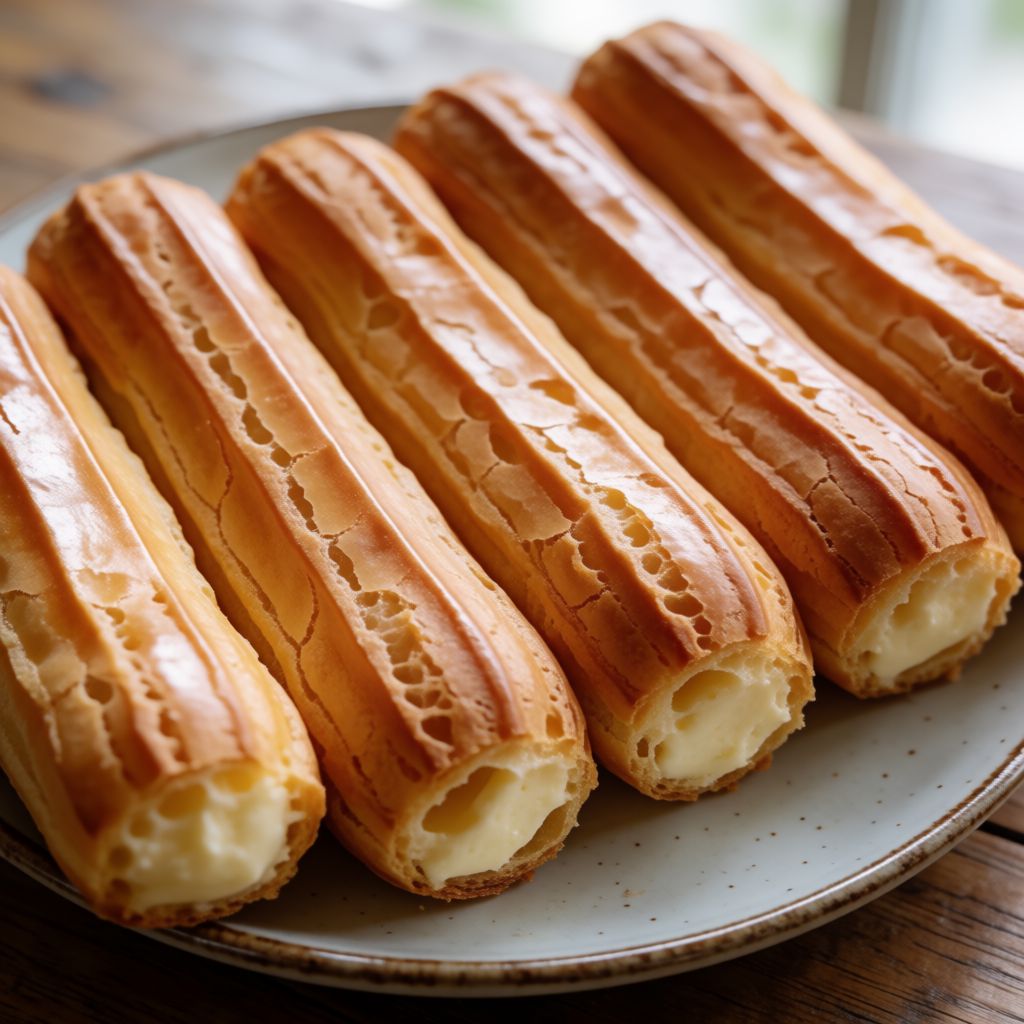
 AI photo
Éclairs
Classic French éclairs with vanilla custard cream, salted caramel and a glossy chocolate glaze.
Labels are worked out automatically from the ingredients and can be wrong. Check the packaging if it matters to you.
Ingredients
- 100 ml Milk
- 100 ml Water
- 80 g Butter
- 20 g Caster sugar
- 1 pinch Salt
- 110 g Plain flour
- 160 g Eggs
- 15 g Icing sugar for dusting
- 0.5 pcs Vanilla pod








Vanilla Custard Cream
- 60 g Caster sugar
- 3 pcs Egg yolks
- 15 g Cornflour
- 250 ml Milk


Chocolate Glaze
- 100 ml Salted caramel sauce
- 90 g Dark chocolate finely chopped
- 100 ml Double cream
- 10 g Glucose syrup


Steps
Preheat the oven to 200°C (conventional setting).
Pour in the milk and water, add the butter and bring to the boil. Add the sugar and salt and stir until the sugar dissolves. Remove from the heat and sift in the flour.
Mix until smooth, return to the heat and stir until the dough pulls away from the base and reaches 75°C.
Remove the pan from the heat and let the dough cool on the counter for 5 minutes. Gradually beat in the whisked eggs in small amounts, mixing well after each addition before adding more.
5 minKeep mixing until the dough is smooth, elastic and firm enough to hold its shape when piped.
Transfer the dough to a piping bag fitted with a 10mm multi-grooved star nozzle and pipe oblong strips about 10cm long onto a baking tray lined with parchment. Dust icing sugar over the top.
Put into the oven and immediately lower the temperature to 175°C; bake for about 28–30 minutes, until the éclairs are a good golden colour.
29 minRemove the éclairs from the oven and let them cool completely on a wire rack. Make three small holes in the base of each one to release steam — this stops them collapsing, and you'll later pipe the filling through these holes.
Vanilla custard cream: split the vanilla pod and scrape out the seeds. Mix the seeds with the sugar to separate them. In a saucepan, whisk together the vanilla sugar, egg yolks and cornflour until smooth.
Pour in the milk and heat slowly to the boil, stirring constantly, until the cream thickens. Let it bubble gently for a couple of minutes while stirring, then pour into a bowl, cover the surface with cling film and chill until completely cool.
Chocolate glaze: in a saucepan, heat the double cream and glucose syrup until almost boiling. Pour this over the chocolate in a bowl and stir until you have a smooth, glossy glaze.
Filled éclairs: pipe a little salted caramel sauce into each of the three holes in the base of each éclair. Then pipe in the vanilla custard cream.
Dip the tops of the éclairs into the chocolate glaze and serve these lovely pastries.
An éclair is choux pastry doing a trick: a dough that's basically a thick paste, baked so violently that its own moisture turns to steam and blows the inside hollow. No raising agent, no yeast, no faith required — just water and butter boiling, flour cooking in that liquid, and then eggs let down slowly to build an emulsion that's wet enough to puff but dry enough to hold a wall. That wall, once baked rigid, is the whole point: a case for filling later.
What decides whether it works is almost entirely upstream of the oven. The paste (it's called "pâte à choux", but don't let the French throw you — it means "cabbage dough", because the baked shapes look like little cabbages, nothing more mystical than that) needs the flour properly cooked into the butter-water before any egg goes in, and the eggs need adding in dribs so the mixture doesn't suddenly go thin and soupy on you. Add them too fast and you can't walk it back — the structure that was meant to trap steam just runs flat on the tray.
The oven is doing one job: get hot fast so the water in the dough flashes to steam before the outer crust sets hard, so the steam has to push the inside open rather than just evaporate through a loose skin. That's why the temperature drops partway through — the shove is needed only at the start; after that it's about colouring and drying the walls so they don't go soft and collapse under custard later.
Milk and water together, not just water: water alone gives you a crisper, more hollow shell; milk softens that and browns the crust faster because of its sugars. Butter needs to be a real butter, not a spread — spreads carry water in different ratios and will throw off how much flour the liquid can absorb before it seizes. The small sugar and salt aren't for sweetness you'll taste; they're seasoning for the eggs and butter so the shell isn't blank.
Flour: plain, nothing with raising agent in it. The lift here is steam, not bicarbonate — self-raising flour would only mean a texture that's wrong twice over, puffed by two different mechanisms fighting each other. Sift it because lumps thrown into hot liquid cook on the outside and stay raw-floury in the centre, and you will taste that later as a grainy bite nobody can explain.
Eggs are the adjustable part. 160g is a guide, not a law, because eggs vary and so does how much your liquid evaporated while boiling. The real test, which no scale will give you, is the dough holding a ribbon shape off a spoon and falling back slowly — stiff enough to pipe and keep its ridges, loose enough to climb and puff. Some say you must use exactly the eggs stated or the recipe fails. No — because the dough tells you when it's right with its own texture, and a slightly drier or wetter batch still bakes fine if you judge by that, not by the gram count alone.
The piping nozzle matters more than it looks: the grooves from a star tip give the shell ridges, and ridges mean more surface area to crisp and colour, and more structural rib to resist sagging once filled. A plain round nozzle gives a smoother, weaker tube. If you don't own a multi-groove star nozzle, a plain large round one works — you lose the ridged look and a bit of rigidity, not the mechanism.
The three holes pricked in the base after baking aren't decoration for the filling stage — they're damage control. A choux shell cools with hot trapped steam still inside it; if that steam has nowhere to go, it condenses back into water against the inner wall, and that water softens the structure from within until the whole thing caves in on itself on the rack. Puncturing lets the steam out while the walls are still rigid enough to hold their shape without it. Those same holes are then your access for the filling — one defect-prevention step doing two jobs.
The custard (crème pâtissière, but it's just a cooked egg-yolk-and-starch cream, nothing exotic) uses cornflour rather than more egg yolks to thicken, because starch lets you boil the mixture properly, killing off any raw-egg texture and thinning risk, without the yolks curdling into scrambled bits — the starch coats and protects them from the heat. Keep stirring while it bubbles; stop too early and it's loose on the tongue, let it catch on the base and you get scorched flecks through a pale cream. Chilling with cling film pressed onto the surface stops a skin forming — skin is just evaporation at the top, nothing more, and pressing plastic straight onto the surface removes the air it needs.
No vanilla pod in the cupboard — fine, a good vanilla paste or extract does the same flavour job, just add it off the heat since vanilla's aromatics are volatile and boiling drives them off; you'd be flavouring the steam, not the custard.
The glaze is ganache under a fancier name: hot cream melts chopped chocolate into a pourable shine. Glucose syrup there isn't about sweetness, it's about gloss and set — it stops the chocolate recrystallising into a dull, grainy surface as it cools, giving you that wet-look shine instead. No glucose in the house — a spoon of golden syrup does something similar, though the set will be slightly softer. Chop the chocolate fine, because big chunks dropped into cream that's "almost boiling" rather than boiling will still be lumpy when you want smooth — the smaller the pieces, the less heat and stirring you need to melt them evenly, and less stirring means less risk of the chocolate seizing into a grainy mess.
In a British kitchen with no kazan-grade equipment this is all genuinely doable in a wide pan and an ordinary domestic oven — just know your oven's real behaviour: domestic ovens often run cooler at the door and hotter at the back, so the "good golden colour" you're baking to matters more than trusting the dial, and a tray turned halfway through is cheap insurance. Twenty éclairs from this batch is a proper tea-table number — enough for a gathering, with a couple left for the person who always has two.