
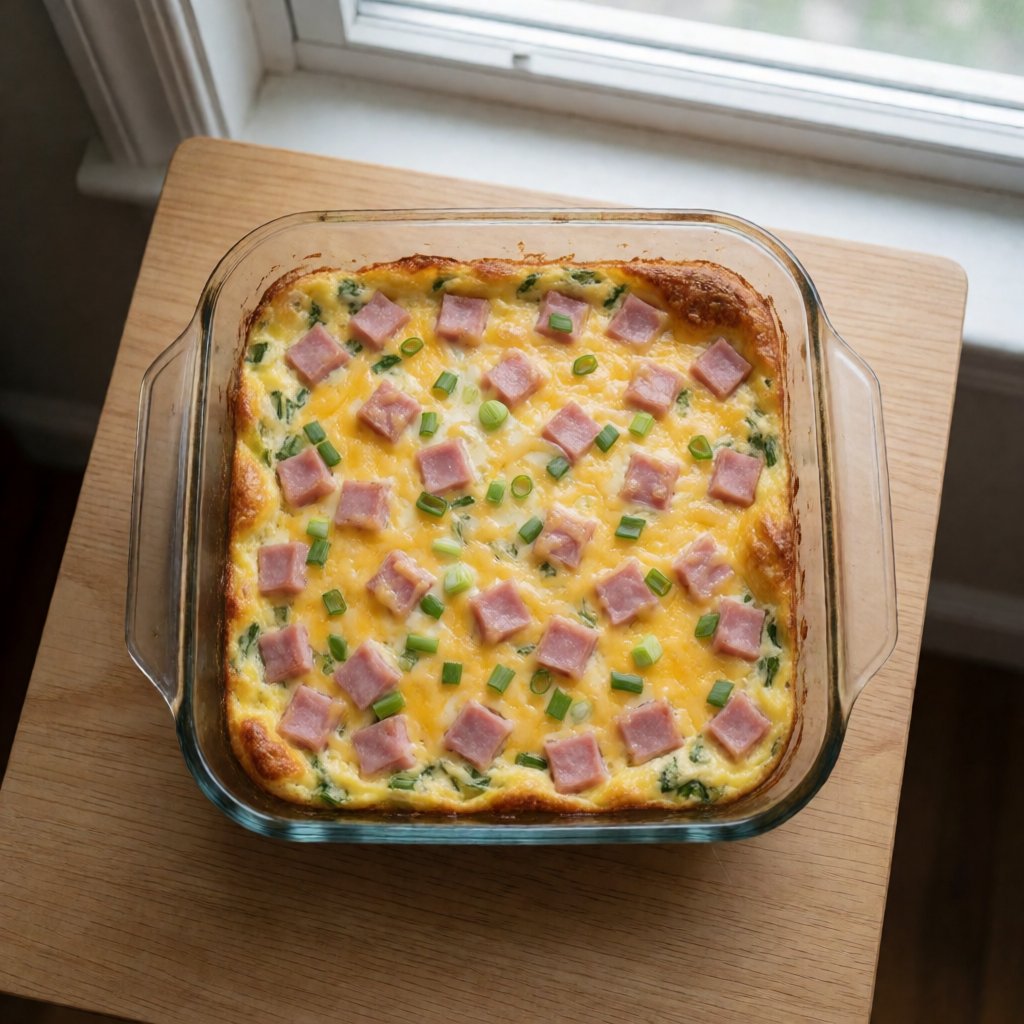
 AI photo
Baked Eggs with Ham and Cheese
A simple baked egg dish with ham and cheddar, ready in well under an hour.
Labels are worked out automatically from the ingredients and can be wrong. Check the packaging if it matters to you.
Ingredients
- 5 pcs Eggs
- 100 ml Milk
- 80 g Ham
- 50 g Cheddar grated, divided in half
- 2 pcs Spring onion stalks
- 1 pinch Salt
- 1 pinch Black pepper







Steps
Beat the eggs with the milk, salt and pepper.
Spread the ham, spring onion and half the cheddar on the bottom of the dish, then pour over the egg mixture.
Sprinkle the remaining cheddar on top.
Bake in the oven at 200°C for 20–25 minutes, until the centre is firm.
25 minRemove the dish from the oven.
What was changed
Hard cheese was replaced with Cheddar, a widely available hard cheese in the UK.
This is a crustless, loose cousin of a quiche — eggs set into a soft curd by the oven's steady heat, with ham and spring onion scattered through it and cheddar melted into a skin on top. No pastry, no fuss with blind-baking. Just a dish you pour batter into and the oven does the binding.
What decides whether it works is the egg-to-milk ratio and how you read doneness. Five eggs to 100 ml of milk is lean — barely 20 ml a yolk. That's not a custard in the quiche sense, where milk dominates and the texture goes silky; here the egg proteins are close to neat, so the set will be firmer, closer to a baked omelette than a wobble of cream. Less milk means a shorter window before it tips into rubber, so don't treat the given time as gospel — treat it as the earliest point you're allowed to check.
Doneness is not a clock reading, it's a look: the centre should hold its shape when the dish is nudged, moving as one piece, not sloshing as liquid under a set skin. Some say the top has to be golden to be ready — no, because the colour on top only tells you the cheese has browned, which is a fat-and-sugar reaction with nothing to do with what's happening underneath. You can have a gorgeous bronzed top sitting over raw egg. Judge the centre, not the crust.
Eggs: use what's fresh, because an older egg has a looser white, and a looser white sets softer and later — if your eggs have sat around a while, don't be surprised if the middle needs an extra few minutes past what's written. Size matters too; these are assumed to be a standard UK medium-to-large egg, and if yours run smaller you've effectively reduced the egg-to-milk ratio further, so the bake will be even softer and need longer.
Milk: its only job is to dilute the egg protein so the set is tender rather than tight. More milk, softer and slower to set; none at all, and you get something closer to a firm, slightly rubbery baked omelette. If you want a richer result, swap some milk for single cream — but know that cream sets less firmly than milk because of its fat, so the centre will look softer even when it's actually done. Any milk with a moderate fat content works; skimmed will set fine too, it just tastes thinner.
Ham: this is a fridge-clearout ingredient, and that's its whole history — Sunday roast ham, gammon trimmings, whatever cured, cooked meat is sitting in the fridge wanting a second life. It needs no more cooking, only warming through, so chop it small enough that it heats in the time the eggs take to set. The criterion for a substitute is simple: a salty, already-cooked meat that won't need its own cooking time — crisped bacon pieces, chorizo, even flaked smoked fish all meet it.
Cheddar: pick anything that melts into a stretch without turning oily and separating into little puddles of fat — a hard, press-aged cheese does this; Red Leicester, Gruyère, a mature Cheshire all qualify. One real catch with bagged pre-grated cheese: it's usually dusted with an anti-caking starch to stop it clumping in the bag, and that same coating can stop it melting smoothly, leaving a grainy, greasy top instead of a glossy one. Grating a block yourself a few minutes before costs you nothing and avoids the problem.
Spring onion: it goes in raw, under the egg, because it only needs the gentle ambient heat of the bake to soften — drop it on top instead and the direct heat will dry and char the tips before the centre's anywhere near set.
The dish you bake it in matters more than people think. Go wide and shallow rather than deep: a shallow layer sets through evenly, edge to centre, in the time you've got; a deep one sets at the rim long before the middle, and by the time the middle's firm the edges have gone past rubbery into dry. A domestic oven also runs differently if it's fan-assisted — fan ovens circulate heat harder and effectively cook a touch hotter than the dial says, so if yours is fan-forced, start checking a few minutes earlier than the recipe's floor. And once it's out, give it a couple of minutes standing before you cut in — the centre is still finishing on its own residual heat, and cutting too soon just lets raw egg run out where it was nearly there. That wait is not wasted time, it's part of the cooking.
·