
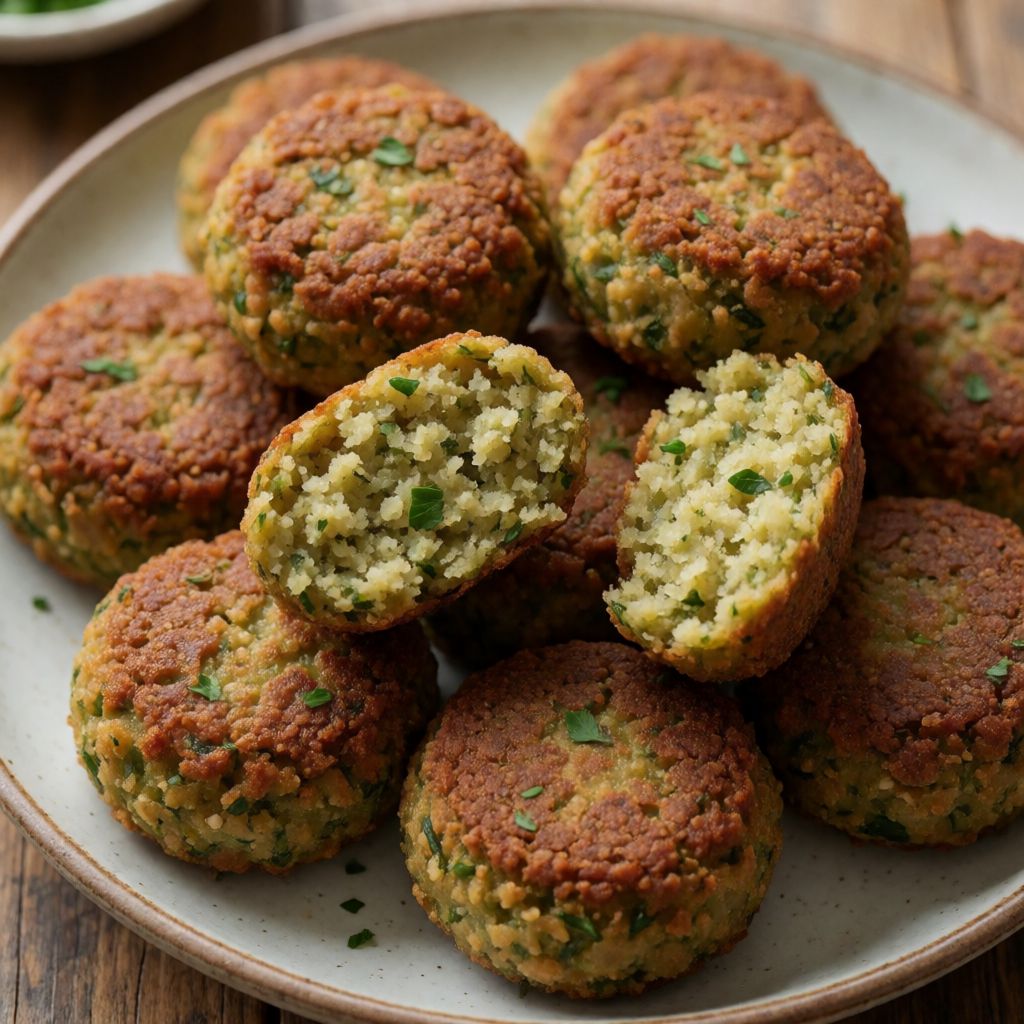
 AI photo
Falafel
Crisp, spiced chickpea fritters served in warm pitta with fresh salad and a lemony crème fraîche dressing.
Labels are worked out automatically from the ingredients and can be wrong. Check the packaging if it matters to you.
Ingredients
- 400 g Chickpeas dried
- 2 bunch Parsley finely chopped
- 4 clove Garlic finely chopped
- 2 pcs Onion finely chopped
- 4 tsp Ground coriander dried
- 4 tsp Cumin dried
- 2 tsp Salt
- 2 tsp Black pepper freshly ground
- 2 pcs Potato peeled and grated, excess water squeezed out
- 3 pcs Eggs
- 4 tbsp Breadcrumbs dried
- ½ tsp Chilli
- ½ pcs Lemon juice
- 1 l Vegetable oil
- 4 pcs Pitta bread
- 2 pcs Tomato diced
- ½ pcs Cucumber sliced
- 70 g Lettuce
- 100 ml Crème fraîche
- 1 pcs Lemon juice and finely grated zest
- Salt to taste
















Steps
Soak the dried chickpeas in cold water for about 12-24 hours, ideally changing the water once or twice, and rinse thoroughly after soaking.
1080 minPut the chickpeas and the rest of the ingredients into a food processor and blend until the mixture is smooth and even in texture.
3 minIf the mixture is too wet, add a couple of tablespoons of plain flour or extra breadcrumbs and let it rest for a little while.
8 minShape the mixture into round falafel with a spoon.
Heat the oil for deep-frying in a pan to 175-180°C and fry the falafel in small batches until crisp and golden.
Lift out with a slotted spoon and drain on kitchen paper.
2 minServe the falafel sprinkled with lemon juice and salt. Make the dressing by mixing crème fraîche with lemon zest and salt, and fill the pitta with salad, falafel and the dressing - hot falafel are also delicious just on their own.
Falafel is a dried-pulse problem solved by economics: chickpeas are cheap, keep for a year in a jar, and turn into something that holds together and fries crisp without a scrap of flour needed as glue, if you treat them right. The whole dish lives or dies on two things — the chickpeas staying raw and dry going into the processor, and the oil temperature staying honest while the falafel cooks through before the outside burns.
Some say you can use tinned chickpeas and save yourself the twenty-four-hour soak. No — because tinned chickpeas are already cooked, which means they're wet and starchy in a different way, and they'll bind into a paste that falls apart in the oil or, worse, absorbs oil like a sponge because there's no structure left to fry against. Dried, soaked, raw chickpeas keep their cell walls mostly intact; blended, they form a rough, slightly grainy mass that holds a shape and crisps rather than collapses. This is not tradition for tradition's sake — it's the only version of the dish that survives contact with hot oil.
The soaking matters more than any other step precisely because it's invisible by the time you're at the stove. Twelve to twenty-four hours in cold water lets the chickpeas take up roughly double their weight in water and soften enough to blend, without cooking them — cooking them would turn this into hummus with pretensions. Changing the water once or twice isn't fussiness; dried pulses release starches and raffinose sugars as they soak, and stale soaking water is where the faintly sour, tinny smell some people associate with chickpeas actually comes from. Rinse well after, and you've removed most of that along with it.
The herbs and spices — parsley by the bunch, not a sprinkle, plus coriander, cumin, chilli, garlic — aren't seasoning in the usual sense, they're a third of the volume of the mixture. This is why falafel is green inside rather than beige: it's parsley with chickpeas holding it together, not the other way round. If parsley isn't to hand, coriander leaf (fresh, the thing Americans call cilantro) does the same job of freshness and bulk — just don't use dried herbs here, they won't carry the same water content the mixture needs to stay workable.
The grated potato and the egg are doing a job that's easy to misread as "binding," but what they actually prevent is cracking in the oil. Raw chickpea paste alone is crumbly; potato starch, once it hits hot oil, gelatinises fast and sets a skin, while egg protein does the same from a different direction, coagulating around the particles. Squeeze the potato dry first — excess water here is the real reason falafel mixture sometimes refuses to hold a shape and has to be rescued with handfuls of extra breadcrumbs, which then make the inside dense and dry rather than soft. Get the potato dry enough and you shouldn't need the rescue.
Breadcrumbs beyond that small adjustment are a backstop, not a backbone — if the mixture is behaving, you barely need them. Any dry crumb works; stale bread blitzed in the processor is free and better than shop-bought crumbs that have often been sitting in a packet for months.
For the oil, the only real requirement is that it has no flavour of its own to compete with the cumin and garlic — sunflower, groundnut, a plain vegetable oil, anything that won't leave its own signature in the crust. Olive oil at these temperatures is wasted money and starts to smoke before you're near frying heat. A litre sounds like a lot for a family pan, but shallow frying falafel means they half-sit in the oil rather than swim, and they'll scorch on one side before cooking through — depth here is what buys you an even crust all round.
The crème fraîche dressing and the raw salad aren't an afterthought tacked on by the pitta — they're doing the job acid and freshness always do against anything fried: cutting the richness so four falafel in a pitta reads as a meal rather than a plate of fried food. Lemon juice in the dressing and again straight onto the hot falafel the moment they come out of the oil does real work too, not decoration — a squeeze of acid on something hot and crisp wakes up spicing that otherwise sits a bit flat and dense from all that chickpea.