
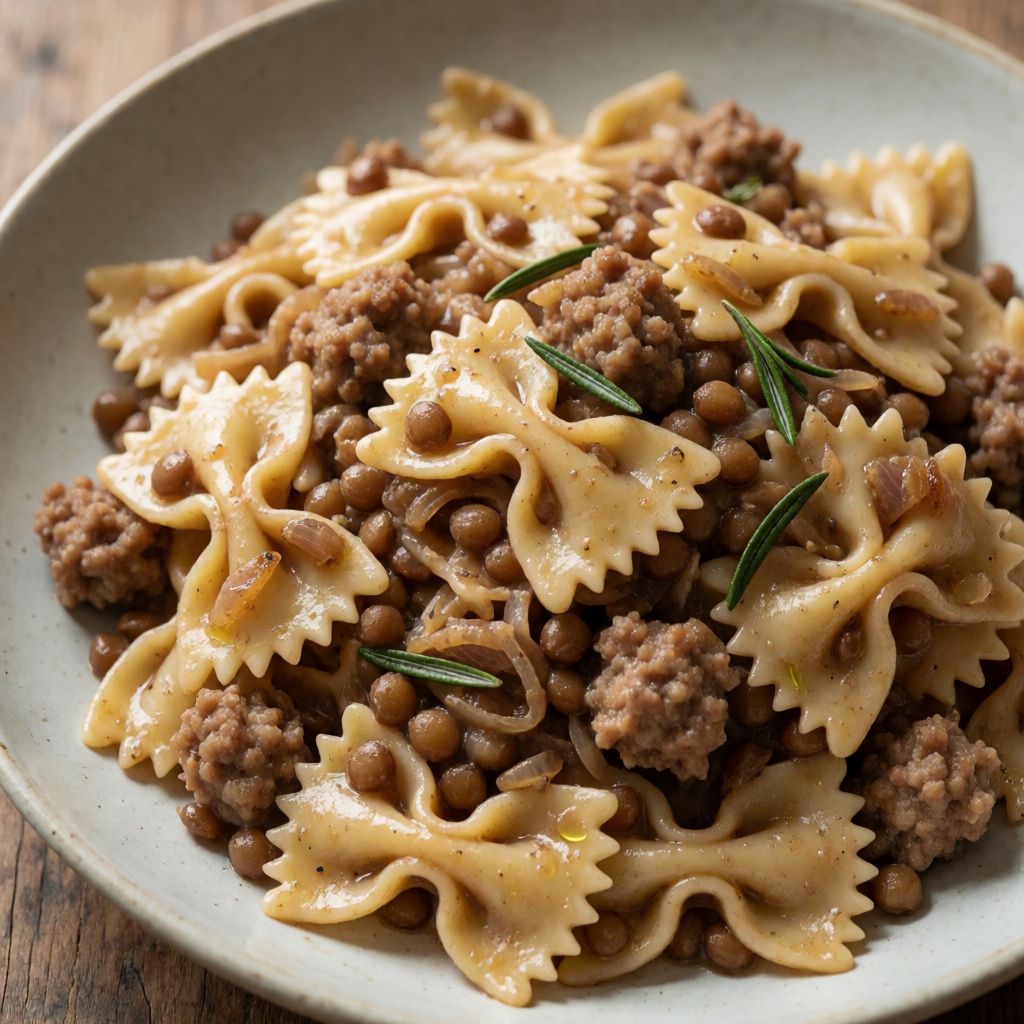
 AI photo
Farfalle with Sausage and Lentils
A quick pasta dish with Italian sausage, lentils and rosemary, finished with Parmesan.
Labels are worked out automatically from the ingredients and can be wrong. Check the packaging if it matters to you.
Ingredients
- 400 g Farfalle pasta
- 1 pcs Shallot
- 150 g Sausage meat
- 1 can Lentils
- Rosemary to taste
- Olive oil to taste
- Salt to taste
- Black pepper to taste
- Parmesan to taste









Steps
In a non-stick frying pan, fry the finely sliced shallot and sausage meat in olive oil.
Cook the farfalle pasta until al dente.
Add the drained lentils to the pan, season with salt, pepper and rosemary, and cook until done.
Add the cooked pasta to the pan for a few minutes, grate over the pecorino and serve.
This is a weeknight dish built on one trick: fry the sausage meat hard enough to actually brown it, and let the lentils borrow that fat instead of bringing their own. The shallot, the rosemary, even the pasta — they're just there to carry what the meat renders into the pan. Nothing here needs a kazan or a long afternoon; it's a twenty-minute pan dish, and that's the whole point of it.
What decides whether it works is simple and has nothing to do with a dial setting: does the sausage meat get real colour before the lentils join it, and do you time the pasta so it lands in the pan wet enough to still carry its starch. Get the first wrong and the dish tastes flat and grey. Get the second wrong and you get dry clumps where you wanted a sauce.
Some say "fry on medium heat." No — there's no such universal unit on a domestic hob, gas or electric, and chasing a number on a dial misses what's actually happening in the pan. What you're watching for is the meat losing its raw pink and picking up brown patches where fat meets hot metal directly, not where it's sitting in a puddle of its own juice. Crowd the pan with too much meat at once and it exhales liquid before it can brown — grey, sad crumbs stewing in their own water. That's the oldest fault in any pan-fried mince, and it's a pan problem, not a heat problem: use a pan wide enough that the meat touches metal, not itself.
Shallot instead of onion is a choice about moisture, not fashion. Shallots hold less water and more sugar, so they soften and start to sweeten faster, which matters when the whole cook is twenty minutes and you don't want to wait around for an onion to lose its bite. If all you have is an onion, white or brown, slice it thinner than you would the shallot and give it longer in the pan before the meat goes in — you're compensating for water it has to cook off first.
Sausage meat, loose, without its casing, is doing a specific job: its fat is the cooking medium for everything that follows, including the lentils. Don't trim it thinking you're being healthy — you'd just be removing the thing that makes the dish work. If you only have ordinary mince, use it, but add a splash of oil to the pan to replace the fat you've lost, and bump up the rosemary and pepper, because sausage meat already carries its own seasoning that plain mince doesn't.
The lentils come from a tin because that's the entire reason this dish takes twenty minutes and not ninety. A tinned lentil is already fully cooked — your only job is to season it and let it sit in hot fat long enough to take on flavour, not to cook it from raw. Dried lentils need a separate pot and the better part of half an hour of their own simmering before they're anywhere near this pan; use them if that's what's in your cupboard, but boil them first, don't expect them to finish in the time the sausage meat needs. Tinned legumes becoming a kitchen staple is not an accident of taste — it's postwar convenience that stuck, and this dish is a quick cousin of the old Italian pasta e lenticchie, just with rendered sausage fat standing in for the pancetta or cheese rind that version usually leans on.
Rosemary is a resinous herb — its oils need heat and fat contact to open up, which is why it goes in early with the shallot and meat, not scattered on at the end like a garnish. Strip the needles off the woody stem and bruise them a little between your fingers first; dried rosemary works too, just use less, since drying concentrates it. Thyme is the honest substitute if rosemary's missing — another herb tough enough to survive real heat without turning bitter, which basil or parsley simply aren't built for here.
Use a plain, light olive oil to start the pan, something without a loud flavour of its own, and save any good extra-virgin bottle for a final drizzle if you want one — frying burns off most of what makes a fancy oil fancy anyway, so you're paying for nothing by using it early. Any neutral oil would technically do the job of getting the pan going before the meat's own fat takes over, but olive oil keeps the dish honestly Italian in character rather than just functional.
Farfalle isn't an arbitrary shape — its folds catch the bits of lentil and meat that a smooth noodle would just shed. Any short pasta with ridges or folds, penne, fusilli, works the same way; spaghetti or other smooth long shapes will leave half the sauce in the pan rather than on the plate. And a note on the card's own numbers: it says one serving, but 400 g of pasta with 150 g of sausage meat and a full tin of lentils is really enough for two people with a proper appetite, maybe three if it's one course among others — think of it as one shallot and one tin per pan regardless of how many are sitting down, and scale the pasta by the old rule of about 100 g a head.