
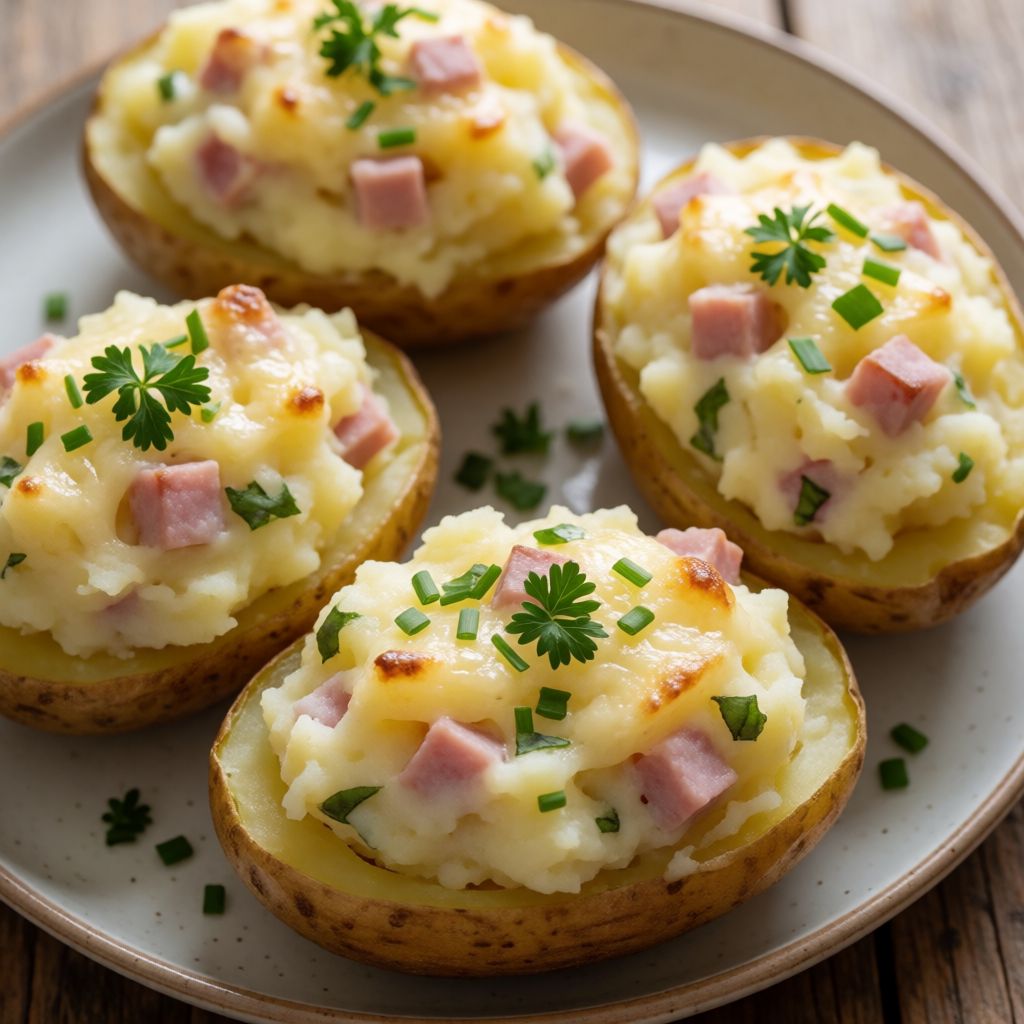
 AI photo
Stuffed Baked Potatoes
Baked potatoes hollowed out and filled with a savoury mixture of ham, cheese and herbs, then baked until golden.
Labels are worked out automatically from the ingredients and can be wrong. Check the packaging if it matters to you.
Ingredients









Steps
Wash the potatoes and boil them in salted water for about 30 minutes, until tender.
30 minLet the potatoes cool, cut each one in half lengthways and scoop out the flesh with a spoon, leaving a thin shell.
Mash the flesh with a fork, add the ham, provolone, chives, basil, parsley, salt and pepper, and mix well.
Fill the potato shells with the stuffing, mounding it up on top.
Place the stuffed potatoes on an oiled baking tray, sprinkle with the remaining provolone and Parmesan, and drizzle with olive oil.
Bake in a preheated fan oven at 170°C for 30 minutes.
30 minFinish under the grill until golden, 2-3 minutes.
3 minServe the stuffed potatoes hot.
What was changed
Prosciutto has been replaced with Ham, a ham that is easy to find locally.
Twice-cooked potato — boiled first, then rebuilt and baked. The whole dish is a shell made of starch, strong enough to hold itself up, filled with the same potato gone soft and mixed with ham and cheese. What decides whether it works is the shell: thick enough to carry filling without collapsing, thin enough that it isn't just "potato skin with a job to do."
Boiling the potato whole, skin on, in salted water does two things. It cooks the flesh to the point where it falls apart under a fork — you want crumble, not resistance — and the skin, left on, keeps the starch from leaching out into the water, which is why you salt that water generously: it's seasoning the flesh from inside out before you ever touch it with a spoon. Some say boil it already halved to save time — no, because the cut faces drink water and you get a soggy, waterlogged scoop that won't hold shape in the oven.
The second cooking, the bake, is not reheating. It's drying and setting. Those 30 minutes at a moderate oven temperature are there so the filling firms up around the cheese rather than staying a loose mash, and the finish under the grill is purely about the surface — a minute or two of fierce top heat to brown the cheese cap while the inside, already warm and set, doesn't need more time, just colour. Watch it, don't time it: the provolone goes from pale and shiny to blistered and freckled with brown, and that's your signal, not a clock.
Choose a potato built for this: floury, not waxy — something that falls apart rather than holds its shape when boiled, because you need that collapse to mash easily later, but you also need enough body in the skin to form a shell that stands up on a tray. A big baking potato, the kind sold loose and labelled for jacket potatoes, is exactly the size this recipe wants — about 200g each, big enough to scoop without the shell tearing.
Ham here is doing a salt-and-savour job, not a protein-centrepiece job — cooked ham, sliced thin and cubed, melts into the mash rather than sitting as chunks. If you've only got bacon, fry it first and drain it; raw-cured meat won't cook through in the time the filling spends in the oven, and that's a genuine food-safety issue, not a texture quibble.
Provolone is picked for how it behaves under heat — it stretches and browns rather than just melting into a puddle, which is why some goes into the mix and some stays back for the top. Any semi-hard cheese that does the same — a mild cheddar, a gruyère — will substitute fine; what you're after is a cheese that holds structure when it gets hot, not one that separates into oil and curd, which is what a very soft or very fresh cheese will do and leave you with a greasy top instead of a golden one.
Parmesan on top is for crust, not flavour depth — it's grated fine, it dries out fast under the grill, and that's what gives you the last bit of crunch and colour that a lump of provolone alone wouldn't achieve in three minutes. If you haven't got parmesan, any hard, dry, well-aged cheese that grates to a powder will do the same job; a soft cheese won't crisp, it'll just slump.
The herbs — parsley, chives, basil — are there raw, folded in after the potato's already hot enough to wilt them gently, not cooked. This matters because cooked basil loses its smell fast and turns bitter; stirred into warm mash it stays green and fragrant rather than going dark and flat. Use what's growing or what's fresh in the fridge; dried herbs here will taste like dust against fresh cheese and ham, so if you must substitute, use less than you think and add it earlier so it has time to soften.
Olive oil is just "fat with a clean taste" doing a drizzle's job — carrying heat to the surface and helping the cheese brown rather than dry out. Use anything you'd happily eat cold, with no strong smell of its own fighting the ham and basil; a flavourless vegetable oil for the tray, a better oil for the final drizzle if you want to taste it. Patience is the real ingredient twice over here — once waiting for the first boil to properly soften the flesh, once letting the bake set the filling before you rush it under the grill. Skip either and you get a potato that looks right and falls apart on the plate.