
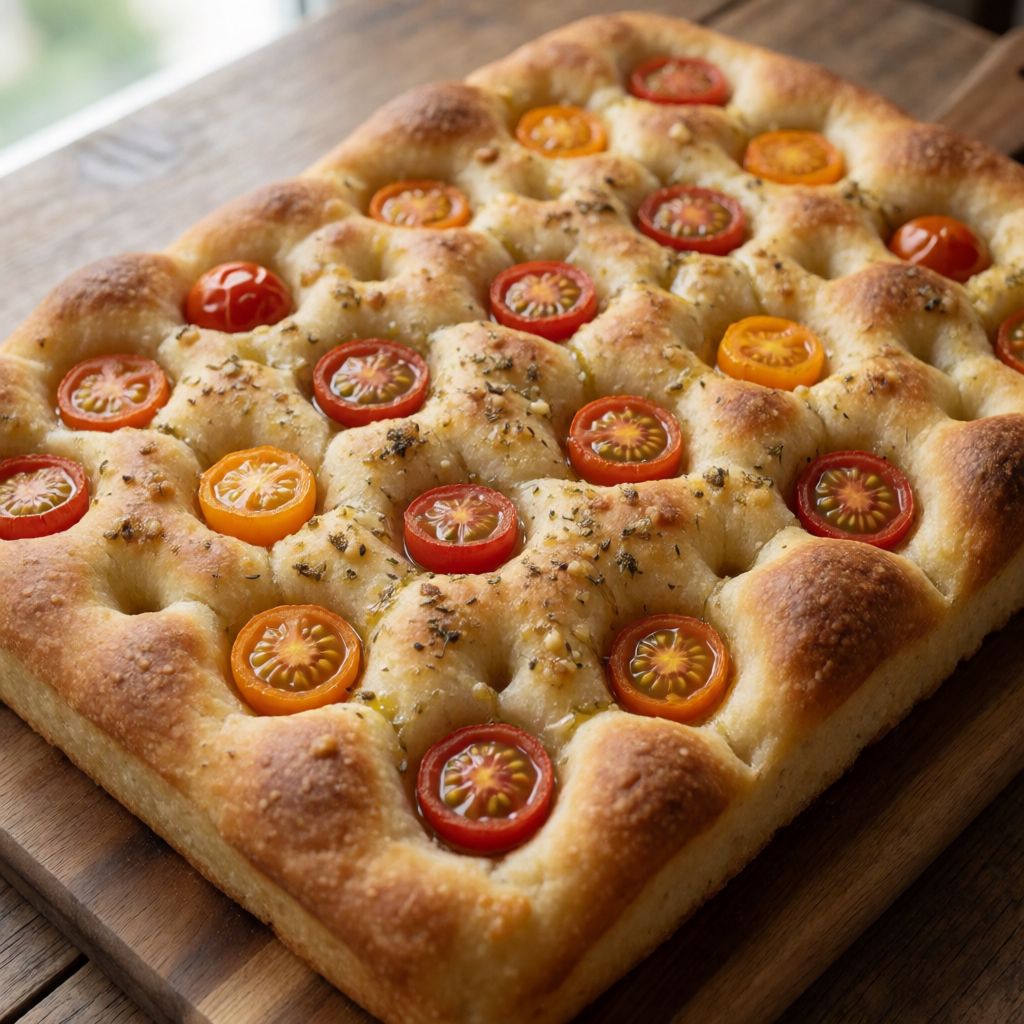
 AI photo
Cold-Fermented Focaccia with Tomatoes and Garlic Oil
A slow, cold-fermented focaccia topped with cherry tomatoes, red onion, rosemary and a garlic olive oil.
Labels are worked out automatically from the ingredients and can be wrong. Check the packaging if it matters to you.
Ingredients
- 350 ml Water
- 10 g Yeast
- 200 g Plain flour
- 200 g Durum flour
- 50 g Wholemeal flour
- 1.5 tsp Salt
- 2 tbsp Olive oil
- 2 clove Garlic crushed
- 100 g Tomato
- 1 pcs Red onion thinly sliced into wedges
- 3 pcs Rosemary sprigs, needles only
- 1 tsp Salt











Steps
Dissolve the yeast in room-temperature water, add the flour and mix briefly to a smooth dough.
Cover the dough and let it rest for autolyse for 45 minutes.
Add the salt and knead the dough on low-medium speed with a mixer for 1-2 minutes, or fold it by hand several times until smooth.
Transfer the dough to a bowl greased with olive oil.
Cover the bowl with a lid or a clean cloth and leave to rise on the counter for 2 hours.
Afterwards, place the dough in the fridge overnight, for at least 8-12 hours.
The next day, take the dough out of the fridge 3 hours before baking.
Let it rest in the bowl for 1 hour, then transfer the dough to a small baking tin or ovenproof dish about 23 x 30 cm.
Wet your hands with cold water and gently stretch the dough so it fills the tin to the edges.
Let the dough rise in the tin for 2 hours in a warm place, until doubled in size.
Make small dimples in the dough with damp fingertips.
Be careful not to press your fingers all the way through to the bottom of the tin.
Mix the olive oil with the crushed garlic until smooth.
Drizzle the dough with this mixture, scatter over the red onion and cherry tomatoes, pressing them lightly into the dough.
Sprinkle with roughly chopped rosemary and flaky salt.
Bake the focaccia in a preheated fan oven at 210°C for about 25 minutes, until the bread is crisp and golden.
Focaccia is not bread with toppings. It's an argument between a wet dough and time, and the dough wins if you let it sit still long enough. This one has three flours doing three different jobs — plain flour for lift, durum for that yellow, slightly waxy chew, wholemeal for the smell of actual wheat underneath the olive oil — and a hydration high enough that you can't knead it on a worktop without swearing. That's deliberate. Wet dough traps steam, steam makes holes, holes are the whole point.
What decides whether it works isn't the oven, it's the night before. Dumping the dough in the fridge for 8-12 hours isn't a storage convenience, it's where the flavour actually gets made: cold slows the yeast right down so instead of racing to produce gas, it has time to produce the sour, bready, slightly nutty compounds that a fast rise never builds. Some say a quick two-hour rise on the counter gives you "the same bread, just faster." No — faster gives you a puffed-up nothing that tastes of yeast and little else. Patience here isn't virtue signalling, it's an ingredient, the same way salt is.
On the flours: plain flour is there for gluten strength and a soft crumb, durum (the stuff semolina pasta is made from) adds body and that faint yellow tint plus a chew that plain flour alone can't give, and wholemeal is for flavour, not structure — it's the bran and germ carrying wheaty, slightly bitter notes that cut through all that olive oil. If you've only got plain flour in the cupboard, use all plain — you lose some chew and colour but the bread still works, because gluten development, not flour pedigree, is what actually holds the air bubbles up.
The autolyse — that 45-minute rest before you even think about salt — exists to let the flour fully hydrate and the gluten start forming on its own, without you doing any work. Skip it and knead straight away, and you'll fight the dough for twice as long to get the same smoothness, because gluten needs water and time together, not muscle. This is also why salt goes in after, not before: salt tightens gluten strands early and slows water absorption, which fights the very thing autolyse is trying to do.
Yeast dissolved in room-temperature water, not warm — hot water doesn't make it rise faster in any useful way, it just risks killing a good chunk of the yeast outright, and you won't notice until the dough sits there sulking. If your kitchen runs cold, give the first 2-hour rise more time rather than warmer water; dough tells you when it's doubled by how it looks and how it springs back when poked, not by a clock.
Garlic oil: crush the garlic rather than mince it, because you want flavour without burnt bitter specks sitting directly on 210°C dough — crushed garlic releases its oil gradually and more evenly into the olive oil, giving you perfume rather than char. Use any olive oil with a flavour you actually like, since this isn't a neutral-oil job — the whole point is you taste it. For the onion, red onion wedges hold their shape and sweeten rather than collapsing to mush, which thin-sliced white onion tends to do under high heat.
On the oven: 210°C fan is hot enough to set the crust and colour the top fast before the inside dries out — focaccia baked too cool stays pale and chewy rather than crisp, because you need that initial blast of heat to turn surface starches golden quickly. A domestic oven running fan at this heat is doing roughly what a stone-floored commercial oven does by brute mass — you're just getting there with moving hot air instead of stored heat, which is honestly fine, just watch the top for colour rather than trusting the dial, because every home oven lies about its actual temperature by a good 10-15 degrees either way.
One for the UK kitchen specifically: a 23×30cm tin is a fairly standard roasting-tin size, so you don't need to buy anything special — if your Sunday roast tin fits that rough footprint, it'll do. Feeds four to six as a side with drinks, fewer if it's dinner on its own with a salad, because once you've tasted the crust everyone goes back for a second piece anyway.