
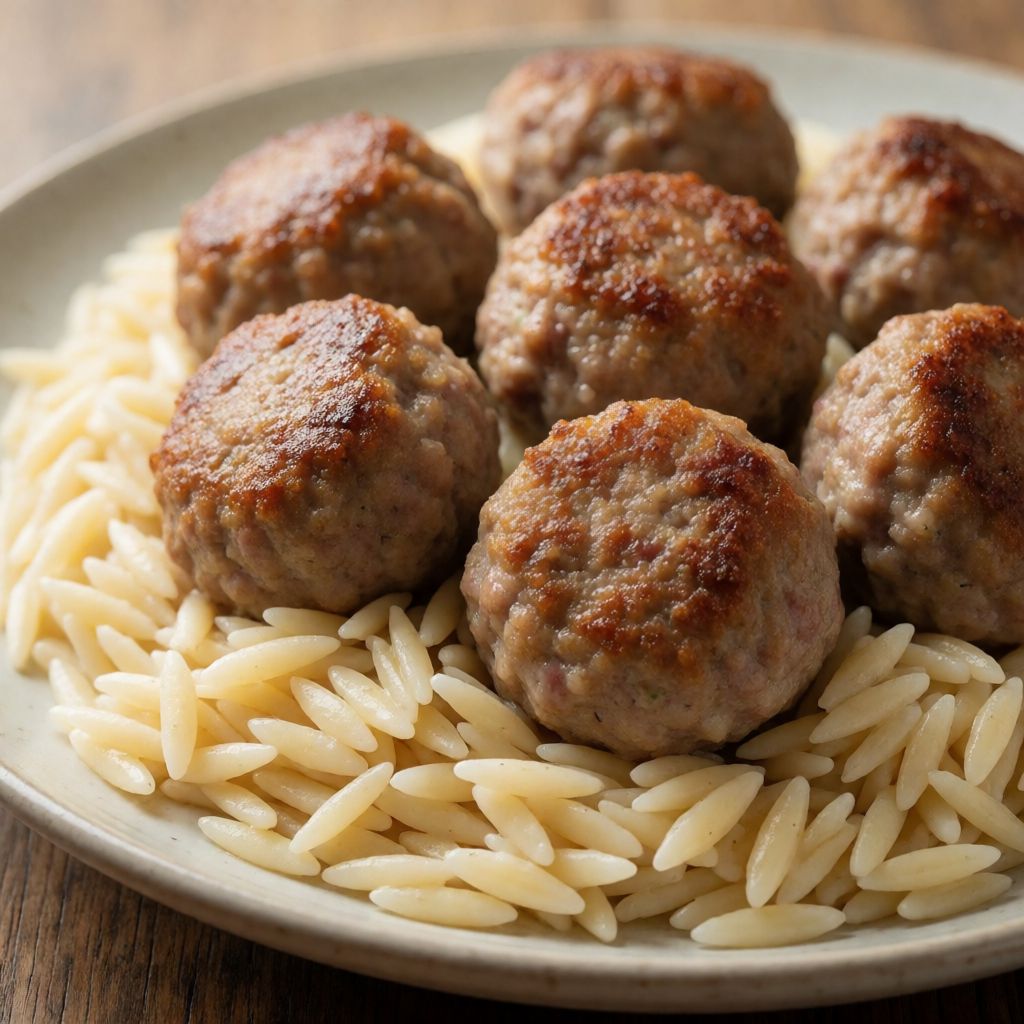
 AI photo
Greek-Style Meatballs with Orzo
Juicy veal and pork meatballs with feta and sun-dried tomatoes, simmered with orzo in a herby tomato sauce.
Labels are worked out automatically from the ingredients and can be wrong. Check the packaging if it matters to you.
Ingredients
- 400 g Veal and pork mince
- 50 g Plain flour
- 50 ml Milk
- 2 pcs Eggs
- 1 pcs Onion finely chopped
- 3 clove Garlic finely chopped
- 50 g Feta crumbled
- 40 g Sun-dried tomatoes finely chopped
- 1 tsp Cumin
- 1 tsp Oregano
- 2 tbsp Olive oil for frying
- 15 g Butter for frying
- Salt
- Black pepper
- 1 pcs Onion finely chopped
- 3 clove Garlic finely chopped
- 50 g Sun-dried tomatoes finely chopped
- 1 pcs Courgette diced small
- 800 g Tinned chopped tomatoes
- 500 ml Stock
- 1 tbsp Dried thyme
- 1 tsp Dried rosemary
- 300 g Orzo pasta
- 150 g Spinach
- 100 g Feta
- 80 g Black olives, pitted
- 1 bunch Oregano fresh, a handful
- 1 tbsp Olive oil for frying




















Steps
Mix the veal and pork mince with the flour, milk, eggs, onion, garlic, feta, sun-dried tomatoes, cumin and oregano. Chill the mixture in the fridge for at least 30 minutes, or longer if possible.
30 minFry the meatballs in a hot pan with olive oil and butter, turning a few times, until evenly rounded and golden brown on all sides. Set aside on a plate.
8 minIn the same pan, fry the onion, garlic and sun-dried tomatoes over medium heat for a few minutes until the onion softens.
5 minAdd the courgette, chopped tomatoes, stock, thyme, rosemary and orzo. Stir, cover and simmer gently until the pasta is tender, stirring occasionally.
15 minStir in the spinach, then top with the meatballs. Sprinkle with feta, add the olives and fresh oregano before serving.
3 min
This is a one-pan meal that does something slightly sly: it cooks a pasta dish and a meatball dish in the same fat, so the sauce ends up tasting of the meatballs you fried ten minutes earlier, and you only wash one pan. That's the whole architecture of the thing. Everything else — the feta, the olives, the cumin in the meat — is detail.
What decides whether it works is the order of fats, not the timer. You brown the meatballs first, in oil and butter, and you leave behind a pan full of caught-on brown bits and rendered fat. That residue is not mess to be rinsed away — it's the start of your sauce. Onion goes in next, into that same fat, and it picks up everything the meat left behind. Skip this and you've made two separate dishes that happen to share a plate; do it right and you've made one dish with a backbone.
The meatballs themselves are held together by an old trick — flour, milk and egg, basically a loose panade — and that's worth understanding rather than just following. Mince on its own, when it hits a hot pan, tightens and weeps water; the panade gives the protein something starchy and soft to set around instead, so the meatball stays tender in the middle while the outside colours. People think a meatball falls apart because there isn't enough egg. Usually it's because there's too little bread or flour relative to meat, or the mixture was never chilled — fix the ratio and the rest, egg included, is doing far less work than you'd think.
Start with the meat. Veal and pork together give you fat content pork alone can be stingy with and leanness veal alone can't buy — veal dries out if it's all you use, pork alone can turn greasy and slightly sweet. If you can't get veal, use all pork mince with a slightly higher fat percentage, or beef mince cut with a bit of pork fat. What you're protecting against either way is a dry meatball, which is really a fat and moisture problem, not a cooking-time problem.
Chilling the mixture for thirty minutes isn't ritual, it's physics: cold fat holds its shape, warm fat smears. A meatball shaped from a mixture straight out of the bowl will slump and spread the second it hits the pan, because the fat in it has gone soft and the panade hasn't had time to bind. Chilling lets everything firm up enough to hold a round shape under heat. Patience here is an ingredient — longer in the fridge, even overnight, only helps.
Feta and sun-dried tomatoes inside the meat mixture are doing a job beyond flavour: feta's saltiness and moisture season from within, so you need less added salt, and sun-dried tomatoes bring an acidity and chew that plain mince doesn't have. If you're out of feta, any firm, salty, crumbly cheese — a mature Lancashire, even a feta substitute — does the same job; a soft, wet cheese like mozzarella won't, it'll just melt and run.
For frying, oil and butter together is a compromise worth knowing: butter alone burns well before the meatballs are browned, because its milk solids scorch at a fairly low temperature, but it gives better colour and a nutty edge than oil alone. Olive oil raises the point at which the fat starts to burn, so the two together let you get real colour on the meatballs without the pan turning bitter and black. Any neutral or mild oil does the same supporting job — you don't need one with flavour of its own here, since the butter's already supplying that. "Medium heat" tells you nothing on a domestic hob, where every ring's medium is a different number — judge it by the pan: hot enough that the meatball sizzles the moment it touches, not so hot that it's spitting and blackening before the inside's had a chance to firm up.
The chopped tomatoes, stock, thyme and rosemary are the sauce's backbone, and the courgette is there to add bulk and a little sweetness without weight — it's the vegetable you drop in when you want volume on the plate without turning this into a stew. Stock rather than water matters because the orzo is cooking in it rather than just being boiled and drained; water gives you bland starch, stock gives you a pasta that's seasoned from the inside.
Spinach goes in right at the end, off heat or just barely on it, because spinach collapses from a full bowl to almost nothing within a minute or two in residual heat — add it with the courgette earlier and you'd have nothing left but a grey smear by the time you serve. The olives, the fresh oregano, the extra feta on top are there raw and unheated on purpose: they're the contrast to a pan that's been simmering for twenty minutes, something sharp and textured against something soft. Don't stir them in and cook them off — scatter them at the table.
This feeds four as a proper main course, the kind of thing that sits next to a Sunday roast in habit if not in style: one pan, everyone served from the middle. If you're feeding fewer, the meatball mixture freezes well raw, shaped and uncooked, better than the finished sauce does — the orzo turns soft and overswollen on reheating, soaking up whatever liquid's left in the pan.