
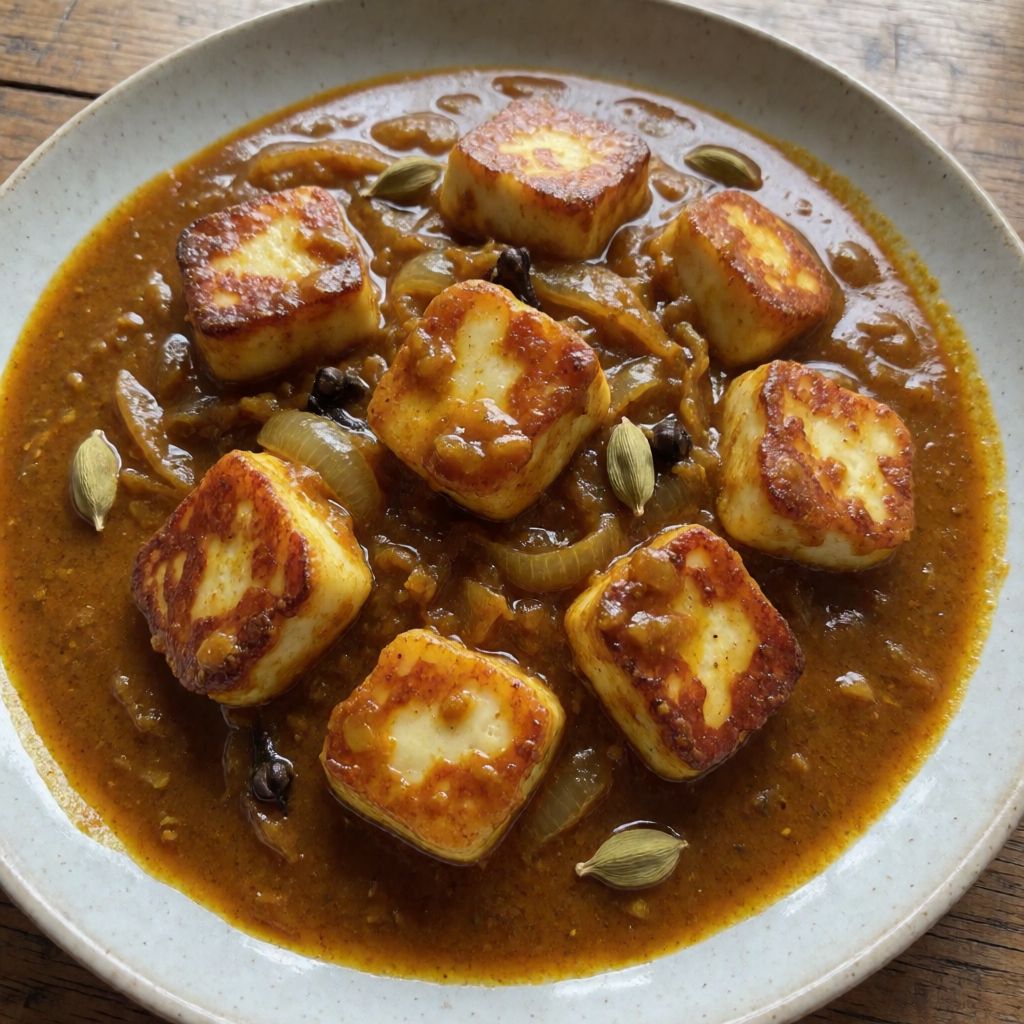
 AI photo
Halloumi Curry
A warming curry with golden-fried halloumi, spinach and basmati rice.
Labels are worked out automatically from the ingredients and can be wrong. Check the packaging if it matters to you.
Ingredients
- 200 g Halloumi diced
- 1 pcs Onion cut into wedges
- 3 clove Garlic finely grated
- 2 tbsp Ginger finely grated
- 1 pinch Cloves dried
- 0.5 tsp Cardamom dried
- 0.5 tsp Chilli flakes
- 1 tbsp Curry powder medium hot
- 400 g Chopped tomatoes canned
- 100 ml Double cream
- 80 g Spinach
- 1 pcs Lime organic, juice and finely grated zest
- Salt
- Black pepper freshly ground
- 300 ml Basmati rice
- 25 g Butter
- 1 tbsp Sesame seeds toasted
- 1 bunch Coriander finely chopped, fresh
- 4 pcs Naan bread
















Steps
Heat a saucepan with oil over medium-high heat and fry the halloumi cubes until nicely golden. Set the halloumi aside on a plate.
3 minPut the onion in the pan, lower the heat slightly and cook until soft.
4 minAdd the garlic, ginger, cloves, cardamom, chilli flakes and curry powder and heat through for a few minutes until fragrant.
2 minAdd the chopped tomatoes to the pan and bring to the boil.
3 minLet it simmer gently for 10 minutes, meanwhile cook the basmati rice.
10 minStir the cream and spinach into the curry, season well with salt, pepper and lime juice.
2 minAdd the fried halloumi cubes and heat through well.
2 minServe the rice with the halloumi curry in deep bowls, place a small knob of butter on top to melt into the sauce. Sprinkle with coriander and sesame seeds and serve with naan or flatbread.
Halloumi curry is a cheat on two traditions at once — it borrows the spice logic of an Indian gravy and plugs in a Cypriot cheese that was never meant to go near a curry pot. It works because halloumi doesn't ask permission from anyone: it's a cheese bred to survive heat, so it can sit in a tomato sauce and hold its shape instead of dissolving into string or grease. That's the whole trick of the dish. Everything else — the onion base, the toasted spices, the cream at the end — is standard curry-gravy mechanics you'd use for chicken or chickpeas.
What decides whether this works is the first three minutes, in the pan, before the sauce exists. You fry the halloumi in dry heat until it goes gold and faintly crusted — not warmed through, coloured. That crust is a wall. Without it, the cheese goes soft and sweats its brine straight into your tomatoes, and you get a curry that tastes like salt water instead of curry. Some say halloumi "doesn't need frying, it's already cooked" — true, it's already edible, but edible and right are different jobs. You're not cooking it, you're building a surface.
Halloumi itself: buy it for salt and resistance to heat, not for taste, because on its own it hasn't got much — it's a carrier. If you can't find halloumi, look for any firm, low-melt cheese that keeps its block shape in a hot pan: paneer is the obvious swap, and it's honestly closer to how Indian kitchens would handle this dish anyway, just with less salt, so taste and adjust later. Don't reach for feta or a soft white cheese — anything that crumbles under a fork will crumble in simmering tomato, and then you've made a tomato-cheese soup, not a curry with cheese in it.
Garlic and ginger go in grated, not chopped, for a practical reason: grating breaks the cell walls properly so the flavour releases into the hot fat within the couple of minutes you've given it, where a rough chop would still be half-raw by the time the tomatoes go in. The dried spices — cloves, cardamom, chilli, curry powder — are there in small amounts on purpose. A pinch of cloves and half a teaspoon of cardamom aren't meant to announce themselves; they sit underneath the curry powder and round its edges off. If your curry powder is a loud one, ease back on the chilli flakes, because you're building one flavour, not stacking five competing ones.
Canned chopped tomatoes are the economical, honest base here — out of season fresh tomatoes in the UK are mostly water and disappointment, and tinned ones were picked and processed ripe, so you get more actual tomato flavour from a tin in February than from a punnet at the supermarket. Simmering them down for ten minutes isn't arbitrary: it's reducing water out, concentrating what's left, so the sauce clings to rice instead of running off it. That's also your free window to get the rice on — not dead time, matched time.
Cream goes in at the end, off the hardest heat, because cream that boils hard can split — the fat separates from the liquid and you get little oily beads floating on a thin sauce instead of one smooth body. Stir it in once things have calmed down and let it just come back to a gentle heat, not a boil. The spinach wilts in that same short window; it needs almost nothing, just enough heat to go from stiff to soft, and if you cook it longer than that you're paying in colour and texture for nothing gained in flavour. Lime at the very end is doing the opposite job of the cream — cutting through the richness it just added, so don't skip it even if you think a curry with cream in it doesn't need acid. It does, maybe more than usual.
Butter melting into the bowl at the table is the same move as finishing any curry or dal with ghee — a last hit of fat and aroma added cold-ish onto a hot dish, so it releases its smell right as you're about to eat rather than having cooked off twenty minutes earlier in the pan. It's a small gesture and it costs you one knob of butter; it's worth doing. Rice, naan, sesame, coriander are all there to carry sauce and add crunch or green freshness against a dish that's otherwise soft textures throughout — don't treat them as optional garnish, they're doing structural work on the plate.
This feeds four as a proper dinner, less if you're serving it alongside something else — think of the portions the way you'd think of a Sunday roast serving: generous, built to fill a bowl, not a starter. Patience here isn't long, but it's specific — three minutes of real colour on the halloumi, two minutes of real smell from the spices, ten minutes of real reduction in the sauce. Rush any one of those and you still get a curry, just not this one.