
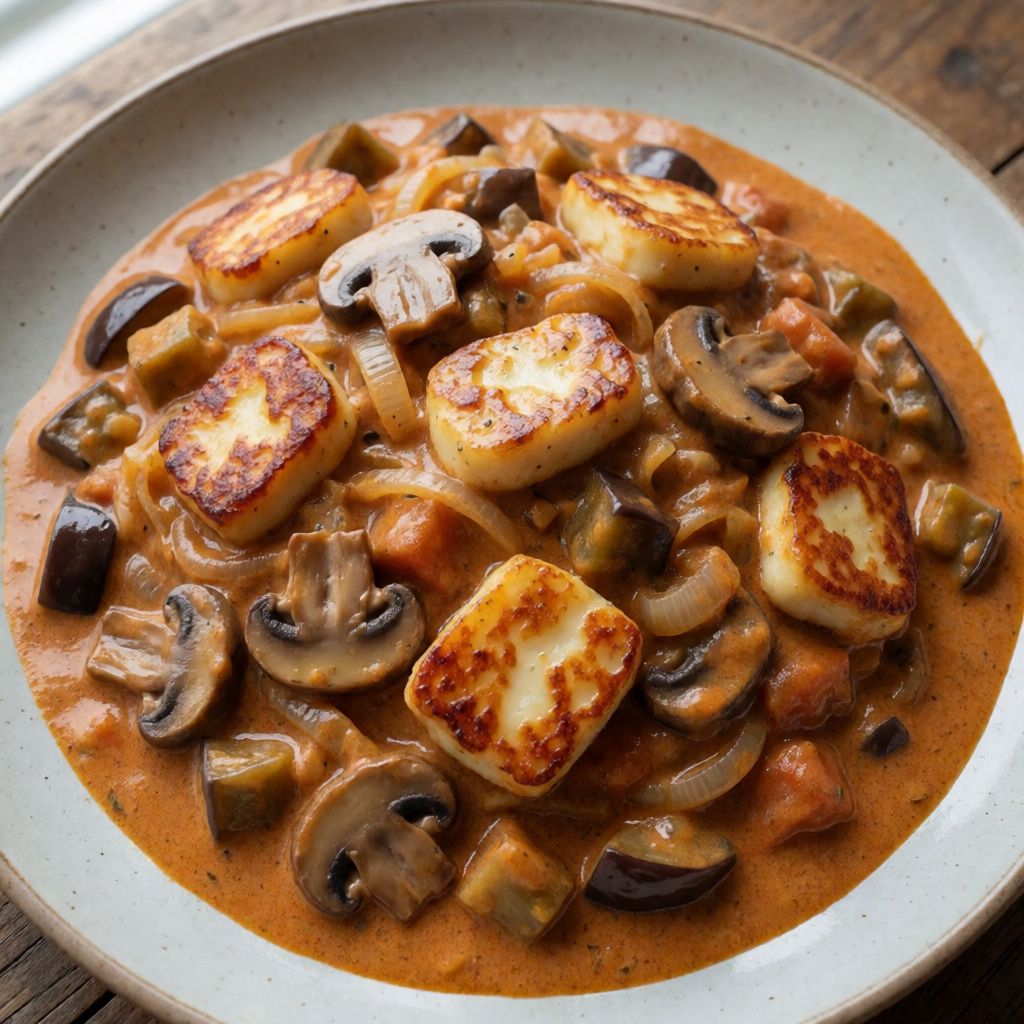
 AI photo
Halloumi Stroganoff with Mashed Potato
A creamy halloumi and mushroom stroganoff, served with buttery mashed potato and cauliflower.
Labels are worked out automatically from the ingredients and can be wrong. Check the packaging if it matters to you.
Ingredients
- 250 g Mushrooms quartered
- 1 pcs Aubergine diced
- 200 g Halloumi diced
- 4 pcs Onion finely chopped
- 2 clove Garlic finely grated
- 40 g Tomato purée
- 1 tbsp Paprika
- 1 tsp Smoked paprika
- 30 g Plain flour
- 200 ml Vegetable stock
- 100 ml Double cream
- 3 pcs Bay leaves
- Salt
- Black pepper freshly ground
- 1 bunch Parsley finely chopped
- 1 kg Potatoes
- 500 g Cauliflower cut into florets
- 100 g Butter
- 150 ml Milk
- 1 pinch Nutmeg
















Steps
Heat some oil in a saucepan and fry the mushrooms over high heat until golden brown. Add the aubergine, halloumi, onion and garlic. Keep frying until the aubergine is also golden.
Mix the tomato purée, paprika, flour and vegetable stock until smooth, stir in the cream and add to the pan along with the bay leaves.
2 minCover with a lid and let it simmer for 15 minutes, meanwhile boil the potatoes and cauliflower for the mash. Add a little more vegetable stock if needed and season with salt and freshly ground black pepper.
15 minMashed potato: boil the potatoes in unsalted water for 10 minutes. Add the cauliflower florets and keep boiling until the potatoes and cauliflower are tender.
9 minMash the potatoes and cauliflower with the butter, then whip with a mixer on low speed. Gradually add the warm milk until the mash is creamy and velvety. Season with salt, pepper and freshly grated nutmeg.
Serve the stroganoff with the mash, sprinkled with parsley leaves.
Stroganoff is a misnomer here and worth admitting straight away. The real Russian dish is beef in a sour-cream sauce, built on the Maillard crust of seared meat deglazed with smetana. This version keeps the gesture — strips of something browned hard, then bathed in a creamy, paprika-dark sauce — and swaps the beef for mushrooms, aubergine and halloumi. That's not a cheat, it's a sensible translation: you need something that browns and holds its shape in a sauce, and all three of those do the job meat used to do, each for a different reason.
What decides whether this works is heat management in the first five minutes. Mushrooms, aubergine and halloumi all carry water or fat that wants to steam rather than fry, and a crowded pan at a half-hearted heat will boil them grey instead of colouring them. So the mushrooms go in first, alone, into a pan that's properly hot — hot enough that a piece set down hisses immediately and doesn't just sit there sweating. Only once they've actually browned do aubergine, halloumi, onion and garlic join. Some say stir constantly so nothing catches — no, because constant stirring is exactly what stops browning: every time you move a piece you interrupt the one spot of contact that was finally getting hot enough to caramelise. Leave it alone longer than feels polite, then turn.
Mushrooms here aren't a vegetable, they're the browning agent that used to be the meat. Quartered, not sliced thin, because a thin slice gives up its moisture and collapses before it ever colours; a quarter has enough mass to hold heat on its cut face long enough to actually caramelise. Any firm, non-watery mushroom works — chestnut, button, even a mix with something wilder if you've got it — but avoid anything already slimy or weeping, because that water is precisely what fights you in the pan.
Aubergine takes the place of the tender, slow-cooked part of the beef. It has almost no structural protein to speak of, so what you're managing is moisture: the flesh is mostly water held in a spongy cell structure, and frying it hard before it ever meets the sauce drives some of that water off and seals the surface, so it holds its cubed shape in a simmering liquid instead of dissolving into mush. Dice it to roughly the same size as the mushroom pieces, not smaller — small pieces vanish entirely under fifteen minutes of simmering.
Halloumi is doing something no component of a real stroganoff does: it's there for a squeak and a chew that survives heat, because it's a curd cheese with enough structural protein cross-linking to resist melting the way mozzarella or cheddar would. That's its whole reason for being on this ingredient list — if you replace it, replace it with something equally heat-stable (paneer is the honest substitute, with less salt and less tang, so season up a touch), never with a soft or fast-melting cheese, which will just disappear into the sauce as grease.
Onion, four of them, finely chopped rather than sliced, because this isn't an onion you want visible in long strands in the finished sauce — it's there to dissolve into sweetness and bulk, cooked alongside everything else rather than given its own slow caramelising time (there isn't room for that here, and it isn't that kind of dish). Garlic grated rather than chopped because grated garlic releases its oils faster and more evenly into a short cooking time — a whole clove bitten into raw would sting; grated and cooked through for a few minutes, it just rounds things out.
Flour whisked into cold stock, never added dry to a hot pan, is the single most important move for avoiding a lumpy sauce — lumps happen when starch granules on the outside of a clump swell and seal before any liquid reaches the dry flour hiding inside. Mixing it into the stock first means every granule is already wet before heat ever touches it. Double cream at the end, off the aggressive heat, because cream with a lower fat content can split if it hits a hard simmer; double cream's higher fat content is more forgiving, which is exactly why it's specified rather than single cream or milk.
Potato and cauliflower together: any potato that mashes floury rather than waxy (Maris Piper, King Edward — the ones your gran used for a Sunday roast) gives you the actual mash texture; a waxy potato like a new potato will go gluey under a mixer, because it's built to hold its shape, not surrender it. Butter goes in before the milk, worked through while the potato is still hot enough to take it in, because butter folded into a cooling mash sits as streaks instead of marrying in. The milk is added warm, gradually, for the same reason you temper eggs into a hot custard rather than dumping them in — a cold liquid hitting hot starch can seize it up into something gluey rather than silky, so warm it first and add it in stages, watching the texture rather than following a fixed amount. Some say add the milk cold to save a saucepan — no, because that's the step where a smooth mash turns gluey, and no amount of vigorous mixing afterward fully undoes it.
Bay leaves are a patience ingredient more than a flavour one — fifteen minutes of gentle simmer is roughly what it takes for their oils to actually migrate into a liquid; thrown in for five minutes they're doing almost nothing except sitting there looking traditional. Fish them out before serving, obviously — nobody wants to bite into a stiff bay leaf and wonder what went wrong with the dish.