
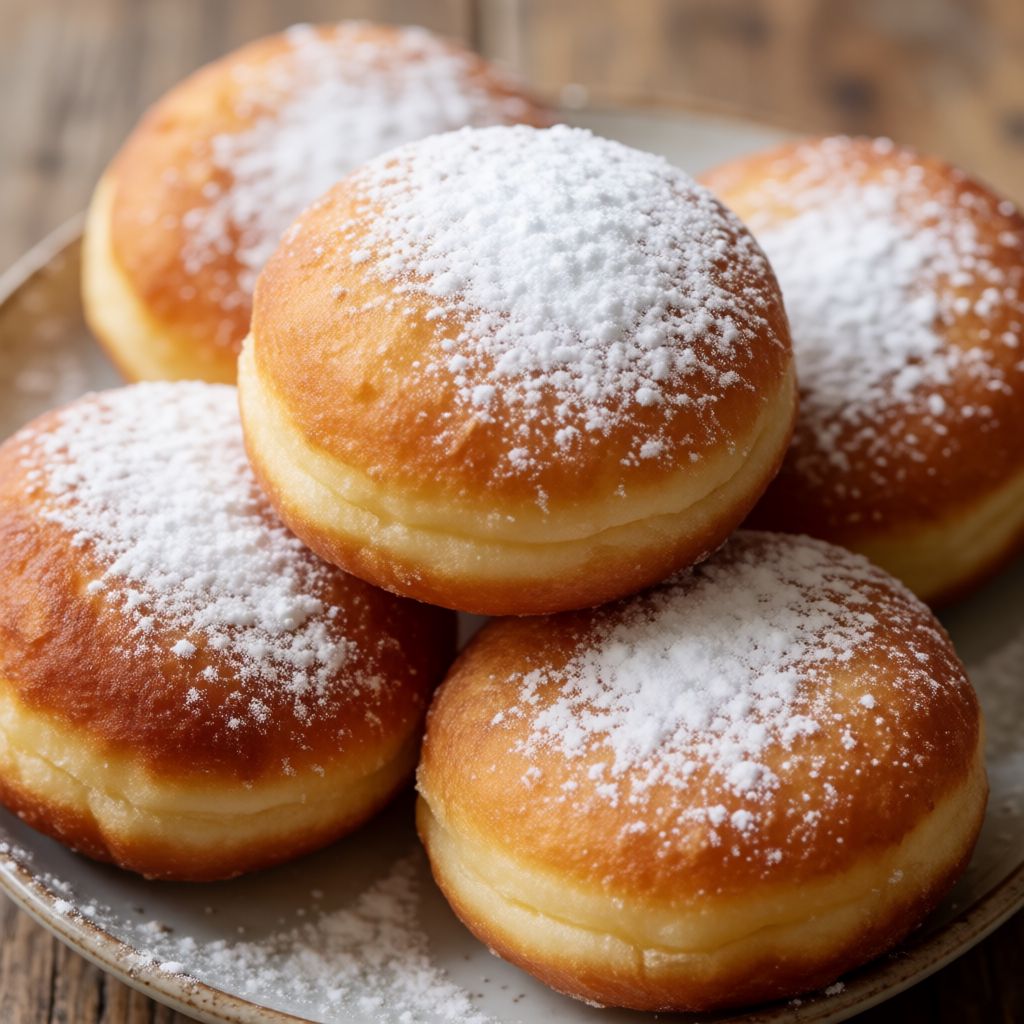
 AI photo
Krapfen (Italian Doughnuts)
Soft, airy fried doughnuts filled with Nutella, jam or pastry cream — a beloved sweet treat.
Labels are worked out automatically from the ingredients and can be wrong. Check the packaging if it matters to you.
Ingredients
- 250 g strong white flour
- 2 pcs eggs
- 80 g milk warm
- 25 g caster sugar
- 10 g yeast
- 50 g butter
- 1 pcs lemon zest
- 1 pinch salt
- peanut oil or corn oil, to taste, for frying
- Nutella to taste
- jam to taste
- pastry cream to taste
- icing sugar for dusting










Steps
Knead the strong white flour with the caster sugar and lemon zest by hand or in a stand mixer. Add the eggs and the warm milk with the yeast dissolved in it. Work until you have a smooth, non-sticky dough.
Add the salt and work in the butter in small pieces, waiting for each piece to be absorbed before adding the next, until the dough is smooth and glossy.
Shape the dough into a ball on the work surface and let it rise in a warm place until doubled in size.
Gently turn the dough out onto the work surface, roll it out and cut circles about 7 cm in diameter.
Place the dough circles on a sheet of baking paper, leaving a few centimetres between them, and let them rise for a further 45 minutes.
45 minCut a small square of paper around each doughnut and fry two or three at a time in hot oil, removing the baking paper as soon as they go in.
Turn the doughnuts carefully so they brown evenly, without burning, and cook through inside.
Place the cooked doughnuts on a paper towel to drain excess fat, and let them cool.
Once the doughnuts have cooled, fill them as you like with Nutella, jam or pastry cream using a piping bag.
Dust with a little icing sugar and serve.
A krapfen is a brioche-style yeast dough, fried instead of baked, then stuffed once it's cool. Think of it as a doughnut that spent its childhood being treated like bread: slow rise, soft crumb, butter worked in late. What decides whether it works isn't the frying — it's everything before the frying. If the dough hasn't properly doubled twice, you get a dense, oily lump no amount of Nutella can rescue.
Some say a doughnut needs to be a doughnut shape, hole in the middle, to fry evenly. No — krapfen are solid discs, and that's the point: the hole exists on ring doughnuts so a thick centre doesn't stay raw while the edges burn. Here you're frying something closer to a small bread roll, thin enough through its 7cm width that the heat gets to the middle before the outside scorches. That's also why you fry two or three at a time, not a potful: crowd the oil and it drops in temperature, and a dropped temperature means the dough sits soaking up fat instead of sealing fast.
The baking paper trick under each piece isn't fussiness. This dough has had two rises already and is fragile — pick it up with your fingers to transfer it to oil and you deflate it, squashing out the air you spent two hours building. Slide it in on its own paper square, peel the paper off a few seconds later once the underside has set. That's a workaround for not having the flat peel or wide fryer a proper pasticceria uses — in your kitchen, baking paper is the peel.
Strong white flour, not plain, because this dough needs to hold gas through two long proves without collapsing — the higher protein gives it the backbone. If you've only got plain flour, you can still get there, but the rise will be slower and the crumb a touch more delicate; don't expect the same chew.
The yeast dissolving in warm milk — "warm" meaning you can hold your finger in it comfortably, not hot enough to sting — is doing a specific job: waking the yeast up before it ever meets the flour, so it's already active rather than starting cold. Milk too hot and you kill it outright, which is the real reason behind "always use warm liquid," not some fixed ritual number.
Butter goes in late and in small pieces, each one absorbed before the next arrives, because butter coats gluten strands and makes it harder for them to stick to each other. Add it all at once to an unformed dough and you get a slick, slack mess that never develops structure — add it to dough that's already built some gluten, bit by bit, and the fat works with the structure instead of against it. This is also where the "glossy, smooth" cue in the method is the real doneness signal — not a clock.
Lemon zest is there for scent, not acidity — it cuts the heaviness of egg and butter without adding sourness. If you haven't got a lemon, orange zest does similar work; vanilla is a different flavour but a reasonable stand-in if citrus isn't to hand.
For frying oil, the criterion is simple: no smell or taste of its own, because you don't want the oil competing with the crumb or the filling. Peanut and corn oil both qualify; in a British kitchen, a mild sunflower or vegetable oil does the same job. Don't reach for olive oil here — it has a voice, and it'll talk over the lemon zest.
The two rises are where patience earns its place as an ingredient, not decoration. The first proves the raw dough; the second, after shaping, proves the individual pieces so they puff rather than stay squat once they hit the oil. Rush either one in a cold British kitchen — and most flats are cooler than a bakery's proving cupboard — and you'll fry dense discs that fill fine but eat heavy. A turned-off oven with the light on, or a spot near (not on) a radiator, is your realistic "warm place."
Filling is genuinely to taste, and that's economics as much as flavour: Italian pasticcerie filled krapfen with whatever they had running cheap that week — jam when fruit was in, custard when eggs and milk were cheap, chocolate-hazelnut once Nutella existed as an industrial way to stretch expensive cocoa with cheap hazelnut paste during postwar shortages. There's no correct filling, only what's in your cupboard and what you fancy with your tea.