
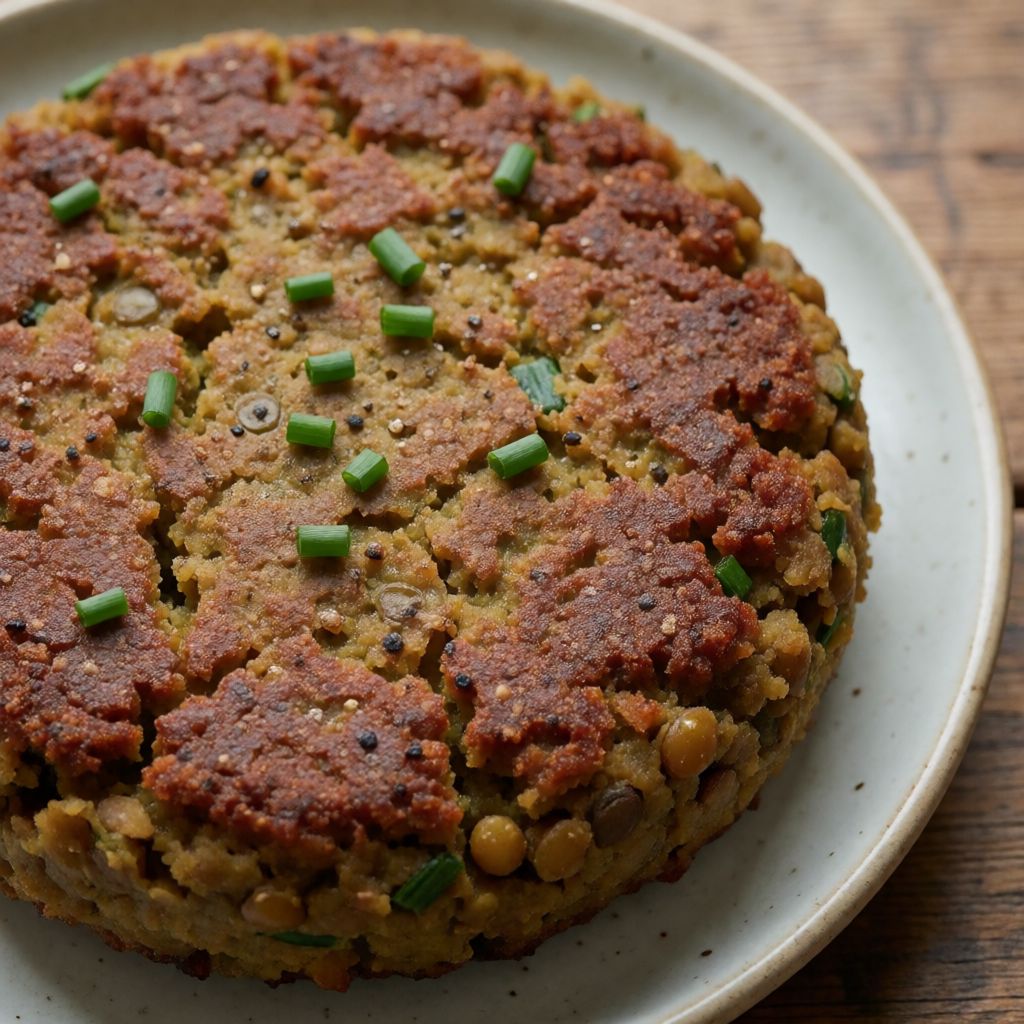
 AI photo
Vegetarian Lentil Burger
A hearty vegetarian lentil burger, topped with melted cheese, lettuce and tomato in a soft bun.
Labels are worked out automatically from the ingredients and can be wrong. Check the packaging if it matters to you.
Ingredients
- 300 g Lentils dried (or 400 g canned)
- 70 g Bread crumb crumbled
- 1 pcs Egg
- 1 tsp Chives
- Salt to taste
- Black pepper to taste
- Olive oil to taste
- Paprika to taste
- 4 pcs Burger bun
- 1 pcs Tomato
- 4 pcs Mature cheddar slices
- Lettuce to taste












Steps
Soak the dried lentils in cold water for at least 2 hours (up to 12 hours is fine).
120 minDrain and simmer the lentils in unsalted water until soft; season with salt only at the end.
Transfer the lentils to a blender, add the egg, crumbled bread and chives.
Blend until smooth, then add paprika, black pepper and salt, and mix well.
Divide the mixture into four portions and shape into flat, round patties.
Fry the patties in a pan with olive oil until golden on both sides.
Split the buns, add a slice of cheddar, lettuce, the hot patty and tomato.
Cover with the top half of the bun and serve the burger immediately.
What was changed
The processed cheese was swapped for Mature cheddar slices, as British shoppers typically choose mature cheddar for burgers.
A lentil burger is not a meat burger with the meat removed. It's its own structural problem: lentils have no muscle fibre, no fat, nothing that holds together when heat hits it. Everything in this recipe exists to solve that one problem — binding a mash of pulses into something that survives a spatula.
What decides whether this works is moisture control at two separate points. First, how dry the cooked lentils are before they meet the egg and breadcrumb — too wet, and no amount of binder saves you, the patty just slumps into the pan and spreads like porridge. Second, how hot the pan is when the patty goes in. A cold-ish pan means the patty sits and steams instead of taking a crust, and a crustless lentil cake is a sad, crumbly thing that falls apart on the way to the bun.
Some say lentil burgers are inherently fragile, that's just what they are — no. Fragile lentil burgers are badly drained lentil burgers. The fix isn't more egg, it's less water going in before the egg ever gets a say.
Soaking the lentils for two hours is the quiet, unglamorous step that nobody photographs, but it's doing real work: it shortens the cooking time and evens it out, so you get lentils that collapse into tenderness together rather than some grains still bullet-hard while others have gone to mush. Patience is the actual ingredient here — skip the soak and you either undercook some lentils or overcook the rest trying to catch up.
Lentils, dried versus canned: dried gives you control over texture and starch, because you cook them yourself down to exactly how soft you want. Canned is the shortcut — rinse them well, because the canning liquid carries a tinny, slightly bitter taste you don't want in the patty, and they're already soft, so there's no soaking, no simmering, straight to the blender. Either way, the lentils need to end up properly tender, not al dente — a lentil with bite left in it won't bind, it'll just sit there as a hard little lump inside a patty that's trying to be smooth.
The egg is the binder in the strict sense — its protein sets with heat and glues the mash together, the way it does in any meatball or fishcake. If you need it eggless, you're not looking for a magic swap, you're looking for anything that behaves the same way when heated: a flax egg (ground flaxseed and water, left to thicken) or a bit more breadcrumb with a spoonful of water worked in by hand. The criterion is "sets and holds," not "is an egg."
Breadcrumb does two jobs at once: it soaks up any spare moisture the lentils are still carrying, and it gives the mash some structure that isn't mush. Any dry, bland crumb does this — stale white bread grated down works as well as the bought kind, and it's cheaper, which is the honest reason breadcrumbs show up in so many British kitchens to begin with: using up bread that's gone past its best, not culinary tradition for its own sake.
Paprika and black pepper aren't decoration — lentils are mild to the point of blankness, and without something with a bit of smoke or heat in it, the patty tastes of nothing but "beige." Salt goes in at the end of cooking the lentils, not the start, because salting pulses too early toughens their skins and slows how fast they soften — an old cook's habit that's actually just chemistry, not superstition.
Olive oil for frying: you want an oil you can heat without it smoking and complaining, and without it fighting the paprika for flavour. Any neutral oil with a reasonably high smoke point does the job — sunflower, rapeseed, whatever's in the cupboard. "Olive oil" here is a default, not a commandment.
The build — bun, cheddar, lettuce, hot patty, tomato, bun — has an order for a reason: cheddar goes under the patty so the heat of it just starts to soften the cheese without you having to do anything extra, lettuce sits below that as a barrier so the bun doesn't go soggy from any juice, and the tomato goes on top of the hot patty rather than under it so it doesn't steam and go limp before you've even taken a bite. In a UK kitchen you've already got a grill pan or a wide frying pan standing in for a flat griddle, and that's fine — there's no magic in a dedicated burger press, just a flat heavy pan and the nerve to leave the patty alone long enough to actually brown before you flip it.