
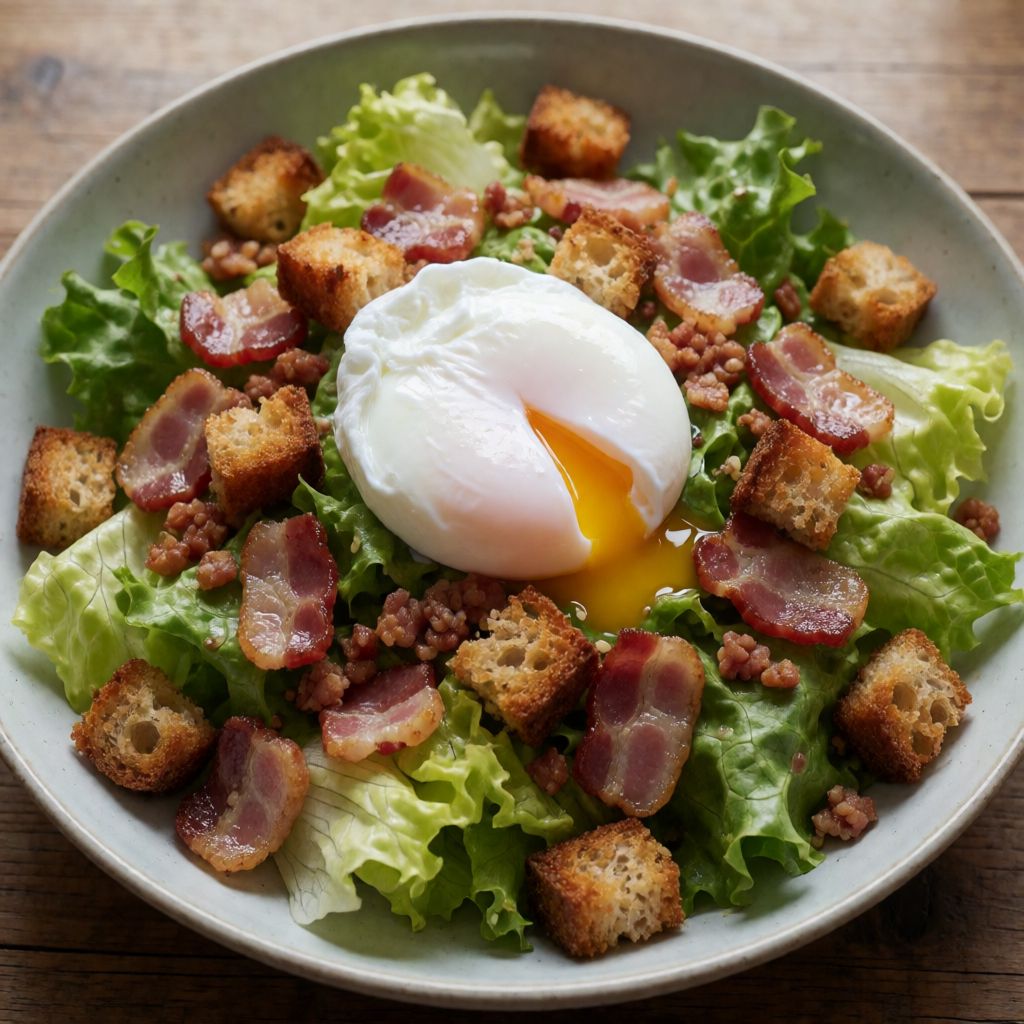
 AI photo
Lyonnaise Salad
A classic Lyonnaise salad with crisp bacon, poached eggs and garlicky croutons.
Labels are worked out automatically from the ingredients and can be wrong. Check the packaging if it matters to you.
Ingredients
- 3 pcs Bacon rashers, cooked until crisp
- 2 pcs Bread slices, e.g. a rustic loaf
- 1 clove Garlic crushed
- 1 tsp Butter
- 4 pcs Eggs
- 2 tbsp Apple cider vinegar
- 125 g Salad mix
- 125 g Rocket
- 100 ml Chives finely chopped
- 1 bunch Watercress
- Salt
- Black pepper freshly ground






For the dressing
- 2 tbsp Mayonnaise
- 1 tsp Dijon mustard
- 1 tsp Honey
- 1 clove Garlic finely chopped
- Salt
- Black pepper freshly ground


Steps
Fry the bacon rashers in a dry pan until crisp.
3 minRub a slice of bread with garlic and spread both sides thinly with butter. Fry the bread in the bacon fat until crisp on both sides. Remove from the heat, cut into rough cubes and season with salt and pepper.
Bring a pan of water to the boil. Crack each egg into a separate small bowl. Once the water is boiling, add the apple cider vinegar and remove the pan from the heat.
5 minUse a spoon or whisk to create a whirlpool in the water. Pour the egg into the centre of the whirlpool and return the pan to the heat.
3 minCook for about 3 minutes, then carefully lift the poached egg out with a slotted spoon and place on a plate. Repeat with the remaining eggs.
3 minArrange the salad mix and rocket on plates or a large platter.
Drizzle the dressing in stripes, sprinkle with the finely chopped bacon and croutons, top with the poached eggs and garnish with chives and watercress.
Dressing: mix all the dressing ingredients together and season with salt and pepper to taste.
2 min
Lyonnaise salad is a working lunch dressed up as elegance — bitter leaves, bacon fat, a poached egg that bleeds yolk into everything the moment you cut it. It comes from Lyon, a city of silk weavers and market traders who needed food that was cheap, fast, and filling between shifts. The egg isn't garnish, it's the sauce. Cut into it and the yolk does what a vinaigrette can't: coats the leaves in something rich and warm.
What decides whether this works is the egg and the fat, in that order. A poached egg with a soft, flowing centre needs a white tight enough to hold its shape and a yolk loose enough to run — that's the whole job of the vinegar and the whirlpool. Bacon fat used while it's still hot, to fry the bread and rub the pan, is what gives the croutons and the finished plate their backbone; let that fat go cold and you've got grease instead of flavour.
Some say you need a kazan-deep pot and a proper poaching basket for a clean egg. No — you need fresh eggs and water just under a boil, nothing more. A domestic hob gives you everything this dish asks for: one pan for bacon, the same pan for bread, a second pan of water for the eggs. No special kit, just sequence — fat first, bread second, eggs last, because the pan stays hot longer than you think and a cold pan is where soggy croutons come from.
Feeds four as a starter, two as a proper lunch with bread on the side. It's not a dish you rush — the eggs alone ask for your full attention for the few minutes they're in the water, because a distracted poach is a ragged, stringy poach, not a neat one.
Start with the bacon, because everything else in this dish borrows from it. You fry it dry — no oil — because bacon carries its own fat, and adding more just dilutes what you're trying to extract. The streaky, smoked kind is traditional in a British kitchen and it's not sentiment: smoked bacon renders a fat with more flavour in it than unsmoked, so the bread and the dressing both taste of something, not just salt and crisp. If you only have back bacon, fine, it'll crisp differently — thinner, less fat rendered — so fry the bread in a little butter alongside it rather than relying on fat that isn't there.
The bread wants to be rustic — open crumb, a bit of chew — because a soft sandwich loaf collapses into crumbs in hot fat instead of holding a crust. Rubbing it with raw garlic first, not cooking the garlic in, is an old trick: raw garlic rubbed onto a porous surface leaves its oil and smell behind without burning, and burnt garlic is bitter in a way that no amount of seasoning fixes. The butter on top is there for browning — fat conducts heat into the bread's surface faster than the bread's own moisture can, which is the entire difference between "toasted" and "fried crisp."
The eggs are the mechanism of the whole dish, so take the vinegar and the whirlpool seriously. Vinegar lowers the pH of the poaching water, which makes the egg white firm up faster — that's what stops it trailing off into wisps the moment it hits the water. Apple cider vinegar is specified for its mildness; any vinegar does the chemistry, but a sharp white vinegar will leave a taste you can detect in the finished egg, so use what smells the gentlest. The whirlpool isn't a flourish — spinning water wraps the white around the yolk as it sets, instead of letting it spread flat across the pan. Some say you need a splash of boiling, roiling water for a poached egg — no, because a violent boil tears the white apart before it's had a chance to set; just off the boil is exactly where you want it, water trembling, not thrashing.
Crack each egg into its own small bowl before it goes anywhere near the water. This isn't fussiness — it's insurance against a weak or old egg, which spreads into watery threads the second it touches heat, ruining the pan for the eggs that follow it. A bowl lets you see the egg and decide, calmly, whether it's good enough to go in.
For the dressing, mayonnaise and mustard do the same job from different directions: mayonnaise carries fat and body, mustard carries sharpness and helps bind the oil-and-vinegar components so they don't separate on the plate. Honey is there to round off the mustard's heat, not to sweeten the salad — use it sparingly, a thin stream, not a spoonful dolloped in. If you don't have Dijon, any mustard with real bite works; yellow American mustard is too mild and too sweet already, so you'd need to drop the honey.
Rocket and watercress earn their place by contrast — both carry a peppery bitterness that a mild salad mix alone can't give you, and that bitterness is what keeps the rich bacon fat and egg yolk from feeling heavy on the tongue. If you can't get watercress, baby spinach with an extra pinch of mustard in the dressing gets you partway there, though it's a stand-in, not a swap with the same character. Chives go on last and raw, because any heat at all turns their sharp onion snap into something flat and grassy — they're there for a clean, fresh bite against all that fat.