
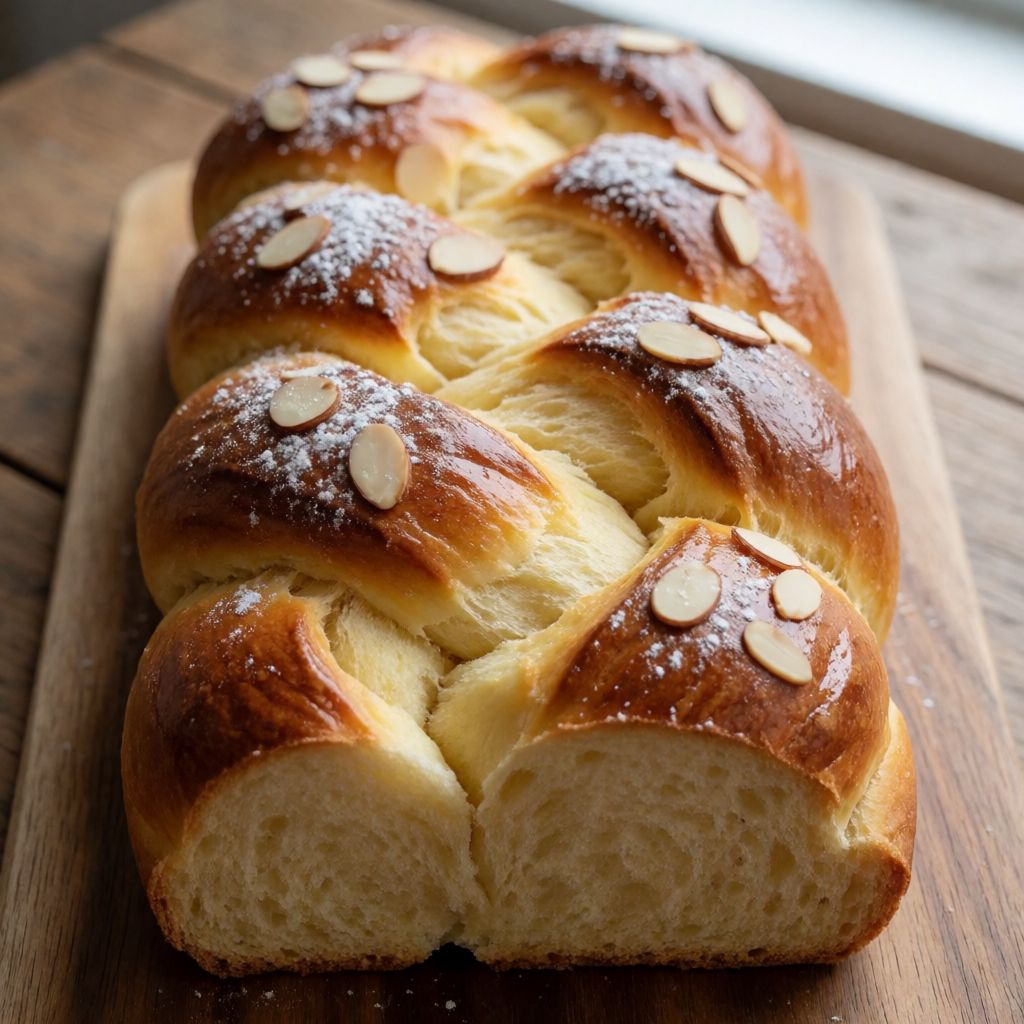
 AI photo
Christmas Plaited Marzipan Bread
A festive plaited yeast bread filled with marzipan, warm spices and raisins, perfect for Christmas.
Labels are worked out automatically from the ingredients and can be wrong. Check the packaging if it matters to you.
Ingredients
- 50 ml Milk warmed to 30°C
- 15 g Yeast
- 125 g Butter soft, room temperature
- 1 tbsp Caster sugar
- 2 pcs Eggs
- ½ tsp Salt
- 250 g Plain flour
- 100 g Marzipan
- 75 g Butter soft, room temperature
- 75 g Caster sugar
- ½ tsp Cardamom ground
- ½ tsp Cloves ground
- ½ tsp Cinnamon ground
- 1 pcs Orange organic, finely grated zest
- 100 g Raisins
- 50 g Almonds blanched and flaked
- 1 pcs Egg beaten, for glazing
- 2 tbsp Pearl sugar for sprinkling















Steps
Pour the milk into a bowl and stir in the yeast. Add the butter, sugar, eggs, salt and about half of the flour. Mix the dough well until smooth, then add the remaining flour and knead until soft and elastic.
Leave the dough to rise on the worktop for about 30 minutes in a clean bowl covered with a tea towel.
For the marzipan filling, mix the butter, sugar, marzipan, cardamom, cloves, finely grated orange zest and cinnamon in another bowl until smooth.
To shape the plait, roll out the dough on a lightly floured surface into an elongated rectangle.
Spread the filling down the centre of the dough and sprinkle generously with raisins and almonds.
Cut the sides of the dough into strips and plait them over the centre along the whole length, so the plait closes neatly.
Finally, shape the dough into a ring or wreath shape.
Place the plait on a baking tray lined with baking paper, brush with the beaten egg and sprinkle generously with pearl sugar.
Let the Christmas plait prove for 20 minutes.
Bake in a preheated fan oven at 180°C for 16–20 minutes.
This is enriched dough doing two jobs at once: it has to be soft enough to tear apart in warm, buttery layers, and strong enough to hold a plait shape through a second rise and a hot oven without collapsing into a flat slab. That tension is the whole recipe. Everything else — the marzipan, the spices, the fruit — is what you wrap inside once the dough itself is right.
What decides whether it works is gluten development against fat content. Butter and egg yolk coat flour proteins and slow down gluten formation — that's why this dough takes real kneading, not the five minutes you'd give a lean bread dough, to go from shaggy to smooth and elastic. Stop too early and the dough won't hold the plait edges once you cut strips and fold them; it'll just slump and the filling will ooze out at every seam.
Some say an enriched Christmas dough needs a long cold prove overnight to "develop flavour" — no, because the yeast here is working against sugar, salt and fat all pulling water away from it; it needs warmth and time, not refrigeration, or it simply won't lift. Thirty minutes on the counter, covered so a skin doesn't form and crack later when you roll it out, is the lower bound — what you're watching for is the dough visibly doubling and holding a dent when you press a finger in without springing straight back.
Marzipan here isn't a flavour so much as a moisture reservoir. Almond paste is mostly ground almonds and sugar bound with a little liquid, and when it's creamed with butter and warm orange zest it turns into a filling that stays soft rather than drying into a seam of sugar as it bakes — that's the defect it prevents: a hard caramelised line running through the bread where plain sugar and spice would have been. Buy the kind with a high almond content (look for 50% or more) — cheap marzipan padded out with more sugar than almond will scorch and turn sticky rather than melt into the dough. If you can't get marzipan at all, almond paste worked loose with a spoonful of ground almonds and a touch of egg white gets you close; ground almonds and icing sugar creamed with the butter is a rougher but workable stand-in.
The spice mix — cardamom, clove, cinnamon — is doing what spice always did in European Christmas baking before refrigeration: these were the preservatives and the luxury markers both, warming oils that also happened to mask a dough that might sit around the house for days over the holidays. You're using them now purely for smell and warmth, so grind your own cardamom pods if you can — pre-ground cardamom loses its top note within weeks on a shelf, and cardamom is the spice doing the most work here, not the cinnamon.
Raisins and flaked almonds are there for contrast of texture, not just flavour — soft dough, chewy fruit, a crack of toasted almond. If your raisins are old and leathery, soak them in warm water or orange juice for ten minutes first and pat dry; dry raisins pull moisture straight out of the dough around them as they bake, leaving little dry pockets. Any dried fruit that holds its shape under heat works in their place — sultanas, chopped dried apricot, even candied orange peel, which would actually echo the zest already in the filling.
Yeast at 15g fresh is a lot for 250g flour, which tells you this dough is built to rise fast against a heavy load of butter, sugar and egg rather than slowly for flavour. If you've only got dried yeast, use roughly a third of that weight and still bloom it in the warmed milk first — 30°C is blood-warm, hand-warm, not hot; above about 40°C you start killing the yeast rather than waking it, which is the real reason recipes keep insisting you don't just boil the kettle and guess.
On an ordinary hob kitchen, "plaiting over a centre, then into a ring" is more fiddly on a small worktop than the instructions let on — give yourself the full width of a baking tray laid out before you cut the strips, because once you start folding you need both hands free and nowhere to put things down except the tray itself. A fan oven at 180°C is doing a specific job here: strong enough heat to set the egg wash into a shine and bake the inside through in under twenty minutes, but not so fierce that the honeycomb pearl sugar on top burns before the crumb cooks — if your oven runs hot, pull it a shade earlier and check doneness by weight in your hand and a hollow sound underneath, not by the clock.
Patience is the one ingredient not listed. Rushing either prove gets you a dense ring that looks the part and eats like a brick; the dough wants two slow stretches of time it can't be talked out of, and that's really the whole secret of this one.