
 AI photo
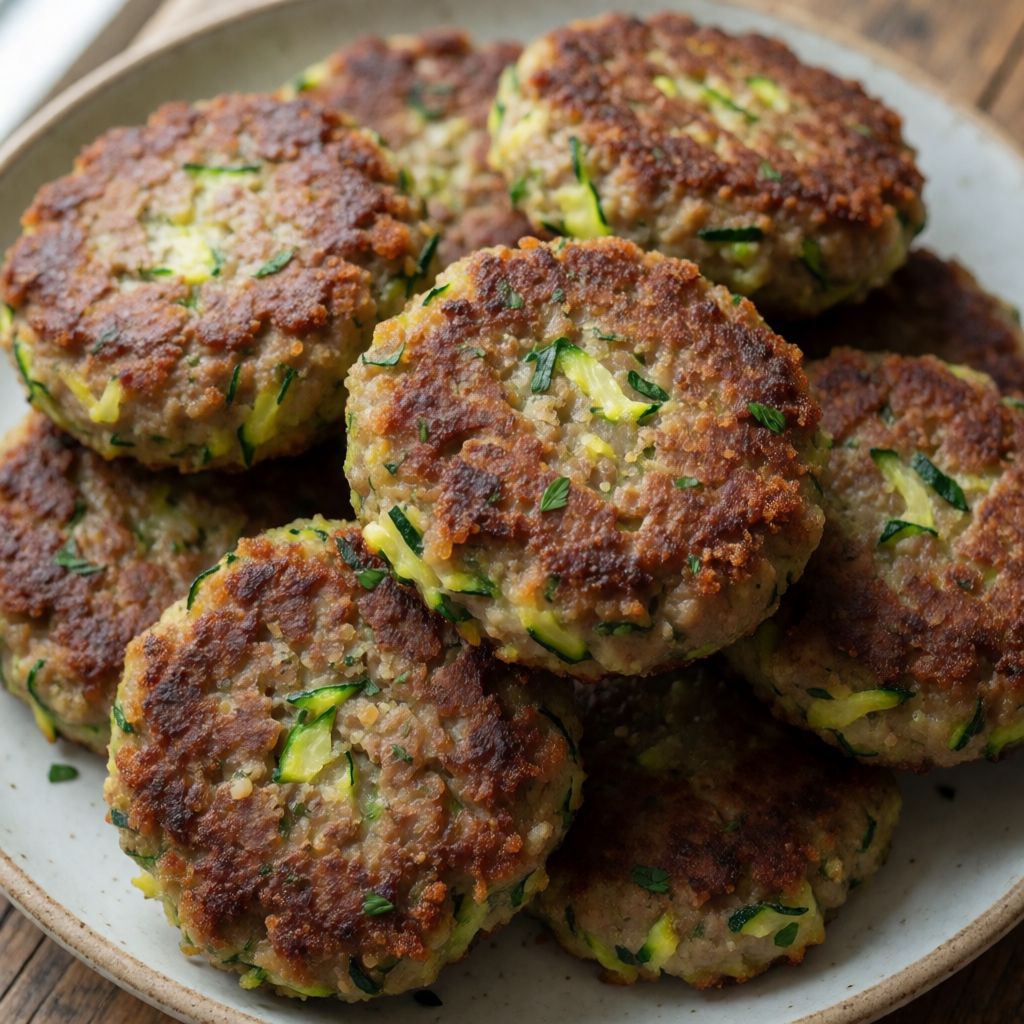
Beef and Courgette Patties
Home-style patties of minced beef and courgette, bound with soft breadcrumb soaked in milk, with pine nuts, pan-fried until golden.
Labels are worked out automatically from the ingredients and can be wrong. Check the packaging if it matters to you.
Ingredients
- 600 g Minced beef
- 2 pcs Courgette
- 2 pcs Eggs
- 150 g Soft breadcrumb soaked in milk
- 1 clove Garlic crushed
- 1 bunch Parsley
- Salt to taste
- Black pepper to taste
- 20 g Pine nuts
- Vegetable oil for frying
- Plain flour for coating
- Olive oil for serving
- Lettuce to taste











Steps
In a large bowl, combine the raw minced beef with the soft breadcrumb soaked in milk, mixing with a fork.
5 minAdd grated courgette, eggs, crushed garlic, parsley, salt and black pepper, and keep mixing well.
5 minAdd the pine nuts and mix all the ingredients until smooth.
2 minShape into patties and coat them in flour.
5 minHeat the vegetable oil in a frying pan and fry the patties on one side, then the other, until golden brown.
15 minCheck that the mince is fully cooked through — the internal temperature should be at least 71°C.
Place the cooked patties on paper towels to remove excess oil.
Serve with a little lettuce, salt and olive oil.
What was changed
Peanut oil was replaced with Vegetable oil, as vegetable oil is the more usual frying oil in a British kitchen.
This is a meatball that's been talked out of being watery and talked into holding its shape without going dense — a courgette carries most of the water weight a beef patty would otherwise lose into the pan, and bread soaked in milk carries the rest, binding instead of draining. What decides whether it works isn't the beef, it's the moisture management: too much grated courgette left unsqueezed and the mix won't hold a shape at all, it'll spread in the pan like a fried egg gone wrong.
People think mince patties need to be lean to be "proper" — no, because fat is what lets heat move through the meat without drying it to sawdust. The soaked bread does similar work from a different angle: it's not filler, it's a sponge that holds moisture inside the patty while the outside gets a crust. Skip it and you get a hard little hockey puck by the time the centre's safe to eat.
The flour coating earns its place for one reason — it seals the surface fast, before the meat juices can leak out and turn to steam that fights the browning. That's the difference between a patty that goes golden and one that stays grey and sweats in the pan.
Fried, then rested on paper, then dressed simply with oil and leaves — the whole shape of the dish says it was built for a stove, not an oven, and for a fridge where courgette and mince both needed using before they turned.
Mince: 600g beef, not the leanest you can find. Ask for something with visible fat flecked through — 15-20% fat if the label gives you a number. Pure lean mince fries dry because there's nothing in the meat to baste itself with as it cooks; the fat renders and keeps things moist from the inside, which matters more here than in a stew, because a patty has no sauce to rescue it.
Courgette: grated, and this is where most people lose the patty before it's even in the pan. Courgette is mostly water held in a loose structure — grate it and that water starts leaving immediately. If you don't squeeze a good handful of liquid out before mixing, you're adding a wet sponge to your beef, and the mix stays loose instead of binding. Squeeze it in a clean tea towel or a sieve with your hand pressed down, properly, until it stops dripping. Any firm courgette works; you're not after flavour from it so much as moisture and a bit of tenderness, so a slightly older, less watery one is actually easier to handle, not worse.
Soft breadcrumb soaked in milk: this is the old trick for stretching mince that goes back to times when meat was the expensive bit and bread was not — but it survives in good kitchens now because it genuinely improves texture, not just the budget. Bread swollen with milk breaks down into a soft paste that binds the mince and keeps it tender as it cooks, doing a job gelatine or fat alone can't. If you've only got stale white bread, soak it the same way — crust and all is fine, just tear it small first so it absorbs milk evenly.
Eggs: the actual binder, the thing that sets and holds everything together once heat hits it. Two eggs for 600g of meat plus courgette plus bread is enough — more and the patties turn rubbery rather than firm.
Garlic, parsley, pine nuts: the garlic and parsley are seasoning, straightforward, scale to your own taste. The pine nuts are the one luxury touch — toasted or raw, they give a bit of bite and a faint sweetness against the beef. If they're pricey or you haven't got them, a chopped toasted almond or even a few sunflower seeds do a similar textural job, though the flavour shifts a little; don't skip the category entirely, the patty's otherwise all soft.
Flour for coating, vegetable oil for frying: use any oil with no smell of its own for the pan — a neutral vegetable or sunflower oil, nothing that's going to compete with the beef or scorch before the patty's through. The flour coat isn't there for crunch so much as insurance: it crisps fast and holds the shape together while raw mince, which is naturally soft, firms up underneath. Fry on one side until it releases cleanly and looks properly browned before you turn it — a patty that tears when you try to flip it is one you turned too soon, not one with a bad recipe.
On your hob, without a kazan's even heavy heat, the pan will have hot spots — move the patties rather than trust one position to cook evenly, and don't crowd the pan or you'll drop the oil's temperature and end up steaming rather than frying, which is exactly how you get a pale, greasy patty instead of a browned one.
The internal check matters more than any visual cue here — 71°C isn't a suggestion, it's the point past which minced beef is actually safe, and colour alone won't tell you reliably with a mix this moist from courgette and milk-soaked bread. A probe thermometer earns its keep on this dish specifically.
Paper towels afterwards aren't ceremony — they pull off the surface oil that would otherwise sit on the plate and turn the whole thing greasy by the time it reaches the table. Serve with lettuce, a pinch of salt, a little olive oil over the top — nothing elaborate, because the patty itself is already doing the work. Give yourself the full prep time; squeezing courgette properly and mixing by hand until it's smooth, not rushed, is most of what separates a patty that holds from one that falls apart in the pan.