
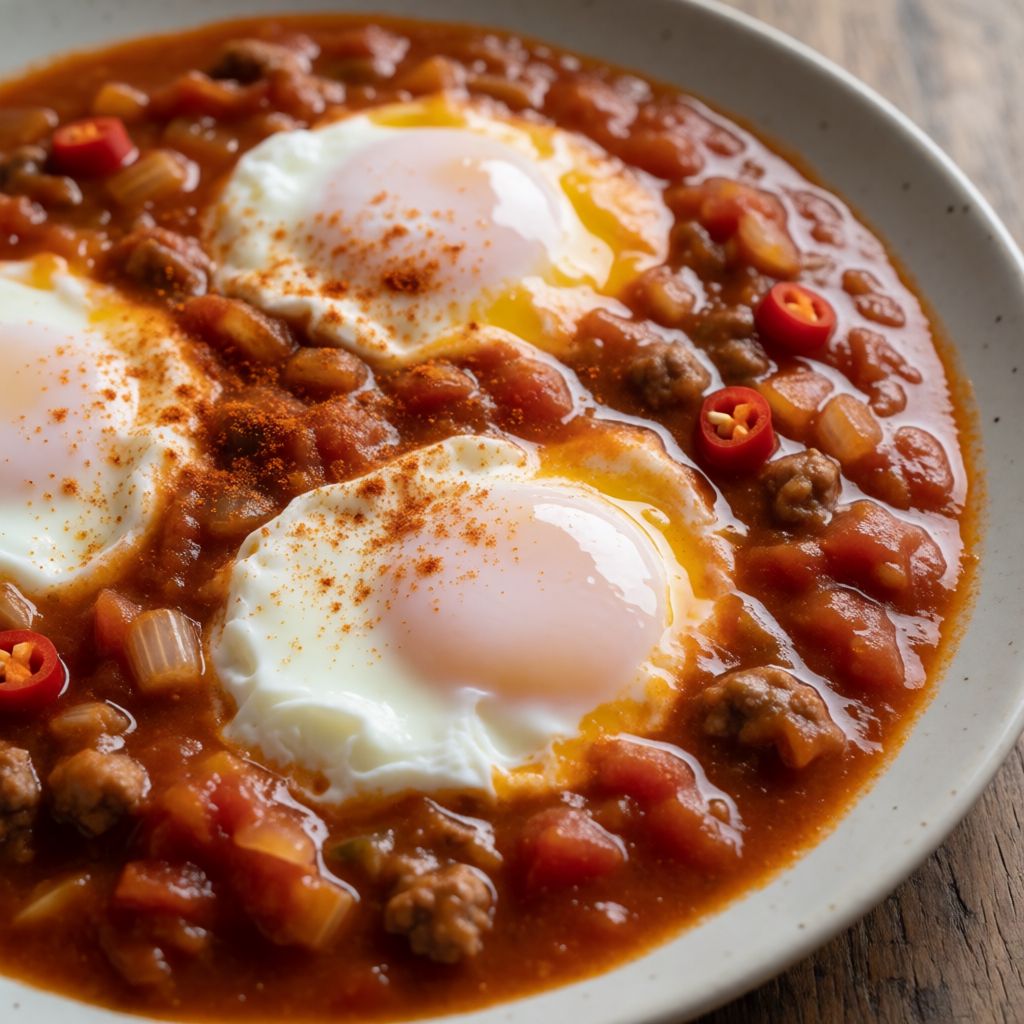
 AI photo
Mexican-Style Eggs in Tomato Sauce
A smoky, spiced tomato and bean sauce topped with baked eggs, served with warm tortillas, avocado and lime.
Labels are worked out automatically from the ingredients and can be wrong. Check the packaging if it matters to you.
Ingredients
- 2 pcs Onion finely chopped
- 2 clove Garlic finely chopped
- 1 pcs Red chilli finely chopped, add to taste
- 2 tsp Cumin
- 1 tsp Ground coriander
- 1 tsp Smoked paprika
- 800 g Canned chopped tomatoes
- 1 pcs Bell pepper diced
- 0.5 pcs Courgette coarsely grated
- 1 can Kidney beans drained and rinsed
- 4 pcs Eggs
- 100 g Mature cheddar freshly grated
- 2 tbsp Olive oil for frying
- Salt
- Black pepper freshly ground
- 8 pcs Tortillas
- 2 pcs Avocado sliced
- 1 bunch Coriander fresh
- 2 pcs Lime cut into wedges
- 100 ml Crème fraîche



















Steps
Heat a frying pan with the oil and fry the onion, garlic, chilli and spices over medium heat until the onion softens and the spices smell fragrant.
5 minAdd the chopped tomatoes, bell pepper and courgette and leave to simmer, covered, for 20 minutes.
20 minAdd the beans to the pan and simmer together for another 5 minutes. Season with salt, pepper and chilli to taste.
5 minCrack the four eggs into the pan, cover with a lid and let the eggs cook for 6–8 minutes, until the whites are set.
7 minSprinkle with a little grated cheese and serve with coriander and sliced avocado. Serve the tortillas alongside with lime, chilli and crème fraîche as accompaniments.
At the table, everyone can fill the tortillas with a spoonful of the eggs and avocado, then add lime juice, crème fraîche and chilli to taste.
This is huevos rancheros wearing a slightly different coat — call it what it is, a poached-in-sauce egg dish, because that's the mechanism that decides everything. You're not frying eggs and dumping them on tomatoes. You're cracking them straight into a simmering, thick tomato-bean-vegetable base and letting the heat of the sauce itself coagulate the white while the yolk stays loose underneath. The sauce is the pan, the plate and the cooking medium all at once.
What makes or breaks it is the thickness of that sauce before the eggs go in. Too wet, and the eggs don't poach — they scramble into the liquid, whites fraying into pink threads through the tomato. That's why step two gives it a full twenty minutes uncovered-then-covered simmer: the courgette and pepper need to give up their water, and the tomato needs to reduce down to something that holds a dent, almost a thick soup you could stand a spoon in. Some people see "canned tomatoes, 20 minutes" and think any consistency will do. No — because an egg needs a nest, not a bath.
The second thing that decides success is restraint with the lid once the eggs are in. You want gentle, ambient heat cooking the white from underneath and around, not a boil that would toughen the edges into rubber before the middle sets. The tell isn't a clock — it's the white: matte and fully opaque at the edges, still faintly glassy in the very centre if you like a soft yolk, or fully blind-white right through if you don't. Six to eight minutes is your lower bound, not your answer.
Onion, garlic and chilli fried first isn't decoration — it's the only chance those three get to actually cook rather than just flavour. Raw garlic in a simmered sauce stays sharp and a bit bitter; given a minute in hot oil before the liquid arrives, it mellows and sweetens. The cumin, coriander and smoked paprika go in dry at the same stage for the same reason: ground spices need a few seconds of direct contact with hot fat to wake their oils up. Thrown into the tomato liquid cold, they just taste of raw powder sitting on top of the sauce rather than running through it.
The tomatoes are the backbone, and canned chopped ones are not a compromise here — they're the better choice. Fresh tomatoes vary wildly in water content and acidity depending on season; a tin is consistent, already broken down, and carries just enough of its own liquid to start the simmer without you adding stock. If you've only got whole tinned tomatoes, crush them by hand in the pan — don't skip that, whole chunks won't reduce at the same rate as the vegetables around them.
The courgette grated coarsely rather than diced is a small mechanical choice with a real reason: grated, it has far more surface area, so it breaks down and surrenders its water into the sauce during the simmer instead of sitting there as separate crunchy batons at the end. If you only have a whole courgette, use the other half tomorrow in something that wants texture — this dish wants it dissolved in.
Kidney beans go in late, after the sauce has already reduced, because they're already cooked — they just need warming through and a chance to absorb flavour, not twenty minutes of simmering that would turn them to mush. Any rinsed and drained tinned bean with a similar bite works here — black beans, pinto, borlotti — the criterion is "cooked already, firm enough to hold its shape," not the specific bean.
Cheddar on top is a British householder's substitute dressed up as intention, and it works fine — mature cheddar has enough sharpness to stand in for a crumbly Mexican cheese like queso fresco, which you likely won't find in an ordinary supermarket. The rule for any cheese substitution here isn't flavour-matching exactly, it's texture: you want something that melts a little from the residual heat but doesn't turn to oil, so a hard, aged cheese rather than a soft fresh one.
Crème fraîche stands in for Mexican crema — same job, same reason to swap: a cool, faintly sour fat to cut the chilli heat and round off the acidity of the tomato. Soured cream does exactly the same job if that's what's in the fridge; the criterion is tangy and thick enough to sit on a spoon, not pour.
And patience is doing real work twice in this recipe — once in the twenty-minute reduction that nobody should rush with extra heat, because a fast boil thickens the surface while the middle stays thin and watery, and once at the table, where the whole point is people building their own tortilla, not racing to eat before the eggs cool.