
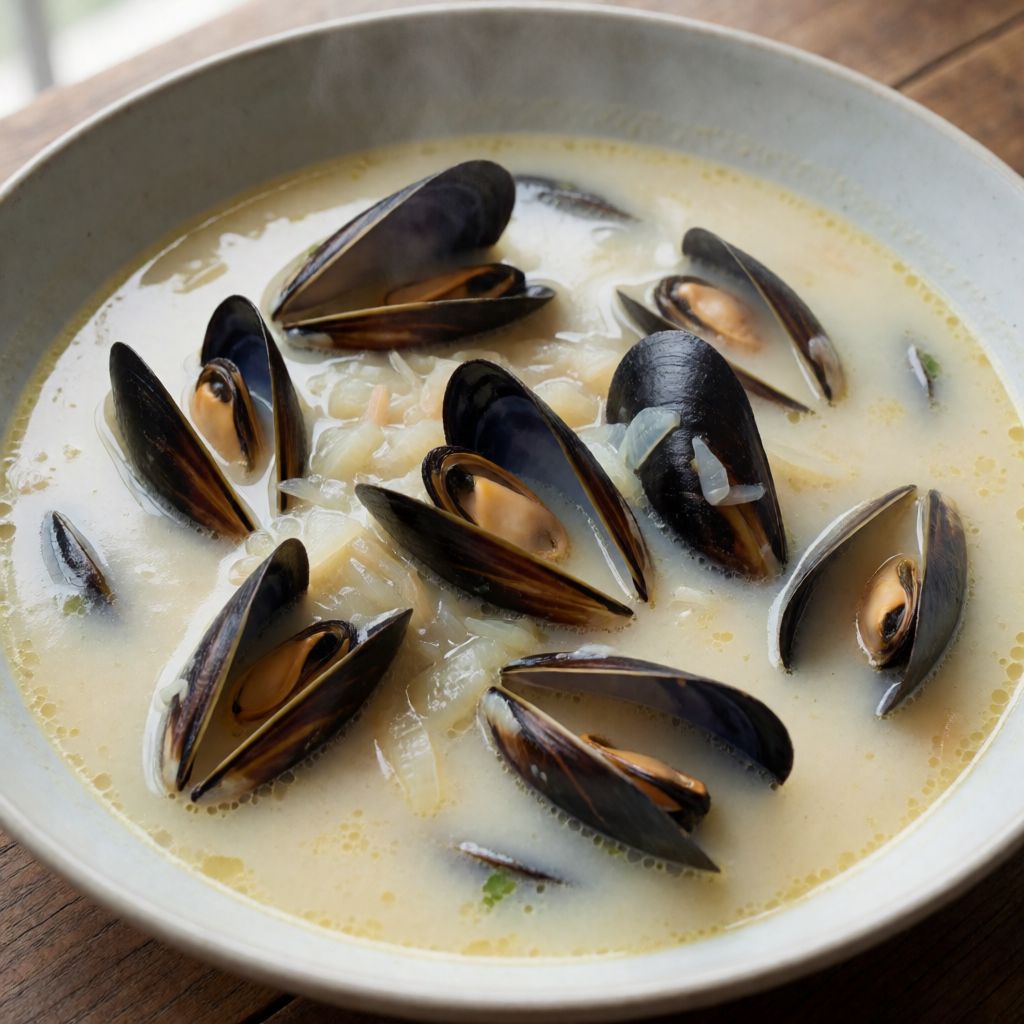
 AI photo
Mussel Soup
A fragrant saffron and fennel mussel soup, finished with cream and a drizzle of parsley oil.
Labels are worked out automatically from the ingredients and can be wrong. Check the packaging if it matters to you.
Ingredients
- 1.5 kg Mussels
- 2 pcs Onion finely chopped
- 2 clove Garlic finely chopped
- 400 ml Stock
- 300 ml White Wine dry
- 150 ml Double Cream
- 1 pinch Saffron crushed
- 1 pcs Fennel cut into thin strips
- 2 pcs Carrot cut into matchsticks
- 1 tbsp Olive Oil
- Salt
- Black Pepper freshly ground
- ½ bunch Parsley
- 100 ml Olive Oil
- ½ bunch Parsley finely chopped
- 4 pcs Bread slices
- 50 g Butter














Steps
Clean the mussels, scrubbing the shells under running water — do not soak them. Discard any mussels with damaged shells and any open ones that do not close when tapped sharply on the worktop.
Fry the onion and garlic in olive oil in a large pot until the onion softens.
Add the mussels, stock and white wine, and cover with a lid.
Cook over medium heat for 5-8 minutes, until the mussels open.
Strain the mussel broth into a clean pot. Set the opened mussels, still in their shells, aside in a covered bowl to keep warm.
Add the fennel, carrot, cream and saffron to the pot of soup. Season the soup well with salt and pepper.
Remove most of the mussels from their shells, leaving 3 mussels in their shells per bowl.
Divide the mussels with the saffron soup among deep bowls.
Garnish with parsley, a little fennel frond and a few drops of parsley oil, and serve with good bread and butter.
Remember: discard any mussels that have not opened during cooking.
Parsley oil: blend the olive oil with the parsley until smooth and green.
What was changed
Whipping cream was swapped for Double Cream, which is the cream British kitchens usually keep on hand.
This is a two-stage soup pretending to be one dish: first you make a broth by steaming mussels open in wine and stock, then you turn that broth into a soup by adding cream, saffron, and vegetables cut thin enough to cook fast. The mussels themselves barely get cooked at all — they're really just the thing that flavours the liquid, and then they come back at the end as the reward.
What decides whether this works is restraint at step one. You're not simmering mussels, you're steaming them in a shallow bath of wine and stock with a lid on, so the steam does the work, not the liquid touching every shell. Five to eight minutes is not a number to trust blindly — it's a lower bound. What you're watching for is the shells gaping open on their own. A mussel that won't open after a fair few minutes of proper steam isn't shy, it's dead before you started, and you throw it out. No amount of extra time fixes that — more heat just toughens the ones that did open.
Some say you should soak mussels in water beforehand to "clean" them. No — mussels are saltwater animals, and fresh water either does nothing useful or, worse, can kill them slowly before cooking, which then shows up as grit and off flavour in your broth. Scrub the shells under the tap instead; that's the part that's actually dirty.
The broth you strain off is the base of the whole soup, so don't rush that straining — any sand that settled at the bottom of the pot stays in the pot, not in your ladle.
Mussels: go for ones with tightly shut shells, or shells that close themselves when you tap them — that tap-test is your real quality control, not a formality. An open shell that stays open is an animal that's already died, and a dead mussel left in a warm kitchen for even an hour starts to turn. 1.5 kg sounds like a lot for four people, but shells are dead weight — you're buying the shell along with the meat, so don't be alarmed by the bag size.
The fennel and carrot are cut into strips and matchsticks for one reason: thin means fast, and fast means they cook through in the time the soup itself needs to come together, without ever needing a separate simmer. If fennel isn't in your shop that week, celery gives you something in the same aniseed-adjacent, crunchy-then-soft family — not identical, but it won't fight the dish.
Saffron is there for colour and a particular bitter-floral note that nothing else quite gives you, which is exactly why recipes ask for only a pinch — it's expensive because a little goes a very long way, not because tradition demands suffering. Crush it first; whole threads sitting unbroken in a bowl of cream are just decoration, not flavour.
Double cream carries the saffron and softens the brine of the mussel broth into something you'd actually want to eat a bowlful of rather than just a mouthful of. If you haven't got double cream, any cream with enough fat to not split when it hits a hot, slightly acidic broth — the wine makes it acidic — will do; thin milk will curdle and look like a mistake, because it is one.
The white wine needs to be dry, not because sweet wine is forbidden somewhere, but because sugar in the pot turns into caramelised sweetness against the salt of the mussels, and it throws the whole balance off toward dessert. Any dry white you'd actually drink a glass of works; don't buy "cooking wine" specially — that's a UK supermarket invention solving a problem that doesn't exist, since you need normal drinkable wine for this anyway, and it's cheaper to just use what you've got open.
The parsley oil is nothing more than blended olive oil and parsley — no emulsifier, no trick, just enough blitzing to break the leaves down so the oil picks up their green colour and a bit of their bite. A few drops on top isn't garnish for garnish's sake; it's a cold, sharp contrast dropped onto a warm, round soup, and that contrast is doing real work on your palate, not just on the bowl's appearance.
Butter and bread at the end are there for mopping, plainly — the broth left in the bowl once the mussels are gone is worth more than the shells you throw away, and a UK kitchen already knows this instinct from gravy on a Sunday roast. Use it here the same way.