
 AI photo
Oxtail Soup
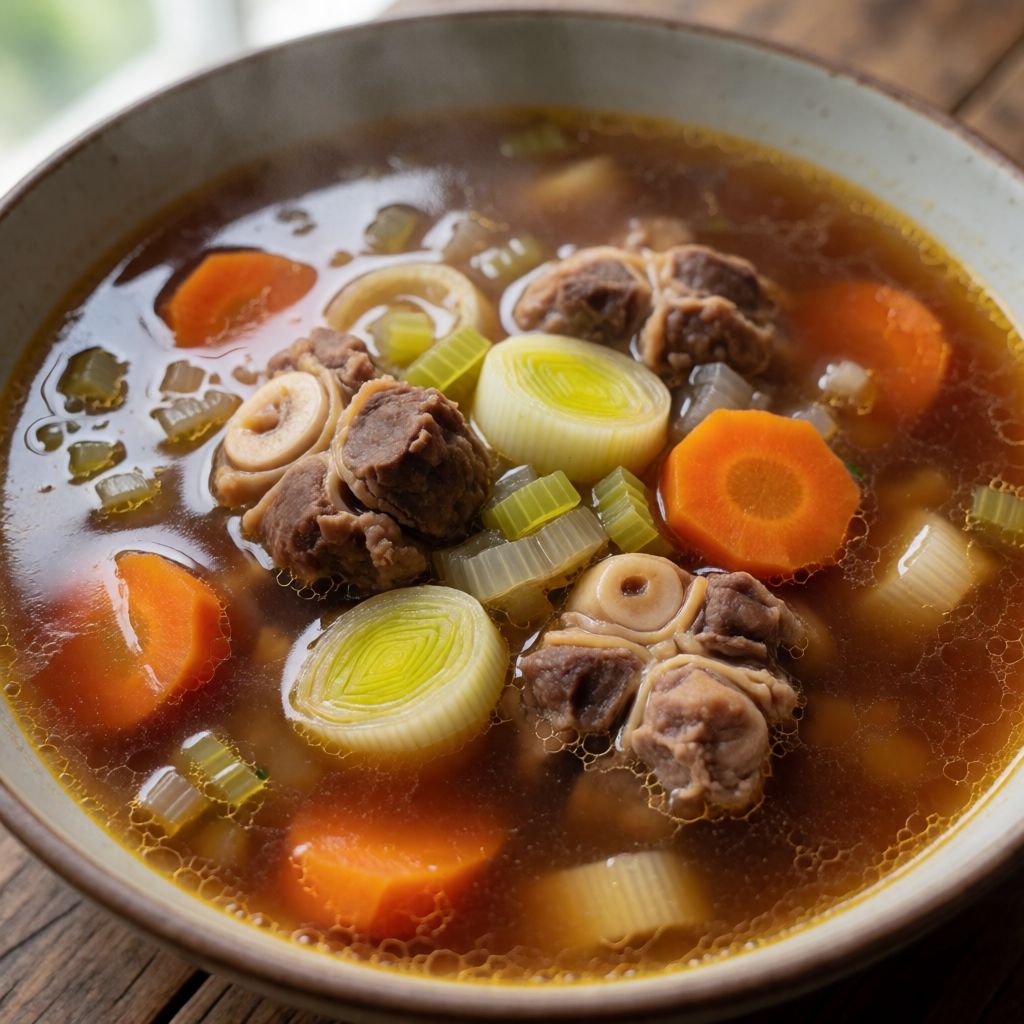
A rich, slow-simmered oxtail broth with vegetables and herbs, finished with a splash of red wine and cider vinegar.
Ingredients
- 1 kg Oxtail
- 2 pcs Leek halved
- 3 pcs Carrot diced
- 3 pcs Celery stalks
- 1 pcs Onion cut into wedges
- 3 clove Garlic halved
- 25 g Tomato Purée
- 1 tsp Paprika
- 4 pcs Thyme fresh sprigs
- 5 pcs Parsley sprigs
- 2 pcs Bay Leaf
- 200 ml Red Wine
- 1.5 l Water to cover
- 1 tbsp Cider Vinegar
- 1 tsp Sugar
- 3 tbsp Olive Oil for browning
- Salt
- Black Pepper freshly ground
- 2 pcs Carrot finely diced
- 1 pcs Leek thinly sliced into rings


















Steps
Cut the oxtail into joints if not already done. Trim off any visible fat. Pat dry with a paper towel.
Brown the oxtail on all sides until golden in a large pot with the olive oil.
Add the carrot, leek, onion, garlic, celery and tomato purée; sauté for about a minute.
Add the paprika, thyme, parsley, bay leaves, wine, cold water to cover the meat and vegetables, and salt.
Slowly bring to the boil.
Skim the foam from the surface, cover with a lid and simmer gently for 3–4 hours.
Skim the soup a few more times during cooking.
Remove the tender oxtail and set aside on a plate.
Strain the soup twice through a fine sieve, discarding the vegetables and herbs.
Pour the clear strained stock back into a clean pot and keep it warm.
Add the carrot and leek to the soup and let simmer for 10 minutes.
Remove the tender meat from the oxtail and shred it into fibres with two forks.
Season the soup to taste with salt, black pepper, cider vinegar and sugar — and serve with the carrot, leek and meat.
Oxtail soup is a bone soup that happens to use the cheapest, boniest, most sinewy cut on the animal and turns that into its whole argument. The tail works hard all its life — it's muscle wrapped round bone, laced with connective tissue — so it has nothing to give you quickly. What it has is collagen, and collagen only becomes anything worth eating after hours of gentle heat breaking it down into gelatine. That's the whole mechanism of this dish: you are not cooking meat, you are melting tendon into liquid, and the clock is just how you know it's happened.
So the question isn't "how long" but "what does it feel like". At three hours the meat is cooked but still clings stubbornly to the bone and feels tight under a fork. Push on, and somewhere past three and a half, four hours, it goes the other way — it lets go of the bone on its own, and when you pull two forks through it, it shreds into fibres rather than tearing in sheets. That's the sign, not a timer going off.
What decides whether this works is mostly what happens before the simmer even starts: the browning, and the skimming. Brown the oxtail properly — not just warmed through, actually coloured dark gold on the cut faces — because that colour is where half your flavour comes from; a pale piece of meat dropped straight into water gives you a grey, flat broth. And skim the foam that rises in the first twenty minutes religiously, because that foam is coagulated blood protein, and if you stir it back in or ignore it you get a muddy, slightly bitter cloudiness in what should end up glass-clear.
Some say oxtail soup needs to simmer on the lowest possible flame for the gentlest possible result. No — because what matters isn't low, it's barely-moving: a bare shiver of bubbles breaking the surface, not a rolling boil. Boil it hard for four hours and the agitation beats the fat and connective tissue into the liquid as an emulsion, giving you a cloudy, greasy soup instead of a clear one. On a domestic hob, this usually means your lowest setting with the lid slightly ajar, checking every so often rather than trusting the dial — every hob lies a little about what "low" means.
The double straining in step 9 is not fussiness, it's the whole payoff of patience. After four hours the vegetables have given everything they had to give — flavour-wise they're spent, texture-wise they're mush — so there's no loss in discarding them. What you're protecting by straining twice, once coarse and once fine, is clarity: small fibres and herb stems that slip through a first pass will sit in your bowl looking like debris. This is also where people often skip a stage because "it's just soup" — but a cloudy, bitty broth and a clear one taste different on the tongue even with identical ingredients; clarity reads as refinement before you've swallowed a drop.
The second batch of carrot and leek, added raw after straining, exists because the first batch is already dead — collapsed, grey, stock-flavour donors with nothing crisp left in them. Ten minutes of simmering on the fresh vegetables gives you the carrot just past raw, bending rather than snapping when you press a piece against the side of the pot, so the bowl has something with texture in it, not just soft fibres of meat in clear liquid.
Oxtail itself is the economic backbone of the whole dish — a cut nobody wanted when beef was divided up for roasting joints, sold cheap because it's mostly bone and gristle, and turned valuable only by long cooking that no quick-cook cut can match. If you can't get oxtail, beef shin or short rib shares the same logic — connective tissue, collagen, needs hours — though neither gives you quite the same gelatine-rich body the tail bones themselves contribute. Don't reach for a leaner cut expecting a shortcut; lean meat just goes dry and stringy over four hours with none of the melting reward.
The tomato purée and paprika aren't there to make it a tomato soup — a spoon of purée and a teaspoon of paprika in a liter and a half of stock is barely a tint, just enough to deepen colour and round out sweetness without you noticing either as a separate flavour. The red wine does similar work to the browning step: acid and sugars that caramelise slightly against the hot pot, adding a layer under the meat flavour rather than a wine taste you can name. Any dry-ish red you'd actually drink will do; there's no reason to buy anything described as "cooking wine" — it's usually worse value and the flavour difference in the final soup is too faint to justify it.
The cider vinegar and sugar at the end are a correction, not an ingredient in their own right — four hours concentrates the broth and can tip it towards flat richness, and that small sour-sweet adjustment at the very end wakes it back up. Taste before you add either; a stock that's already balanced doesn't need both, sometimes neither.
This feeds four as a proper bowlful with bread, not as a starter — oxtail gives relatively little meat per kilo once the bone and fat are accounted for, so don't expect it to stretch much further without topping up the vegetables.