
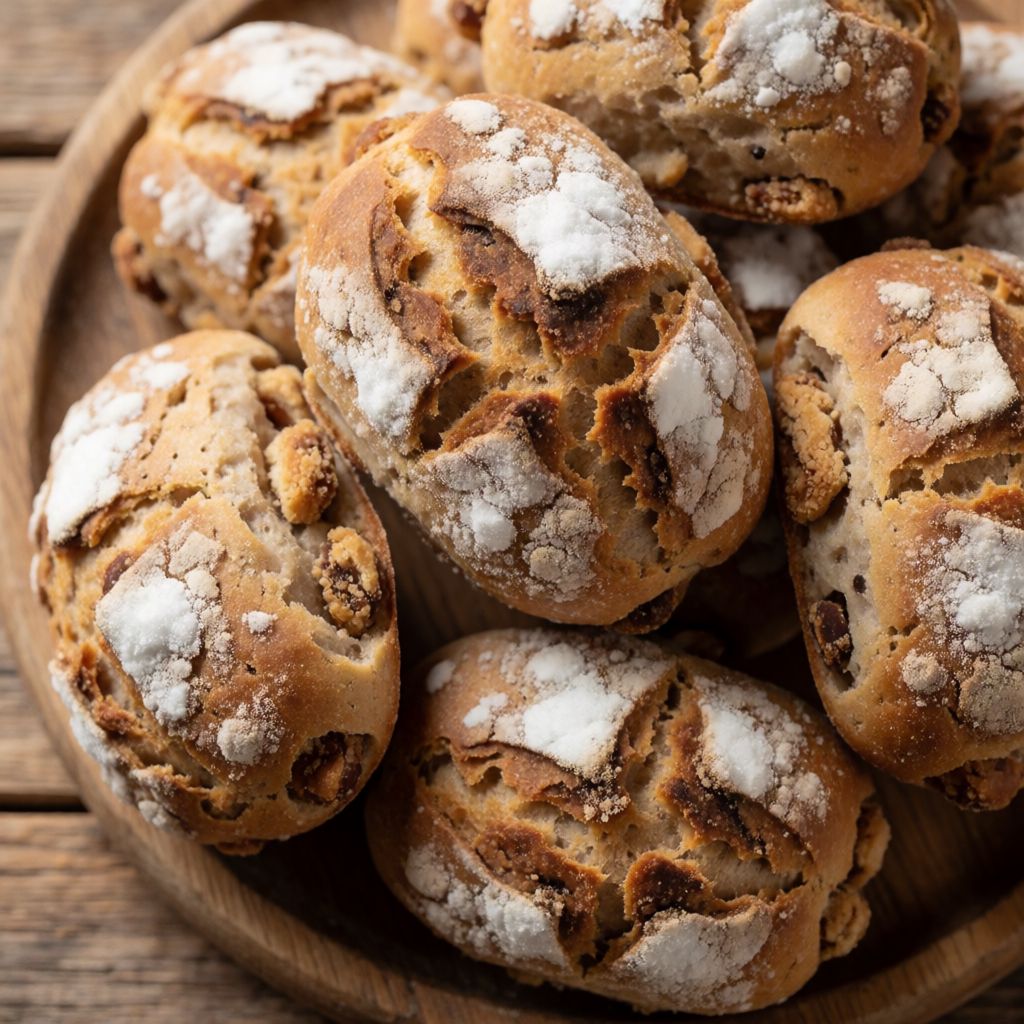
 AI photo
Pan dei Morti (Day of the Dead Bread)
A spiced Italian biscuit-cake, traditionally made for All Souls' Day with crumbled biscuits, dried fruit and nuts.
Labels are worked out automatically from the ingredients and can be wrong. Check the packaging if it matters to you.
Ingredients
- 125 g Crackers
- 60 g Amaretti biscuits
- 60 g Savoiardi (sponge finger) biscuits
- 3 pcs Egg whites
- 120 g Caster sugar
- 125 g Plain flour
- 25 g Cocoa powder
- 65 ml Red wine
- 50 g Almonds
- 50 g Dried figs
- 50 g Raisins
- 25 g Pine nuts
- 8 g Baking powder
- pinch Cinnamon to taste, optional
- pinch Icing sugar to taste, for dusting











Steps
Crush the crackers, amaretti biscuits and savoiardi biscuits in a food processor to fine crumbs.
Tip the crumbs into a large bowl, add the caster sugar, cocoa powder, plain flour and baking powder, and mix.
Finely chop the almonds, pine nuts and dried figs with a knife and add to the mixture.
If you like, add a pinch of cinnamon for extra flavour.
Add the egg whites and mix everything together until smooth.
Turn the dough out onto a work surface and continue kneading by hand until it is compact and even.
Shape the dough into a log and cut into slices about 1 centimetre thick.
Shape each slice into a diamond and place on a baking tray lined with baking paper.
Bake at 180°C for about 25 minutes.
25 minRemove from the oven and leave to cool for a few minutes.
Before serving, dust with icing sugar if you like.
This is a bread that isn't bread at all — no yeast, no rise, no long wait for dough to prove. It's a biscuit dough wearing bread's name, and the name is the whole point: it's baked around the first days of November, for the dead, and it has to look humble and a bit ugly on purpose. Lombardy's bakers built it out of what was already stale in the shop — old crackers, old amaretti, old savoiardi — because this was a feast that came right after the bread of the week had gone hard, and nothing got thrown away. That's not folklore dressing; that's just what a baker does with Tuesday's leftovers on a Friday that needs selling.
What decides whether it works isn't the oven, it's the crumbs. Food-process the three biscuits properly fine — not "mostly fine," fine — because any gritty lump sits in the final dough as a dry pocket that won't bind no matter how long you knead it. The egg whites are your only binder here; there's no butter, no yolk fat to carry moisture around and forgive a coarse crumb. So the finer the crumb, the more surface it has to grab that egg white, and the less you need to compensate by over-wetting the dough with wine.
Speaking of the wine: 65 ml is there to loosen, not to flavour meaningfully once baked — red wine's job is to let the dry crumb-and-flour mix come together without turning into something sticky and over-egged. Add it with the whites, not after; a dough that's had wine worked in last tends to go patchy, wet in streaks, dry in others.
On the ingredients, start with the three biscuits, because together they do three different jobs. Crackers give you dry, neutral bulk — structure without strong flavour. Amaretti bring bitter almond and a little bit of crunch that survives the crumb. Savoiardi bring sweetness and a drier, spongier crumb that helps the dough hold air pockets instead of baking into a solid brick. If you're short one of the three, don't panic and don't substitute blindly — the criterion is "a dry, already-baked biscuit with some sugar in it," so digestive biscuits or plain shortbread can stand in for crackers, and any dry almond biscuit for amaretti. What you can't easily replace is savoiardi's lightness — swap it for more crackers and the bake goes denser, closer to a flapjack than to this.
Flour and baking powder are there only to give the biscuit dough enough backbone that slices hold their diamond shape in the oven rather than slumping into a flat puddle. This isn't a cake chemistry — 8 g of baking powder against 125 g flour is a modest lift, just enough to stop the dough being dense as fudge, not enough to make it rise like bread. Don't be tempted to add more for a "lighter" result; too much lift here and the dried fruit and nuts, which are heavy, sink to the base and burn against the tray.
The dried fruit and nuts — figs, raisins, pine nuts, almonds — are chopped by knife, not processor, and that's deliberate: a food processor turns figs into paste and you lose the separate bite of each one. You want to still find a raisin, still find a sliver of almond, when you eat a slice. If figs feel too soft and sticky to chop cleanly, firm them briefly in the fridge first — a cold fig holds its shape under a knife, a warm one just smears.
Cocoa powder is doing colour and a background bitterness more than dominant chocolate flavour — this bread is meant to look dark, almost like turned earth, which fits its purpose. Use a plain, unsweetened cocoa; a drinking-chocolate mix with added sugar and milk powder will throw off the whole balance of sweetness you've already built with the caster sugar and sweet biscuits.
On temperature: 180°C is a moderate domestic oven setting, hot enough to set the egg white and dry the surface of the diamonds before the fruit inside scorches, but not so hot that the sugar-heavy crumb catches before the centre firms. A normal UK fan oven runs a touch hotter than a conventional one at the same dial setting, so if yours is fan-assisted, drop it 10 degrees and keep an eye on colour rather than trusting the clock alone — the real marker of done is a dry matte top and a slight give, not crumbly-raw, when you press a diamond lightly. Twenty-five minutes is where to start checking, not where to stop.
Patience here isn't about proving dough — there's none of that — it's about letting the baked diamonds sit a few minutes on the tray before you move them. Straight from the oven they're fragile, barely held by egg white that hasn't finished setting; give them that short rest and they firm up enough to survive being lifted without crumbling at the edges. Rush that step and you'll wonder why half your diamonds fell apart on the cooling rack and blame the recipe instead of the five minutes you didn't give it.