
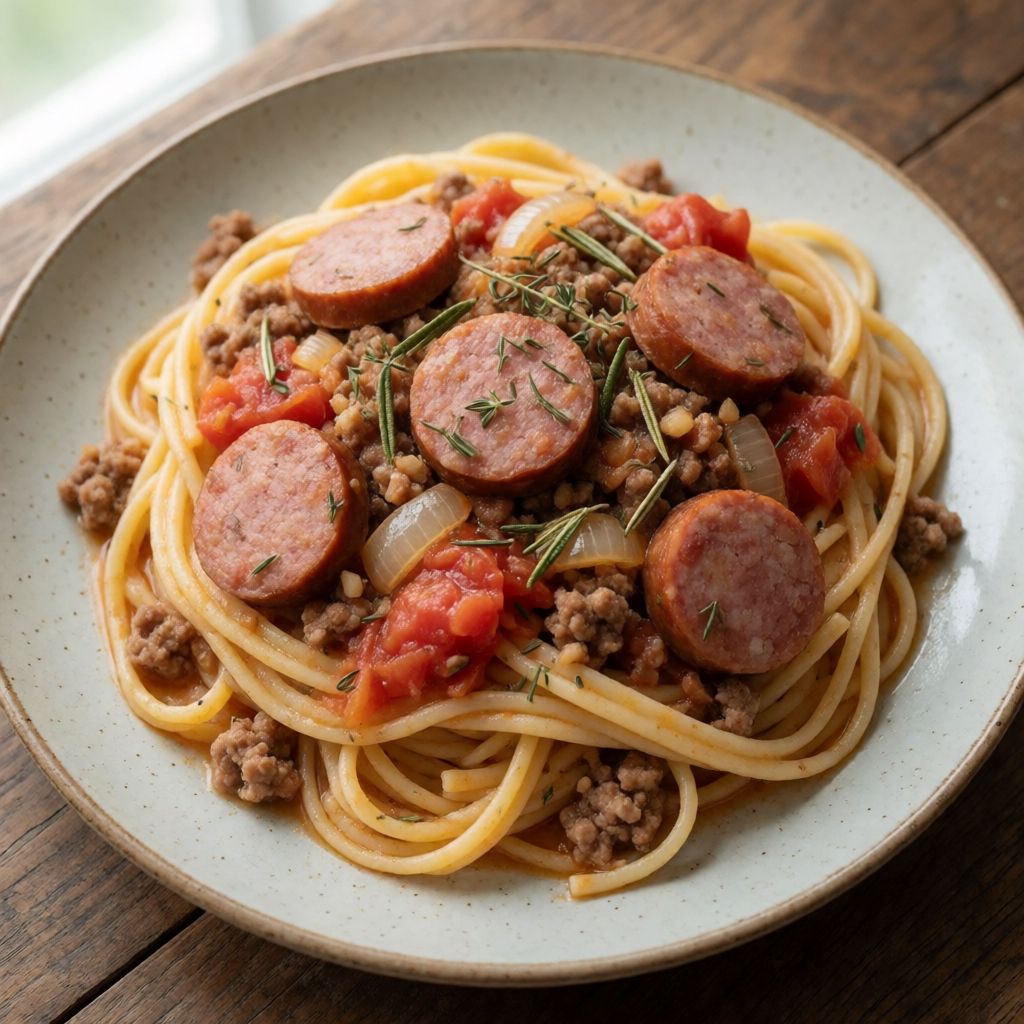
 AI photo
Pasta with Italian Sausage
A creamy tomato pasta sauce with Italian sausage, thyme and rosemary, finished with fresh basil and Parmesan.
Labels are worked out automatically from the ingredients and can be wrong. Check the packaging if it matters to you.
Ingredients
- 300 g Italian sausage
- 2 pcs Onion finely chopped
- 1 clove Garlic finely chopped
- 1 tsp Dried thyme
- 0.5 tsp Dried rosemary
- 400 g Canned chopped tomatoes
- 100 ml Double cream
- 400 g Pasta
- 1 bunch Basil roughly chopped
- 50 g Parmesan freshly grated
- 0.5 bunch Basil








Steps
Heat a frying pan over medium heat, add the sausage meat and turn the heat up to high. Fry, breaking it up and stirring often, until it turns slightly crisp and golden.
5 minDrain off any excess fat, lower the heat to medium and add the onion, garlic, thyme and rosemary. Cook until the onion is soft, then stir in the chopped tomatoes and cream.
4 minLet the sauce simmer gently over a medium-low heat while the pasta cooks in lightly salted water, draining it a minute or two before it's fully al dente. Scoop out a little pasta water and set aside, then tip the hot pasta straight into the sauce.
2 minToss everything together well, loosening with a splash of the reserved pasta water if needed.
2 minStir the fresh basil through the hot pasta and serve straight away, topped with freshly grated Parmesan and a few basil leaves.
This is pasta wearing a pink sauce, but don't be fooled by the tomato - the flavour here comes from the pan, before the tomato ever goes in. You're not simmering a ragù for an hour, you're rendering a sausage for five minutes, and that five minutes is doing most of the work the whole dish rests on.
What decides whether it works is heat at the very start. The pan has to be hot enough that the fat hisses the moment the meat touches it, not idling underneath - because sausage meat is wet, and wet meat given gentle heat just steams in its own juice instead of browning. You end up with pale, crumbly meat and no fond, and here there's no stock, no long reduction to hide behind, so that fond is the whole flavour base. The cue isn't a clock, it's the look of the meat: from slack and pink to matte, with crisp freckled edges. Once you see that, you're past the risky bit.
After that the pan cools its temper on purpose. Onion goes in over medium heat to go soft and see-through, not brown - some cooks push onion hard here hoping for sweetness, but a browned onion fights the cream later, turns the sauce muddy instead of pink. You want it tame, not caramelised.
Tomato and cream aren't really simmered together so much as introduced to each other gently, and basil goes in only once the pan is off the heat, stirred through, never boiled - basil cooked hard turns dark, bitter, and loses the whole reason you bought it fresh. Patience here isn't about waiting it out, it's about knowing which stage deserves the clock and which deserves your eyes instead.
Italian sausage, for anyone without an Italian butcher nearby, is really just a criterion: fresh pork sausage with a loud seasoning, usually fennel seed and a chilli kick, meant to be squeezed out of its skin rather than sliced in rounds. Any coarse, well-seasoned fresh sausage works if you discard the casing and break it up with a spoon in the pan - a plain British pork sausage with a pinch of fennel seed and chilli flakes added will get you most of the way there, since what you're borrowing is the fat and the spice, not a brand name.
The onion is there to carry sweetness into fat that's currently all meat and salt - two onions for four people is generous on purpose, because onion shrinks hard as it softens and you'd be disappointed with one. Garlic goes in with it rather than before, because garlic burns in seconds in hot fat and turns bitter the moment it goes past golden - it has no business meeting the pan before the onion gives it something to hide in.
Dried thyme and rosemary, not fresh, and that's not a compromise - dried woody herbs actually improve with a few minutes of simmering, releasing their oil slowly, where fresh basil would just go limp and grey in the same time. That's the real reason the basil waits until the very end and the thyme doesn't: one herb is built to survive heat, the other isn't, and no amount of care changes that chemistry.
Canned chopped tomatoes save you the stage of crushing whole ones - you're not after a cooked-down, jammy tomato sauce here, just enough body to carry the cream, so chopped is the right shortcut, not a lesser one. The cream is the part people worry about needlessly: some say cream splits the second it meets tomato's acid. It doesn't, not at the fat content double cream has in the UK - you already trust this mechanism every morning, it's why the milk survives going into hot tea rather than curdling, fat-rich liquid is forgiving of mild acid and gentle heat. Push the heat too hard or boil it hard and reduce, and then you'll have trouble - that's the actual cause, not the tomato.
Any short, ridged pasta that can hold a loose sauce in its grooves will do the job this one's written for - penne, fusilli, something with surface, not a flat ribbon that the sauce slides off. Draining it a minute early and finishing it in the sauce, with a splash of its own starchy water held back, is the one step people skip and then wonder why the sauce sits on top of the pasta instead of in it - that starch is what lets fat and liquid grip the pasta instead of pooling round it.
Parmesan goes on at the table, grated fresh, not stirred into the hot pan - pre-grated cheese is dried out on purpose so it doesn't clump in the bag, which also means it won't melt properly into a sauce, it just goes gritty. Buy a block, grate it yourself, and you'll use less to get more flavour - which, given what parmesan costs, is the economic argument as much as the culinary one.