
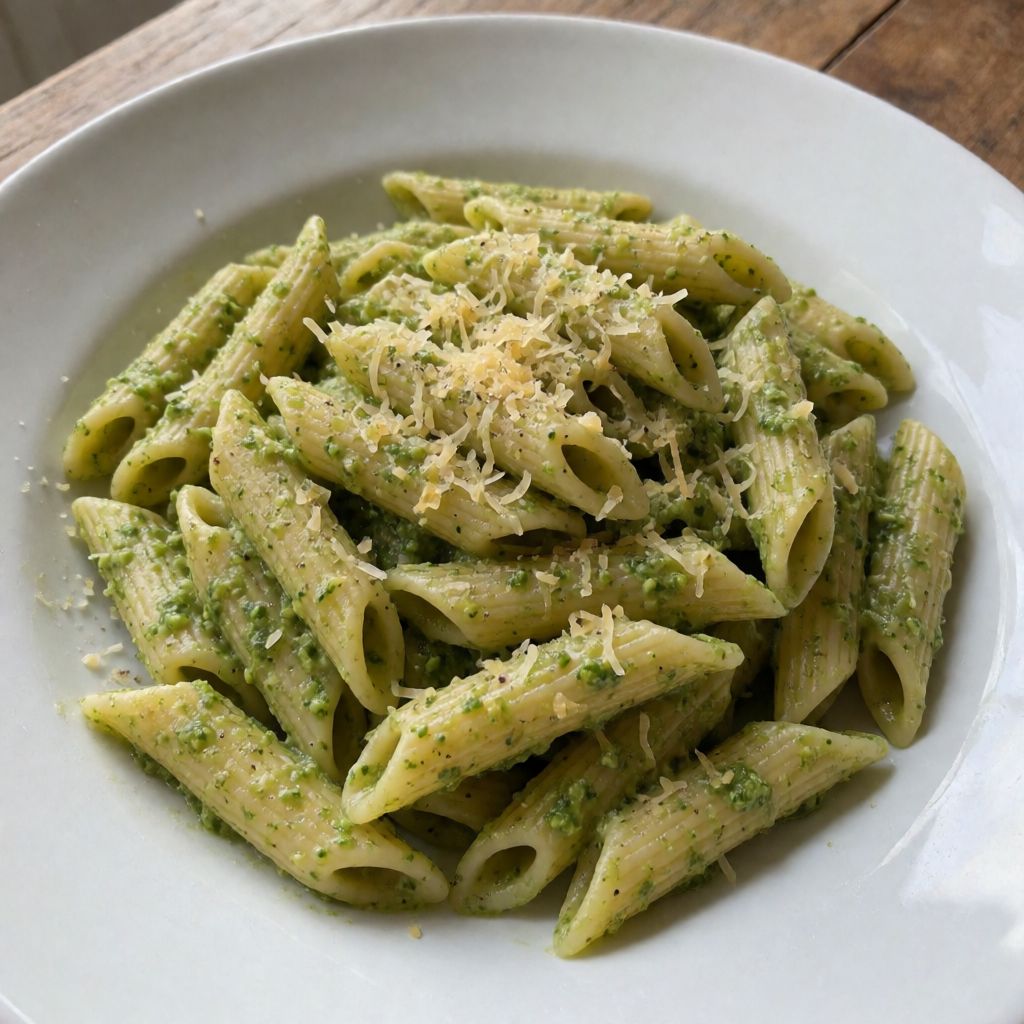
 AI photo
Penne with Sicilian Pesto
Penne pasta tossed with a fresh, raw Sicilian-style pesto of tomatoes, basil, pine nuts, ricotta and parmesan.
Labels are worked out automatically from the ingredients and can be wrong. Check the packaging if it matters to you.
Ingredients
- 100 g Penne
- 1 clove Garlic
- Basil to taste
- Parmesan to taste
- Olive oil to taste
- Black pepper to taste
- 50 g Pine nuts
- 500 g Cherry tomatoes
- 150 g Ricotta
- Salt to taste









Steps
Cook the penne in plenty of salted water.
15 minWash the cherry tomatoes, halve them and put them in a bowl.
5 minAdd the basil, pine nuts, garlic, grated parmesan, ricotta and olive oil.
5 minBlend everything with a stick blender until smooth.
3 minSeason with salt and black pepper to taste.
1 minDrain the penne and toss with the fragrant pesto.
2 min
This is not a cooked sauce — it is the Sicilian cousin of pesto, the one from Trapani, where almonds or pine nuts replace basil's usual partner and raw tomato stands in for cooked. Nothing here touches a flame except the pasta water. The whole dish is built on one idea: ripe tomato pulp, blitzed cold, needs nothing but time and the right fat to turn into a sauce that clings.
What decides whether it works is not the blender, it's restraint with the blender. Basil bruises under a spinning blade — the metal heats on contact and the leaves go from green to grey-green, tasting of cut grass instead of basil. So you pulse, you don't run it continuously: a few seconds, stop, check, a few more. Cherry tomatoes matter too — not because "cherry is sweeter" as a rule, but because a small tomato has proportionally more skin and pulp to juice, so the sauce is thick without reducing it on heat. A big beef tomato here would drown the dish in water.
Ricotta's job is to cut the acidity. Raw tomato is sharp — no sugars have caramelised, no acid has cooked off — and ricotta's mild fat rounds that edge the way cream rounds a vinaigrette. Skip it and you taste mostly vinegar-adjacent tang; too much of it and you taste nothing but dairy. The parmesan does something different — it salts and deepens, gives the savoury bottom note raw tomato can't supply on its own.
Penne, 100g dry, is the standard portion for one adult in a British kitchen — scale by multiplying, not by guessing. Cook it in water salted like the sea, because pasta only ever takes on salt while it's cooking; season it afterwards and you're only salting the surface, and the inside stays bland. Don't rinse it once drained — that myth about stopping it sticking costs you the starch on the surface, and it's exactly that starch that lets the sauce grip the pasta instead of pooling at the bottom of the bowl. Keep a cupful of the cooking water before you drain; a splash of it loosens the pesto if it's gone too thick to coat evenly.
Cherry tomatoes are the backbone, and in a UK kitchen their flavour swings wildly with the season — a punnet in August tastes of something, the same punnet in January tastes mostly of water and acid, grown under glass with little sun. If yours are the pale winter sort, a pinch more salt and a slightly longer rest after halving helps: salt pulls juice out, concentrating what sugar is there. There's no fixing a genuinely flavourless tomato with technique alone — that's an honest limit, not a failure of yours.
Pine nuts bring fat and a faint resin sweetness; 50g for one portion is generous, closer to what two would need, but it's what gives the sauce its body alongside the ricotta. If pine nuts are pricey or you don't have them — and in the UK they usually are pricey — the criterion is a nut with high oil content and no sharp bitterness: blanched almonds or walnuts both work, cashews too if you want something milder. Toasting them first adds a roasted note that's not traditional to this dish but isn't wrong either — it's a different, warmer pesto. Raw keeps it closer to what's in the recipe: pale, sweet, clean.
Garlic — one clove, raw, is a real dose of heat and sulphur compounds that cooking would otherwise soften. If the bite feels too sharp once blended, that's not a flaw to live with; slice the clove and pull out the green germ in the centre if there is one, it's the part that carries most of the harshness and the lingering aftertaste people blame on garlic generally.
Ricotta should be fresh, drained, mild — not the salted, pressed kind used for baking, which won't loosen into the sauce the same way. If you can't get ricotta, the working criterion is a fresh curd cheese with a soft, slightly sweet dairy taste and no real acidity of its own — cottage cheese blitzed smooth, or mascarpone cut with a spoon of yoghurt to bring it closer to ricotta's lightness, both get you there.
Parmesan wants to be a hard, aged, salty cheese — pecorino works if you want more bite, a vegetarian hard cheese works if that matters to you, the function is salt plus savoury depth, not the brand. Olive oil here isn't a neutral cooking medium, it's a flavour in its own right, so use one with some character — fruity, a little peppery on the back of the throat — rather than the blandest bottle in the cupboard; this is the one place in the dish where the oil is meant to be tasted, not just felt.
Patience shows up in small places here, not in long cooking: letting the halved tomatoes sit a few minutes with salt before blending, so they give up some water instead of diluting the sauce once blitzed; pulsing rather than running the blender straight through; tasting before you add the last of the salt, since parmesan and ricotta both carry their own. None of it takes long. All of it is the difference between a sauce that tastes assembled and one that tastes like it was always one thing.