
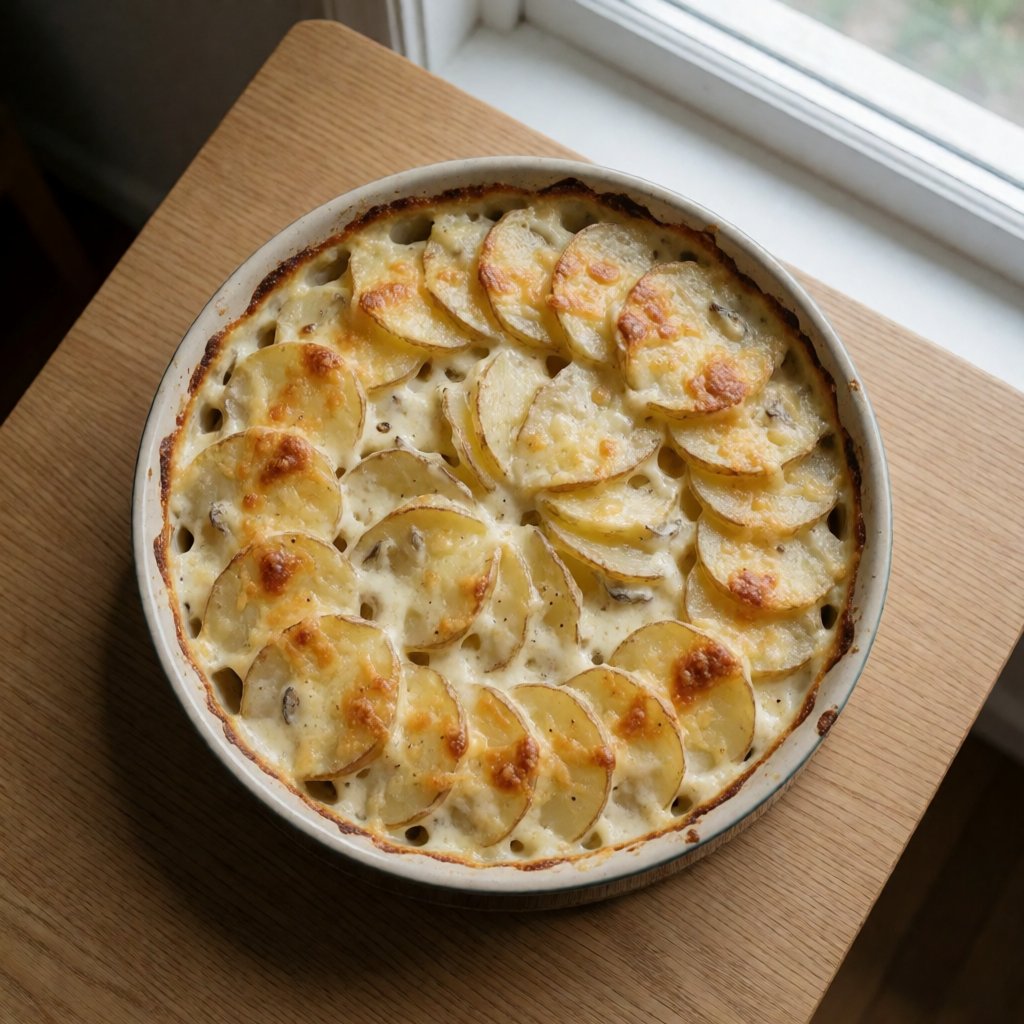
 AI photo
Potato Gratin
A creamy baked potato gratin with garlic and cheese, ideal as a comforting side dish.
Labels are worked out automatically from the ingredients and can be wrong. Check the packaging if it matters to you.
Ingredients
- 500 g potatoes sliced into thin 3 mm rounds
- 200 ml double cream
- 1 clove garlic
- 50 g mature cheddar grated
- 1 pinch nutmeg to taste
- 1 pinch salt to taste






Steps
Rub the dish with garlic, layer the potatoes, and season with salt.
Pour over the double cream.
Cover the dish with foil and bake in the oven for 30 minutes.
30 minRemove the foil, sprinkle with the [c1], and bake for a further 15 minutes.
15 minTake the dish out of the oven.
What was changed
The generic hard cheese was swapped for mature cheddar, the mature cheddar commonly found in UK shops.
This is a dauphinoise in miniature — thin potato slices laid in cream, baked until the cream turns into its own sauce and the top crisps into a cheese crust. Nothing hides in a gratin. No onion, no herb forest, no sauce poured over at the end to save it. Just potato, cream, cheese, and whether you got the mechanics right.
What decides it is the marriage between starch and cream. Slice the potatoes thin — 3mm, no thicker, and you'll feel why once you try to bend a slice that's 5mm: it won't bend, it'll crack in the oven and sit there raw-hearted while the top burns. Thin slices release starch at every cut surface, and that starch is what thickens the cream into something you can cut with a fork rather than a soup you mop up with bread. Skip this and you get wallpaper paste on top and water underneath.
The other thing that decides it is the two-stage bake. Foil on first — this isn't decoration, it's steam management. Covered, the potatoes cook through gently in trapped moisture before anything on top has a chance to dry out or scorch. Take the foil off too early and you get a browned, leathery top sitting over potato that still snaps instead of yields. Foil off only once the potato is nearly there — you want the last quarter of cooking to be about colour and crust, not about finishing the potato itself.
Potatoes: don't reach for the ones you'd use for roasting on a Sunday. Those are floury — Maris Piper, King Edward — bred to fluff up and crisp outside, which in a gratin means they collapse into mush, because floury potatoes break down under heat instead of holding their shape. You want a waxy potato — Désirée, Charlotte, even a supermarket 'salad potato' bag — one that keeps its slice-shape through the bake while still shedding enough surface starch to thicken the cream. Myth worth killing here: 'any potato does' — no, because the whole dish depends on this one trade-off, structure versus starch, and waxy gives you both.
Cream: double cream because fat content is what keeps it from splitting at oven heat and what gives you that thick, almost custard-set texture once it cools a touch. If you're out of double cream, the criterion is high fat and low water — crème fraîche works, thinned slightly with milk if it's very thick; single cream or milk alone will separate and run thin, no matter how long you bake it, because there isn't enough fat to hold the emulsion together.
Garlic: rubbed into the dish, not sliced into the layers. Rubbing leaves aroma without leaving you a mouthful of raw garlic halfway through a bite of cream and potato — a small thing, but it's the difference between background perfume and someone complaining at the table.
Cheese: mature cheddar earns its place here because it's dense and low in moisture — it browns into a crust rather than weeping water into your cream. A young, wet cheese — mozzarella, a soft Brie — would do the opposite: melt into strings or pools and leave the top soggy instead of golden. If cheddar isn't in the fridge, any hard, dry cheese that grates rather than squishes will do the same job — a mature Gruyère, an aged Lancashire.
Nutmeg and salt are the quiet workers. Nutmeg isn't decoration — it's the traditional partner to dairy-heavy dishes precisely because its slight bitterness cuts the flatness of a lot of cream, the same reason it turns up in béchamel. A pinch, grated fresh if you have a whole nutmeg knocking about in a spice drawer — pre-ground loses its edge within months of opening the jar.
Last thing: patience, the ingredient the recipe card never lists. Once it's out of the oven, the cream is still a liquid holding its shape by heat alone. Cut into it straight away and it runs across the plate like a burst dam. Give it ten minutes standing — the starch finishes setting as it cools, and what was sauce becomes something you can lift out in a clean wedge. This waiting is not optional; it's the difference between a gratin and a potato soup with delusions of grandeur.
·