
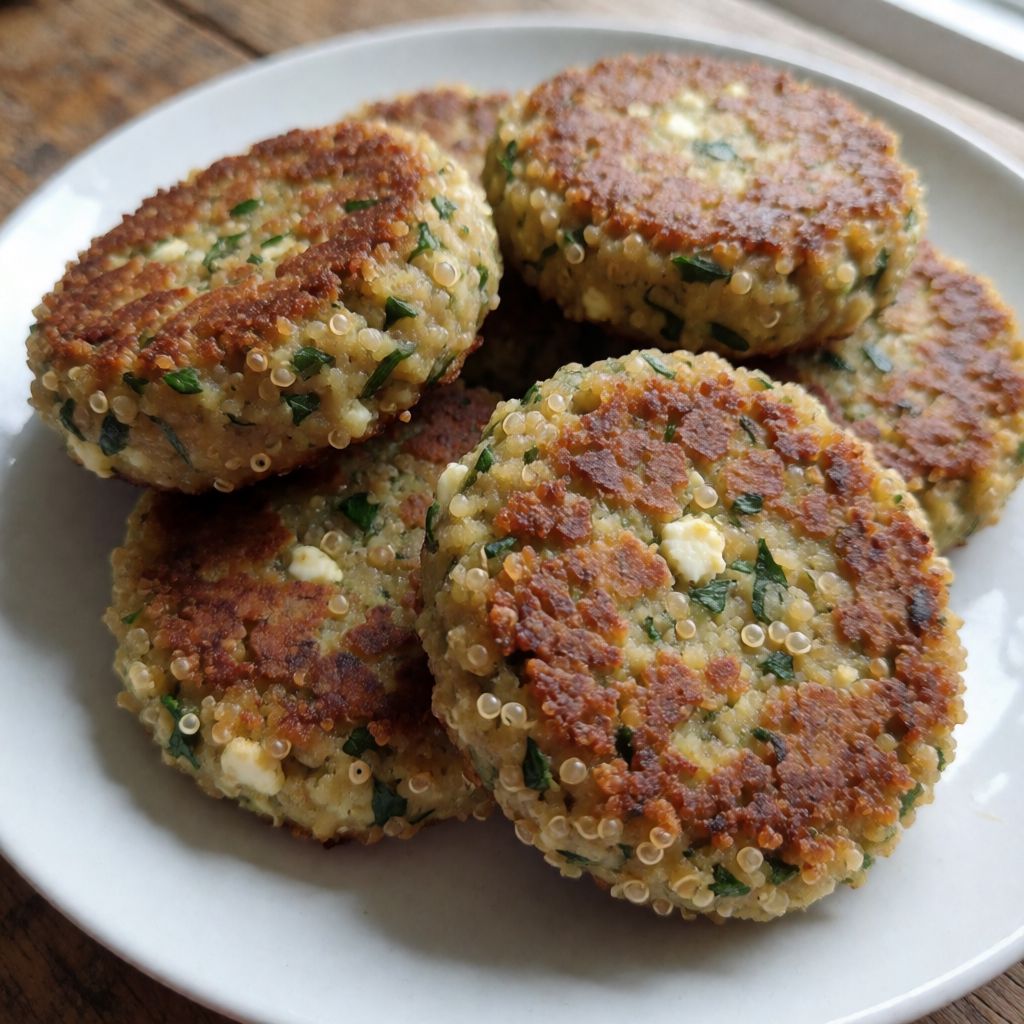
 AI photo
Quinoa, Feta & Chickpea Patties
Hearty quinoa patties with feta and chickpeas, baked until golden.
Labels are worked out automatically from the ingredients and can be wrong. Check the packaging if it matters to you.
Ingredients
- 150 g Quinoa
- 200 ml Stock
- 3 pcs Eggs
- 2 pcs Red onion finely chopped
- 3 clove Garlic crushed
- 1 bunch Parsley finely chopped
- 1 can Chickpeas drained, rinsed and roughly chopped
- 2 tsp Cumin
- 1 tsp Dried thyme
- 1 tsp Oregano dried
- 50 g Plain flour
- 75 g Feta
- 1 tsp Olive oil for brushing
- Salt to taste
- Black pepper to taste, freshly ground















Steps
Rinse the quinoa thoroughly in a sieve.
Put the quinoa and vegetable stock in a saucepan and simmer, covered, for 15 minutes.
15 minDrain off any excess liquid, tip the cooked quinoa into a bowl and mix thoroughly with the eggs, red onion, garlic, parsley, chickpeas, all the spices, flour and crumbled feta.
Mix everything until it forms a smooth mixture.
Let the mixture rest in the fridge for 30 minutes.
30 minShape into 10 patties and place on a baking tray lined with parchment paper.
Brush with oil and bake in a preheated fan oven at 190°C for about 25 minutes.
25 minTurn over halfway through the cooking time.
This is not a burger pretending to be virtuous — it's a bean patty that uses quinoa the way breadcrumbs are used in a proper rissole: as scaffolding, not flavour. Chickpeas give the body, feta gives the salt-hit, and quinoa gives you something to bind it all without turning to paste. Get the moisture balance wrong and you'll know it in the oven: the patty either slumps into a puddle or cracks like a dry riverbed.
What decides whether this works is the fridge rest, not the bake. Thirty minutes isn't a suggestion for tidiness — it's the time the flour needs to actually absorb the liquid sitting in the mix from the egg and the cooked quinoa. Skip it and you're baking a wet mixture that will weep moisture onto the tray and never set a crust; the "25 minutes" in the recipe assumes a mix that's already gone firm in the cold, not one straight off the chopping board.
Some say vegetarian patties always fall apart in the oven — no, because they're usually missing a binder that's actually doing work. Here the egg is the binder (protein sets with heat, holding everything together), the flour is the moisture-manager (it soaks up the wet rather than fighting it), and the quinoa is bulk. Three different jobs. If you only have one of them doing all the work, of course it collapses.
Ten patties from this is a sensible weeknight-plus-leftovers batch: think lunchboxes for the week, not a dinner-party centrepiece. They're sturdy enough to eat cold the next day, which tells you the structure is sound — a bad patty only holds together warm.
Quinoa here isn't cooked for its own sake — it's cooked in stock, not water, because a patty with no seasoning inside it relies entirely on surface salt, and surface salt on a baked (not fried) patty is a thin, unconvincing thing. Fifteen minutes covered, low enough that it simmers rather than boils dry, and you're looking for the grain to go from hard little bead to translucent with the white germ visible — that's the doneness cue, not the clock. Any stock works here; a weak one just means you lean harder on the cumin and thyme to carry flavour.
Chickpeas are roughly chopped, not mashed, and not pureed — that's deliberate. A smooth paste of chickpea gives you a texture closer to hummus than to a patty, and it won't hold a shape in the oven without a wall of flour to compensate. Rough chop keeps little pockets of whole bean, which is where the texture — the bit that makes this a patty and not a dip — actually lives. If you've only got dried chickpeas, soak and cook them soft enough to dent under a thumb; canned ones are already there, which is the entire economic case for using a tin on a weeknight.
Feta's job is salt and tang, delivered in small sharp bursts rather than smoothed through. Crumble it, don't grate it — grating melts it into the mix on contact with your hands' warmth and you lose the pockets. If you're out of feta, any firm, salty, crumbly cheese with no great ambition to melt does the job — a mature Lancashire crumbles the same way and is sitting in most UK fridges already.
The egg count — three for this batch — matters more than it looks. Too few and the mix won't hold through the turn at the halfway point in the oven; too many and you get something closer to a baked omelette with bits in it. Red onion goes in raw and finely chopped rather than cooked down, because a baked patty doesn't get hot enough for long enough to properly soften a coarse-cut onion — cooked onion here would still taste raw in the middle, so fine dice is the fix, not a myth to ignore.
Flour is plain, and 50g for this volume is a modest amount — it's there to tie up moisture, not to make dough. If the mix still feels wet after the fridge rest, that's the flour telling you something: add a spoonful more rather than fighting it with a longer bake, because a longer bake at 190°C just dries the outside while the centre stays slack.
On the oven: 190°C fan is hot enough to set a crust on the outside before the inside dries out, which is why the brush of oil matters — it's not for flavour, it's to stop the surface catching before the centre firms. Turning halfway isn't fussiness; a fan oven's heat isn't perfectly even from one side of a tray to the other, and the underside sitting on parchment doesn't get the same direct exposure the top does. No tray big enough, no fan setting — the limits of a standard UK domestic oven aren't a flaw here, they're exactly what this recipe is built around.