
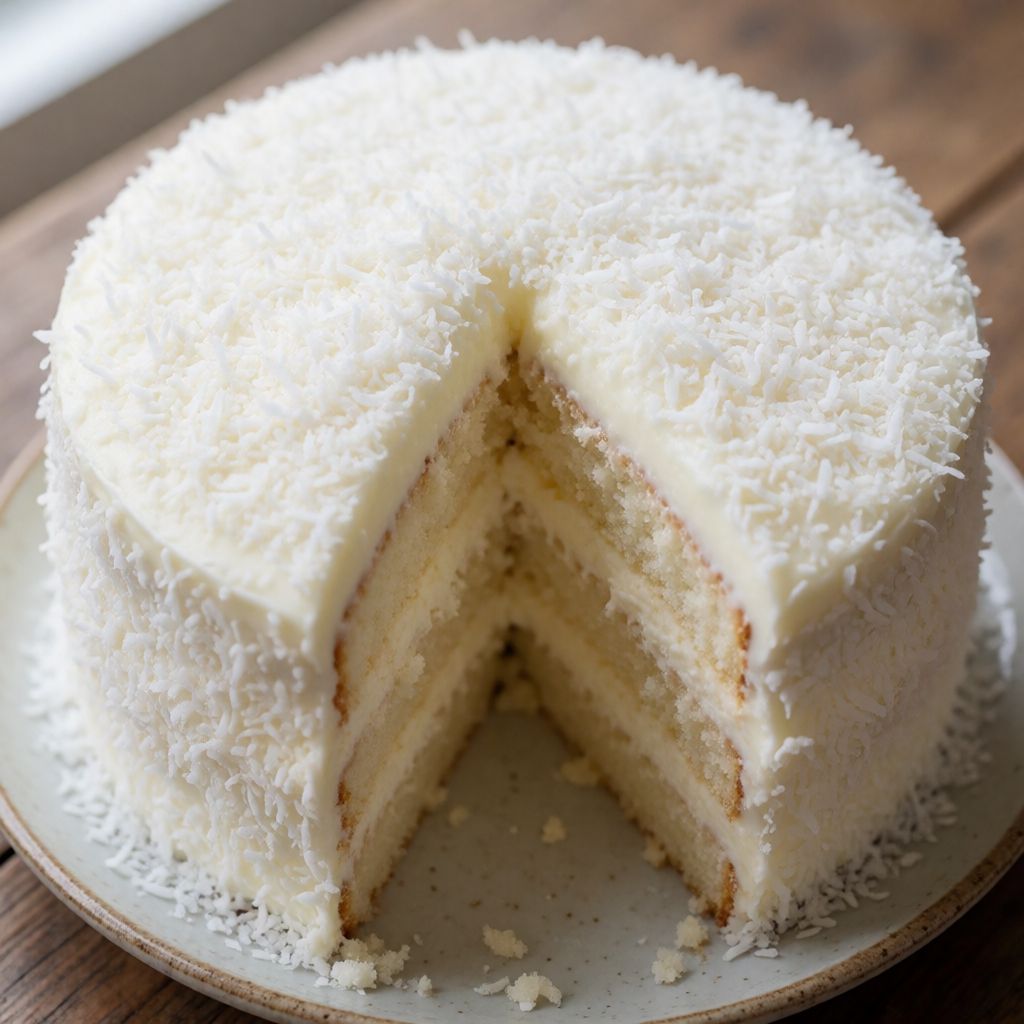
 AI photo
Raffaello Coconut and White Chocolate Cake
A layered sponge cake filled with white chocolate and mascarpone cream, finished with coconut, inspired by Raffaello sweets.
Labels are worked out automatically from the ingredients and can be wrong. Check the packaging if it matters to you.
Ingredients
- 4 pcs Eggs
- 100 g Caster sugar
- 70 g Plain flour
- 70 g Potato starch
- 500 g Mascarpone
- 250 g White chocolate
- 50 g Icing sugar
- 80 g Almonds
- 200 g Vanilla wafers
- 80 g Desiccated coconut plus extra to taste
- 450 ml Double cream
- Milk to taste








Steps
Break the eggs into a bowl, add the sugar and beat with a mixer for 10-15 minutes until pale and fluffy.
15 minSift the flour and potato starch, and gently fold in with a spatula.
Pour the batter into a buttered 22 cm tin and bake at 180°C for 30-35 minutes.
33 minLet the sponge cool completely.
Chop the almonds and vanilla wafers.
Melt the white chocolate over a double boiler or in the microwave, then let it cool slightly.
Beat the mascarpone with the icing sugar using a mixer.
Add the melted white chocolate, chopped almonds and wafers, and mix well.
Whip the double cream until thick and gently fold it into the cream mixture.
Cut the cooled sponge horizontally into three equal layers.
Place the first layer, soak with milk, and spread with cream.
Place the second layer, repeat soaking with milk and spreading cream.
Place the final layer, soak with milk, and spread cream on top and sides.
Decorate the cake with desiccated coconut on the top and sides, and finish with Raffaello sweets.
Keep the cake refrigerated until serving.
This is a biscuit cake pretending to be a sweet shop — a plain sponge, split into three, carrying a mascarpone cream that's been bulked with melted white chocolate, chopped almonds and crushed wafers. Dress it in coconut and it reads as "Raffaello," but what you're actually building is an architecture problem: three soft discs, two thick layers of a cream that must hold its shape under its own weight, and a window of time at the end where the whole thing needs to sit still and let gravity and cold do their work. Nothing here is technically hard. What decides whether it works is restraint at three points — how far you beat the eggs, how wet you make the sponge, and how cold the cream is when you spread it.
The sponge itself is a classic genoise-style base: no raising agent except the air you beat into the eggs. That's why the mixing time is not decoration — it's the only leavening you've got. Potato starch instead of all flour gives you a crumb that's drier and a touch more fragile, which actually works in your favour here: a wetter, springier sponge would fight the knife when you split it into three and would turn gummy once it's soaked.
The "myth" worth naming: some say you need a stand mixer running 15 minutes non-stop or the cake won't rise. No — what you need is the mixture tripled in volume and pale enough that a ribbon holds its shape for a second when you lift the beater. A hand mixer does this fine in a domestic kitchen; it just takes longer and your arm will know about it. Watch the batter, not the clock.
Splitting a 22cm sponge into three equal layers by eye, on a normal kitchen worktop with a bread knife, is the part people dread and shouldn't. The trick isn't skill, it's patience: let the sponge cool completely — properly cold, not just "not hot" — before you touch a knife to it. A warm sponge compresses and tears under the blade; a cold one shears cleanly. If your knife keeps dragging, you're cutting too early, not cutting wrong. A length of cotton thread pulled through the sponge works better than any knife if you have one to hand, but it's not essential.
The milk-soak is doing a specific job: a baked sponge, on its own, drinks like a dry sponge (the pun is unavoidable). Milk — plain, whatever's in the fridge for tea — rehydrates it just enough that each layer is moist without collapsing into mush. Go gently with a spoon or pastry brush rather than pouring; too much milk and the layers slump under the cream's weight once stacked, and the whole cake leans. "To taste" in the ingredients list really means "until the sponge feels damp under your finger, not wet."
On the cream: mascarpone is there for body and a clean dairy flavour, not sweetness — that's why icing sugar is added separately rather than relying on the chocolate. White chocolate brings its own sugar and fat, which is why it's melted and cooled before going in — hot chocolate meeting cold mascarpone will seize and streak, so let it come down to just-warm first, the temperature your lip would call "fine" rather than "hot." The chopped almonds and wafers aren't decorative; they give the cream some bite and stop it reading as one uniform mousse all the way through. If you can't get vanilla wafers, any plain, not-too-sweet biscuit crushed small does the same structural job — it's filler for texture, not a flavour you're chasing.
Whipping the double cream separately and folding it in, rather than beating everything together, is the one step that actually protects the cake. Overwork cream once it's mixed with mascarpone and chocolate and it can split — you'll see it go grainy and loose instead of holding peaks. Folding keeps the air you've whipped in intact, which is what gives you a cream light enough to spread without crushing the sponge beneath it, but firm enough to hold three layers upright. If you've no double cream, any cream with enough fat to whip to soft peaks will do — single cream won't, and that's not a shortcut worth taking.
Any flavourless oil doesn't come into this recipe, but the same logic applies to the butter you grease the tin with: use something with no character of its own, because at 180°C anything strongly flavoured just adds smoke and smell, not taste, to a sponge that's meant to stay neutral.
Last point, and it's the one people skip: the fridge rest isn't storage, it's assembly. A freshly stacked cake is a landslide waiting to happen — cold firms the cream, lets the layers bond to each other, and is what lets you slice it cleanly rather than watching it slide sideways on the plate. Give it the time in the cold before you cut it; that wait is doing work, not just holding the cake until teatime. This feeds ten reasonably, more if it follows a Sunday roast and nobody's that hungry.