
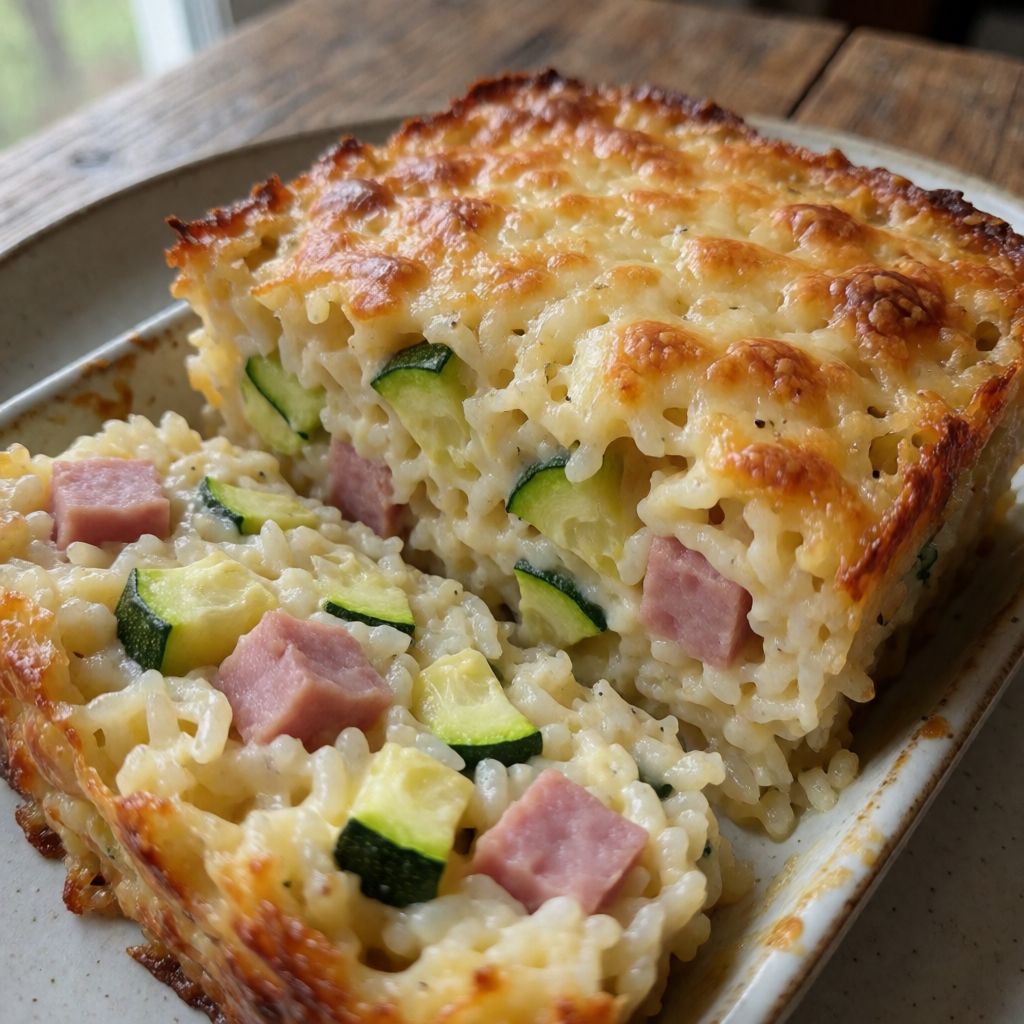
 AI photo
Rice Bake
A comforting rice bake with ham, courgette, Parmesan and Provolone, finished in the oven until golden.
Labels are worked out automatically from the ingredients and can be wrong. Check the packaging if it matters to you.
Ingredients
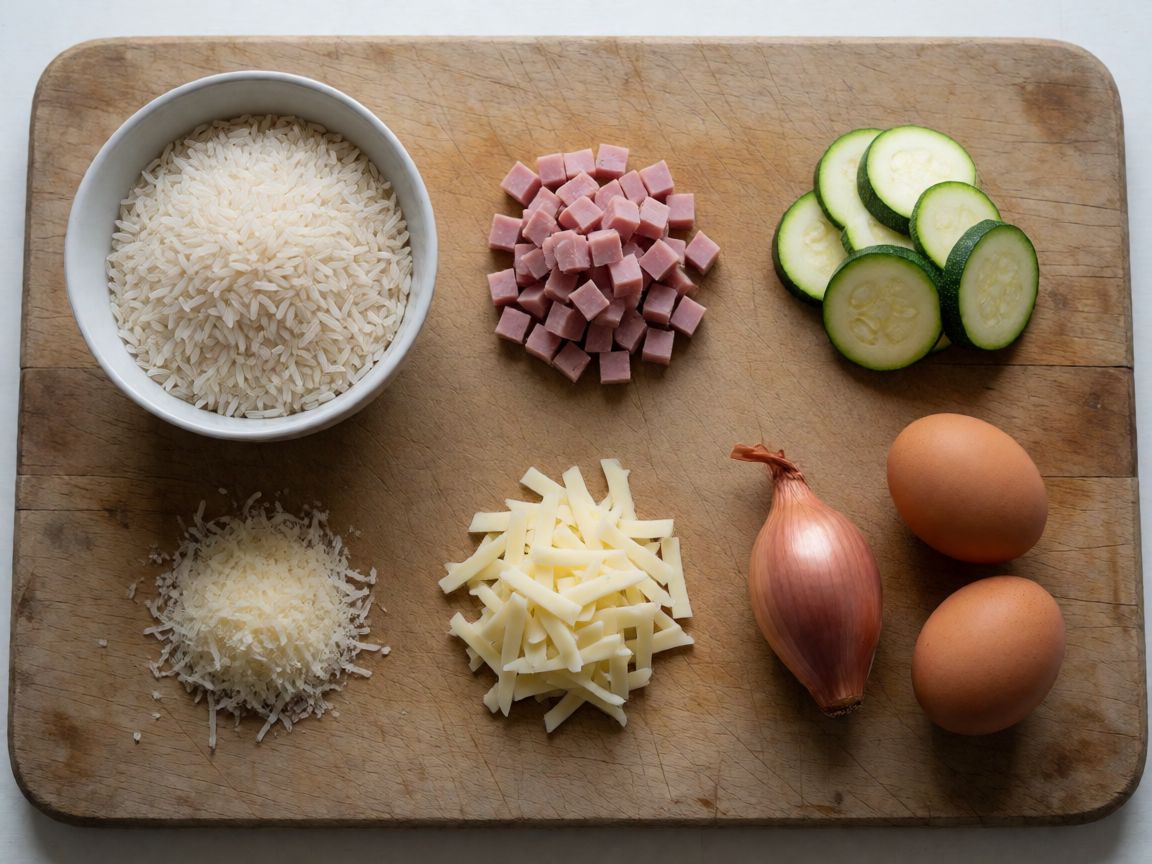









Steps
Boil the rice in salted boiling water according to the packet instructions.
Wash the courgette and cut it into small cubes.
In a frying pan, lightly fry the finely chopped shallot in a little olive oil for a few seconds, then add the courgette and cook until soft.
Beat the eggs with the Parmesan.
Drain the cooked rice in a colander and transfer it to a bowl. Add the sautéed courgette, ham, the egg and Parmesan mixture, the Provolone, salt and black pepper.
Mix until smooth and transfer the mixture to a baking dish greased with olive oil.
Sprinkle the top with Parmesan and bake in an oven preheated to 180°C for about 20 minutes.
20 min
This isn't a risotto, and it isn't a flan either — it's closer to the Italian timballo: cooked rice packed tight with ham, cheese and vegetable, held together by egg, and finished under heat just long enough to set. Think of it as a savoury bread pudding where rice does the work bread usually does. What decides whether it works is not the oven, it's the water you let into the bowl before the oven ever sees it.
Three things in this dish carry water: the boiled rice, the courgette, the egg-and-Parmesan mixture. The oven has no mercy on any of it — a hot box just sets what's already there, it doesn't dry out a wet mixture, it bakes the wet right into the structure. So every step before baking is really a drainage step in disguise. Draining the rice properly in a colander isn't a formality, it's removing the first source of trouble. Sautéing the courgette until it's soft — not just warmed through — is removing the second: raw courgette is close to 95% water sitting in cells that haven't burst yet, and if you skip that pan and go straight to the bowl, that water comes out slowly in the oven instead, under the surface, and you get a bake that's set on top and soft and wet underneath. Some say courgette doesn't need cooking first, it'll cook in the oven anyway — no, because the oven time here is short and gentle, built for setting egg, not for driving off a vegetable's water.
Rice: pick whatever you'd use for a pilaf, something that stays separate when boiled and drained, not something that goes creamy. If it clumps, break it up gently with a fork once it's in the colander, cooling slightly — clumped rice means clumped pockets in the bake, no egg mixture reaching the grains in the middle.
Ham: this is the ingredient with the most freedom in it. Any cooked, salted, already-flavoured meat works — the point of ham here is salt and savour distributed through the rice, not texture, since it's diced small and cooked twice over (once to cure, once in the bake). If there's gammon left from a Sunday roast, that's not a compromise, that's the dish doing what this kind of bake was invented to do — using up cooked meat that's otherwise heading for sandwiches, stretched across rice to feed six instead of two.
Courgette: choose firm ones, not the soft, seedy, oversized kind that's mostly water and air inside — those will fight you even after sautéing. Cut small and even so they soften at the same rate; a fat chunk stays raw-tasting in the middle while the thin edges turn to mush. No courgette to hand — aubergine works on the same logic, cut small, salted and sautéed to drive off its water the same way; mushrooms too, though they bring their own liquid out differently and faster.
Parmesan and Provolone are doing two different jobs, not one job twice. Parmesan goes into the binder and on top — it's hard, aged, salty, it seasons as much as it sets. Provolone goes into the body of the bake for pull and softness when you cut it, a cheese chosen for melting behaviour, not flavour strength. If you're substituting, match the job: a mature hard cheese with real salt — Grana Padano, a well-aged Cheddar at a pinch, though Cheddar will bring its own sharpness along and change the character — for the Parmesan role; and any semi-hard cheese with no loud flavour of its own, low-moisture mozzarella, Emmental, for the Provolone role. Put a loud cheese in the wrong slot and it either disappears in the mix or dominates the top where you wanted a quiet, golden crust.
Eggs: two to 400g of rice is just enough protein to glue, not enough to turn the thing custardy — if you want more hold for slicing clean portions, a third egg won't hurt, but don't mistake this for a quiche.
Shallot: fried only briefly before the courgette joins it, because the point isn't to colour it or soften it fully — it's to take the raw bite off before the courgette's moisture hits the pan and steams everything rather than frying it. A small onion, finely chopped, does the same job if that's what's in the bowl, just milder and sweeter from the shallot is traded for a touch more assertiveness. Oil: anything with no smell of its own, since nothing here should taste of the oil — a light olive oil, a plain vegetable oil, whatever sits in your cupboard without an opinion. And patience belongs on this ingredient list too, in its own quiet way: rushing the courgette, rushing the drain, rushing the set in the oven all end the same way — a dish that looks right on top and falls apart the moment you cut into it.