
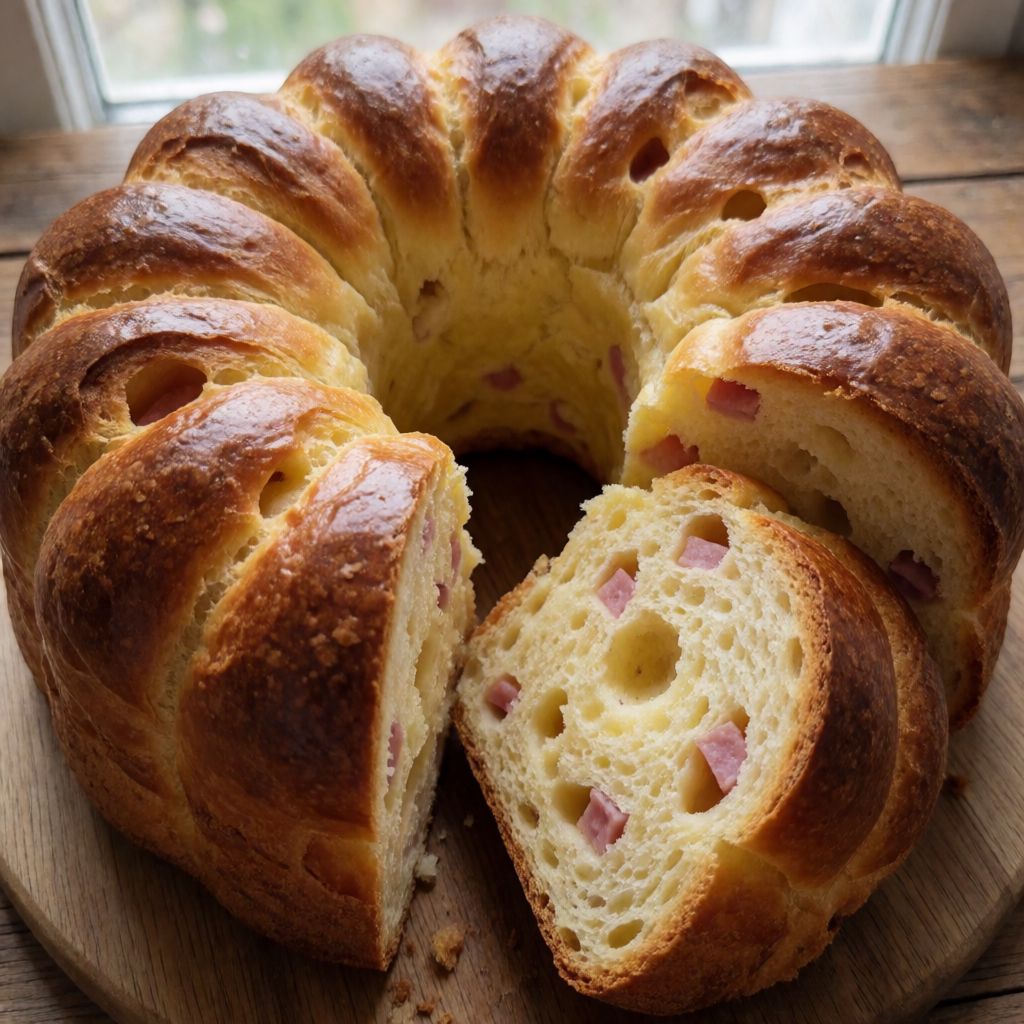
 AI photo
Neapolitan Rustic Babà with Salami and Cheese
A savoury Neapolitan babà rustico, enriched with cured meats and cheese baked right into the dough.
Labels are worked out automatically from the ingredients and can be wrong. Check the packaging if it matters to you.
Ingredients
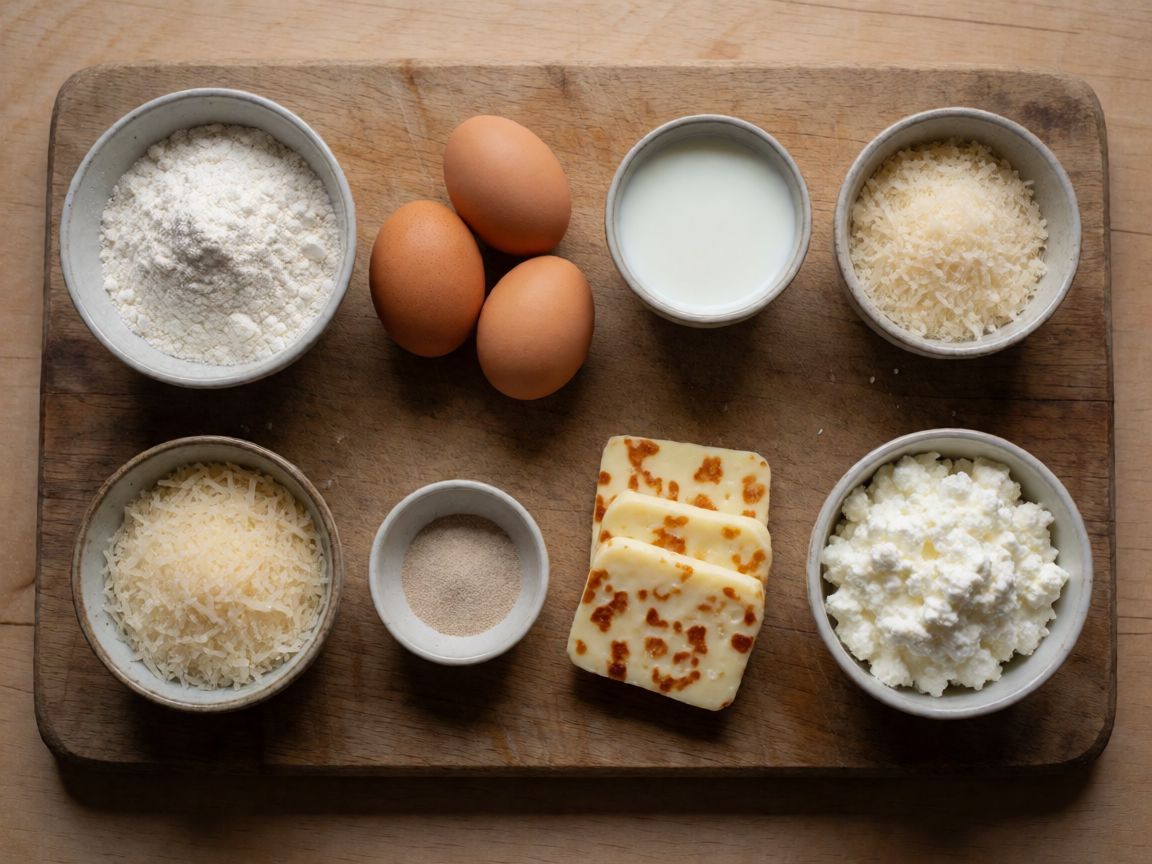
- 600 g Strong white (Manitoba) flour
- 4 pcs Eggs
- 300 ml Milk warm
- 80 ml Vegetable oil or lard
- 15 g Salt
- 25 g Parmesan grated
- 25 g Pecorino Romano
- 15 g Yeast
- Black pepper to taste
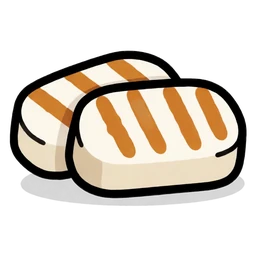
- 350 g Halloumi diced, or use salami, ham, pancetta, capocollo
- 400 g Cottage cheese or use scamorza, provolone








Steps
In a large bowl, mix the strong white flour with the yeast dissolved in warm milk, the grated Parmesan and Pecorino Romano, salt and black pepper to taste.
Add the eggs and pour in the vegetable oil (or lard).
Quickly knead the dough by hand or with a mixer until you get a very soft, slightly rough dough.
Add the cheese and cured meats, cut into cubes, and knead well to distribute them evenly through the dough.
Transfer the dough into a well-buttered babà tin and smooth the surface.
Cover with a damp cloth and leave to rise for 3–4 hours.
210 minBake the rustic babà in an oven preheated to 175°C for about 40 minutes.
40 minRemove from the oven and let it rest for 30 minutes before transferring to a serving plate.
30 min
This isn't a dessert babà, whatever the name suggests to anyone who's had a rum-soaked one in an Italian restaurant. "Babà" here just means the shape and the lazy, wet dough — a savoury loaf that behaves like a yeasted cake, studded with cheese and cured meat, built to be sliced cold at a Neapolitan Easter table or a picnic. Think of it as the Italian cousin to a pork pie: dense, rich, meant to sit around and be good at room temperature.
What decides whether it works is the dough's wetness and the strength of the flour fighting against it. Manitoba flour is specified because it's high in protein — it builds enough gluten to hold a dough this soft and this loaded with eggs, oil and lumps of cheese without collapsing into a greasy puddle. Some say any flour will do if you knead long enough. No — a weak flour (your standard plain, around 10% protein) simply doesn't have the structure to carry 350g of cheese and meat suspended inside it; the loaf will be gummy at the bottom and dense all through, because the gluten network tears before it can trap the gas.
The long rise — three to four hours, covered, somewhere draught-free — is not there to kill time. It's there because this dough is heavier than a normal bread dough: fat, eggs, cheese, salt all slow the yeast down, and a fast rise at a warmer spot would just mean the outside overproofs while the inside is still stiff with cold cheese cubes. You're waiting for the dough to roughly double, for it to look puffed and a little domed, not for a clock to run out. Time is your floor, not your ceiling.
The yeast matters more than it looks. Fifteen grams is a generous amount of fresh yeast for 600g of flour, and that's deliberate — this dough is weighed down by cheese, meat, oil and four eggs, so it needs more lift than a plain loaf to even get off the ground. If you're using dried instant yeast instead of fresh, you want roughly a third of that weight, not the same number — dried yeast is far more concentrated, and using fresh-yeast quantities of it will give you a dough that's bitter and over-fermented before it's even doubled.
The cheeses do two different jobs, and it's worth knowing which. Parmesan and Pecorino, grated into the dough itself, aren't there for big flavour hits — they melt into the crumb and season it evenly, the way salt does, so every bite carries a savoury backbone. Pecorino's sharper and saltier than Parmesan, so if you only have one, lean towards Parmesan and add a touch more salt to compensate, or you'll undersalt a loaf that already relies on cheese for its seasoning. The diced cheese and meat — halloumi, salami, provolone, whatever you're using — is a different thing entirely: chunks meant to stay chunks, pockets of melt and chew against the bread. Halloumi's an odd choice outside Italy but it works for exactly the reason it's famous for on a barbecue — it holds its shape under heat instead of collapsing into oil the way a very soft mozzarella would, so your dough doesn't end up with greasy craters.
For the cured meat, the brief is wide — salami, ham, pancetta, capocollo — because the real requirement is just "dry-cured, well-salted, cuts into cubes without disintegrating." In the UK that opens the door to a decent chorizo, a good streaky bacon fried off first and cooled, or diced Parma ham if you want to spend the money. What doesn't work is anything wet-cured and watery — a supermarket wafer-thin ham will just steam and go rubbery inside the dough rather than holding its own texture.
The oil or lard is there for tenderness, not flavour — fat coats the gluten strands and stops the loaf baking up tough and bread-like, which matters because with this much egg and cheese you want something closer to a rich cake crumb than a chewy roll. Lard gives a slightly more savoury, old-fashioned result and is historically what would have been used in Naples, where lard was cheap and olive oil was for better things. Any neutral oil with no smell of its own does the job fine — sunflower, a mild rapeseed. Don't reach for strong extra-virgin olive oil here; its flavour fights the cheese rather than supporting it.
The rest for thirty minutes after baking isn't optional politeness — it's the same reason you let a roast rest. The cheese inside is still molten, the crumb is still setting; cut into it straight from the oven and you'll tear the structure and lose the melted cheese into the pan rather than keeping it suspended in the slice. Patience here is the last ingredient, and it's cheap — you're just not allowed to skip it.
One shape note for a UK kitchen without a traditional ring-shaped babà tin: a well-buttered standard loaf tin or a round cake tin works. The point of the tin is just to give the wet dough walls to climb rather than spread sideways on a flat tray — without that support, a dough this soft and this heavily loaded will simply sprawl and bake flat rather than rising up around its filling.