
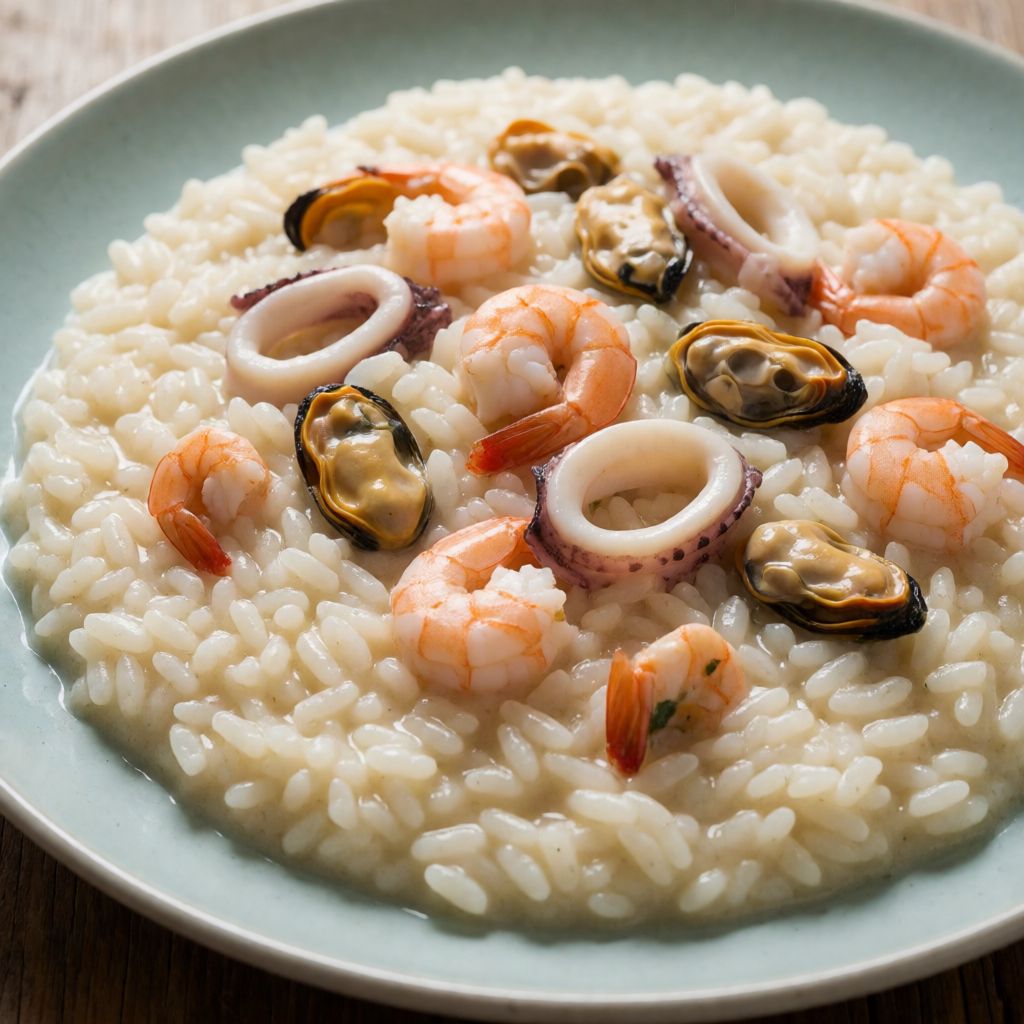
 AI photo
Seafood Risotto
A creamy risotto loaded with lobster tails, prawns and mussels, finished with fresh dill and lemon zest.
Labels are worked out automatically from the ingredients and can be wrong. Check the packaging if it matters to you.
Ingredients
- 2 pcs Shallot finely chopped
- 2 clove Garlic finely chopped
- 300 g Risotto rice
- 200 ml White wine
- 1 l Stock
- 1 tsp Butter for frying
- 1 tbsp Olive oil for frying
- 12 pcs Lobster tails
- 16 pcs Prawns
- 20 pcs Mussels
- 1 clove Garlic finely chopped
- 1 pcs Fennel finely chopped
- 1 pcs Shallot
- 100 ml White wine
- 1 tbsp Butter for frying
- Salt
- Black pepper freshly ground
- 1 bunch Dill fresh
- 1 pcs Lemon organic, finely grated zest















Steps
Put the shallot and garlic in a sauté pan and fry in the butter and oil until the onion is soft and translucent.
4 minAdd the rice and stir for about a minute, then pour in the white wine and half the stock. Mix well and cover with a lid.
2 minStir the risotto regularly, gradually adding the remaining stock, until the rice is perfectly cooked.
20 minSeason the risotto with salt and pepper to taste.
1 minClean the lobster tails and prawns, removing the shells; if you like, keep a few in their shells for garnish when serving.
5 minScrub the mussels under running water with a soft brush, without soaking. Tap any open ones on the worktop and discard any that don't close.
5 minLet the mussels dry on a clean tea towel.
2 minHeat a pan with butter and fry the shallot, garlic and fennel for about a minute.
1 minTurn the heat up to maximum, pour in the white wine, then add the mussels and cover with a lid. Reduce the heat slightly, but the mixture should keep simmering.
1 minSimmer the mussels covered over low heat for 5-7 minutes until they open.
6 minQuickly add the prawns and lobster tails, toss briefly over the heat, then combine the seafood with the risotto.
2 minServe in deep bowls, garnished with fresh dill and finely grated lemon zest.
A risotto is not really a rice dish. It's a starch-extraction process with rice as the raw material. Risotto rice — arborio, carnaroli, whatever's on the shelf labelled "risotto" — has fat, round grains with a dense core and a soft outer layer loaded with amylopectin starch. You're not trying to cook it the way you'd cook rice for a curry, where the goal is grains that stay separate. Here the goal is the opposite: you want the outside to break down into a starchy slurry that coats every grain, while the centre keeps just enough bite to register as rice and not porridge. That's the whole mechanism. Everything else — the stock added gradually, the stirring — serves that one outcome.
Alongside it sits a seafood pan that's doing something completely different: three creatures with three different cooking times, handled so none of them overshoots. Mussels need heat and steam to force their hinge open. Prawns need barely a minute before they go from translucent to opaque and then, a minute later, to rubber. Lobster tail is already cooked through almost as fast as the prawns. The two halves — the slow patient rice and the fast nervous seafood — only meet at the very end, in the bowl, not in the pan. That timing is the real recipe.
What decides whether this works isn't skill with a knife or an expensive pan. It's whether you add stock slowly enough and whether you pull the seafood off the heat the moment it's ready rather than a moment after. Both are failures of patience, not technique, and both are invisible until you've already ruined it.
Start with the stock. People treat it as background, something you boil water with a cube in. Don't. The stock is the only seasoning the rice gets besides salt, and it's going in a litre at a time in small additions, so whatever flavour is weak in the stock stays weak in the finished dish — there's no second chance to fix it later. A fish or light shellfish stock earns its place here; a heavy beef stock will fight the seafood rather than support it. If you've only got a stock cube, that's fine, but simmer a few prawn shells or mussel scraps in it for ten minutes first — you're borrowing flavour you're about to throw away otherwise.
The shallot and garlic go in first and get cooked until "soft and translucent" — that phrase is doing real work. You're not trying to brown them. Browning means Maillard reaction, which means new flavours, which is the wrong direction here; you want the onion to disappear into sweetness, not announce itself. Translucent means the cell walls have broken down enough to let light through — that's your visual cue, not a clock. Some say you must use only butter for this base because that's "authentic." No — butter alone scorches more easily on a domestic hob, which runs hotter and less evenly than a flat-bottomed pan over a wide gas ring in a restaurant kitchen. Oil raises the smoke point and buys you a margin of safety. Use both, as the recipe does, or use a neutral oil alone — anything with no smell of its own, sunflower or a mild olive oil — if you're out of butter.
The rice goes in dry for a minute before any liquid touches it. This step gets skipped by people in a hurry, and it's the reason their risotto turns gluey rather than creamy. Toasting the grain briefly in fat coats each one in a thin fat layer, which slows how fast water can penetrate to the core — that's what keeps the centre of the grain with a bit of resistance later, rather than cooking through uniformly to mush. Then the wine, then stock, added gradually and stirred: the stirring isn't ritual, it's abrasion. You're physically knocking starch off the surface of the grains so it dissolves into the liquid around them, which is what turns a pot of rice and broth into something with body. If you dump all the stock in at once, the grains never rub against each other enough to release that starch, and you get rice boiled in broth, which is a different and worse thing.
The mussels are the part people are genuinely nervous about, usually for no good reason. Scrubbing without soaking matters because mussels don't need to "purge" the way clams sometimes do in sand-heavy waters — soaking them just lets them drown in fresh water they can't process, which stresses and sometimes kills them before they ever reach the pan. A dead mussel, closed or not, is not safe to eat, which is why any open one that doesn't close when tapped gets binned before cooking — it's already dead, or dying, and you have no way to tell how long it's been that way. That's not superstition, that's just the one reliable test you have in a home kitchen without a lab.
The seafood pan itself is a steam engine, not a fry pan. Wine goes in at maximum heat so it flashes to steam almost immediately, then the mussels go in and the lid traps that steam around them — they open because the heat forces the adductor muscle holding the shell shut to relax, not because of any magic in the wine. "Covered, simmering" is the state you're listening for as much as watching for: a steady patter against the lid, not silence and not a violent rattle. Once they're open, you've got a narrow window — prawns and lobster tail go in for a toss, no more, because at that point the pan is hot enough that overcooking happens in the time it takes to find a serving spoon. Prawns curl into a tight C when done; past that, into an O, they've gone too far and the texture turns from snap to chalk.
Fennel earns its spot here for the same reason dill and lemon zest show up only at the very end: seafood cooked simply needs something aromatic and slightly bitter or sharp to cut its sweetness, or the whole bowl reads flat. If you don't have fennel, celery does a rougher version of the same job — less aniseed, more green crunch — but it's a genuine substitute, not an equal one. The lemon zest goes on raw, grated at the table or just before, because its oils are volatile and cooking burns them off in seconds; that's why it's never simmered into the pan with everything else.
None of this needs to be rushed, and rushing is exactly where it goes wrong — the rice undercooked in the centre because you were impatient with the stock, or the prawns rubbery because you panicked and left them a minute too long out of habit from cooking them some other way. Forty-five minutes is the bare minimum the clock gives you, not a target to beat.
·