
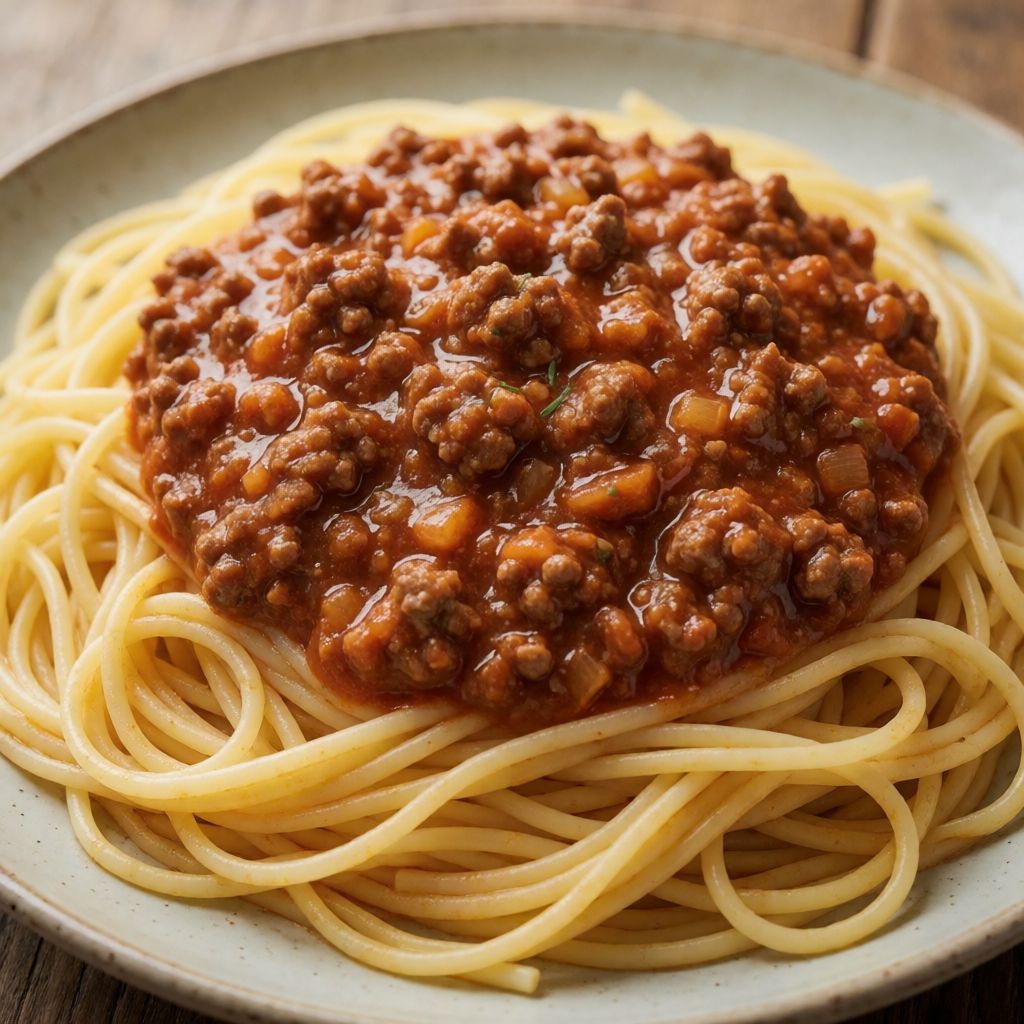
 AI photo
Spaghetti Bolognese
A rich, slow-simmered beef and tomato ragù served over spaghetti, finished with parmesan.
Labels are worked out automatically from the ingredients and can be wrong. Check the packaging if it matters to you.
Ingredients
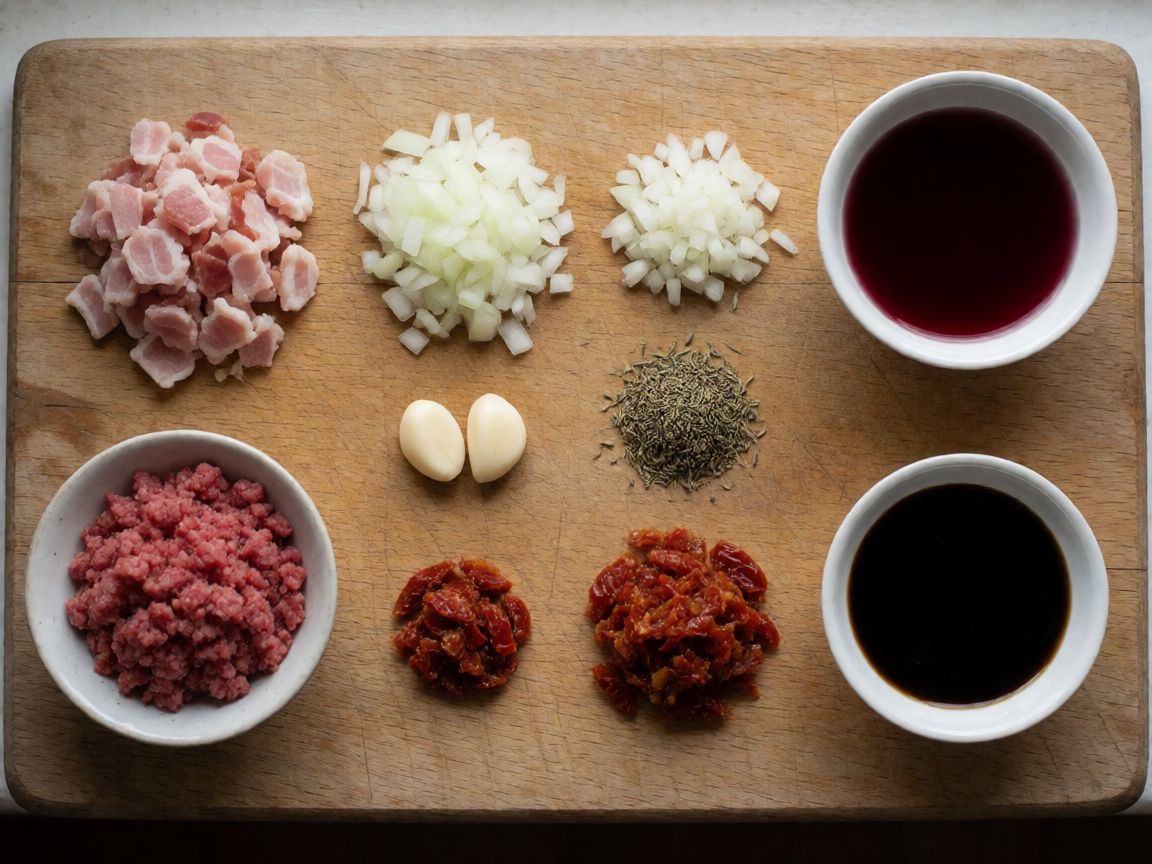
- 50 g Bacon
- 2 pcs Onion finely chopped
- 2 clove Garlic finely chopped
- 2 tsp Dried thyme dried
- 500 g Beef mince
- 100 ml Wine
- 100 g Sun-dried tomatoes finely chopped
- 2 tbsp Balsamic vinegar
- 800 g Chopped tinned tomatoes
- 2 tbsp Olive oil
- Salt
- Black pepper freshly ground
- 400 g Spaghetti
- 75 g Parmesan freshly grated
- 2 tsp Olive oil a few drops to finish












Steps
Fry the bacon in olive oil over medium heat. Remove the bacon and let it drain.
Put the onion, garlic and thyme into the pan with the bacon fat and fry, stirring.
Add the meat, brown it, then pour in the wine. Add the sun-dried tomatoes, balsamic vinegar and chopped tomatoes.
Cover with a lid and simmer gently for about 1 hour so the sauce does not boil dry.
60 minCook the spaghetti according to the pack instructions.
Serve the pasta in deep bowls with the bolognese, drizzled with olive oil and sprinkled with parmesan.
Forget the idea that bolognese is "meat sauce with spaghetti poured over it." It isn't. It's a sauce that has had an hour to stop tasting of its separate ingredients and start tasting of itself. That hour is not decoration — it's the whole mechanism. Wine, tomato, bacon fat and beef are four different liquids and fats that want to sit on top of each other; only slow, covered heat has time to force them into one thing.
What decides whether this works is restraint at two ends. At the start: fry the bacon first, for its fat, not its crunch — you want a pan coated in rendered pork fat because that fat carries flavour into the onion that oil alone never would. At the end: a lid, kept on, so the liquid doesn't vanish before the beef has had time to give up its toughness. Lift the lid too often or too early and you get stringy meat in a thin, separated sauce — not because you did anything "wrong" exactly, but because you broke the slow braise into a quick simmer.
Some say you should brown the mince hard, in batches, for a "proper crust." No — not here. This isn't a steak. The mince is going to spend an hour swimming in tomato and wine; any crust you build will dissolve back into grey within minutes. Brown it enough to lose the raw colour and release a bit of fat, then move on. The flavour you're chasing comes from the hour, not from the first five minutes in the pan.
Patience is the actual ingredient that costs you nothing but time — and it's the one people skip. Everything else on the list is just there to be patient with.
Bacon here is doing fat's job, not bacon's job. Fifty grams is nothing to eat on its own — it's there to be rendered, so the pan holds a layer of savoury fat before the onion goes anywhere near it. If you've only got streaky bacon, that's actually better for this than back bacon, because streaky has more fat to give up. No bacon at all? A knob of butter plus the olive oil gets you partway there, though you lose the smoky edge — not a disaster, just a different sauce.
Two onions, finely chopped, and garlic with thyme straight into the bacon fat: this is the base getting built in order of how long each thing needs. Onion first because it needs the longest, softest cooking to turn sweet rather than sharp. Dried thyme rather than fresh is not a downgrade here — dried herbs survive an hour of simmering; fresh thyme would just dissolve into nothing by the end, so save fresh for garnishing, not for braising.
The beef mince wants a fat content with some give in it — truly lean mince dries out over an hour of slow cooking, because there's nothing in the meat to keep it moist once the surface moisture cooks off. A fattier mince, the kind British supermarkets sell as "beef mince" rather than "extra lean," is the better choice for a sauce that's going to simmer this long, not a quick fry.
Wine, sun-dried tomatoes and balsamic vinegar are the three things doing the real flavour-building, and each is solving a different problem. Wine deglazes the pan and adds acidity that tinned tomato alone doesn't quite have — any dry wine you'd drink works, red gives more depth but white won't ruin it. Sun-dried tomatoes are concentrated tomato flavour, the kind you can't get from fresh ones out of season — if you haven't got them, a spoon of tomato purée fried briefly with the onion gets you some of the same intensity, though not the chewy sweetness. Balsamic vinegar rounds the acidity at the other end; a splash of good red wine vinegar is a fair swap if that's what's in the cupboard.
The tinned chopped tomatoes are the bulk and the liquid that the lid is protecting — 800g sounds like a lot until you remember it's reducing for an hour, losing water the whole time, concentrating rather than vanishing. This is also where "simmer gently" earns its explanation: a hard boil breaks the sauce, splitting fat from liquid, because big bubbles agitate it faster than the proteins and starches can hold it together. On a British hob, that usually means the lowest ring your gas or electric hob actually has, with the lid cracked if it starts rattling — a kazan holds heat evenly all the way round; a flat-bottomed domestic pan heats harder in the centre, so stir now and then rather than trusting it to look after itself.
Spaghetti, cooked separately, needs nothing clever — just enough salted water that it isn't sitting in starch paste, and the timing on the packet as your lower bound, not your answer. Pull a strand out and bite it: it should offer a little resistance in the middle, not crunch and not collapse.
Parmesan at the end, freshly grated rather than the ready-grated tub, matters because pre-grated parmesan is cut with anti-caking agents and has usually lost whatever moisture made it melt properly — it sits on the pasta instead of becoming part of it. The final drizzle of olive oil isn't for flavour so much as for shine and a bit of slip, so the sauce coats rather than clumps — use something with no smell of its own at this stage, a decent extra virgin, since it's tasted raw here, not cooked.