
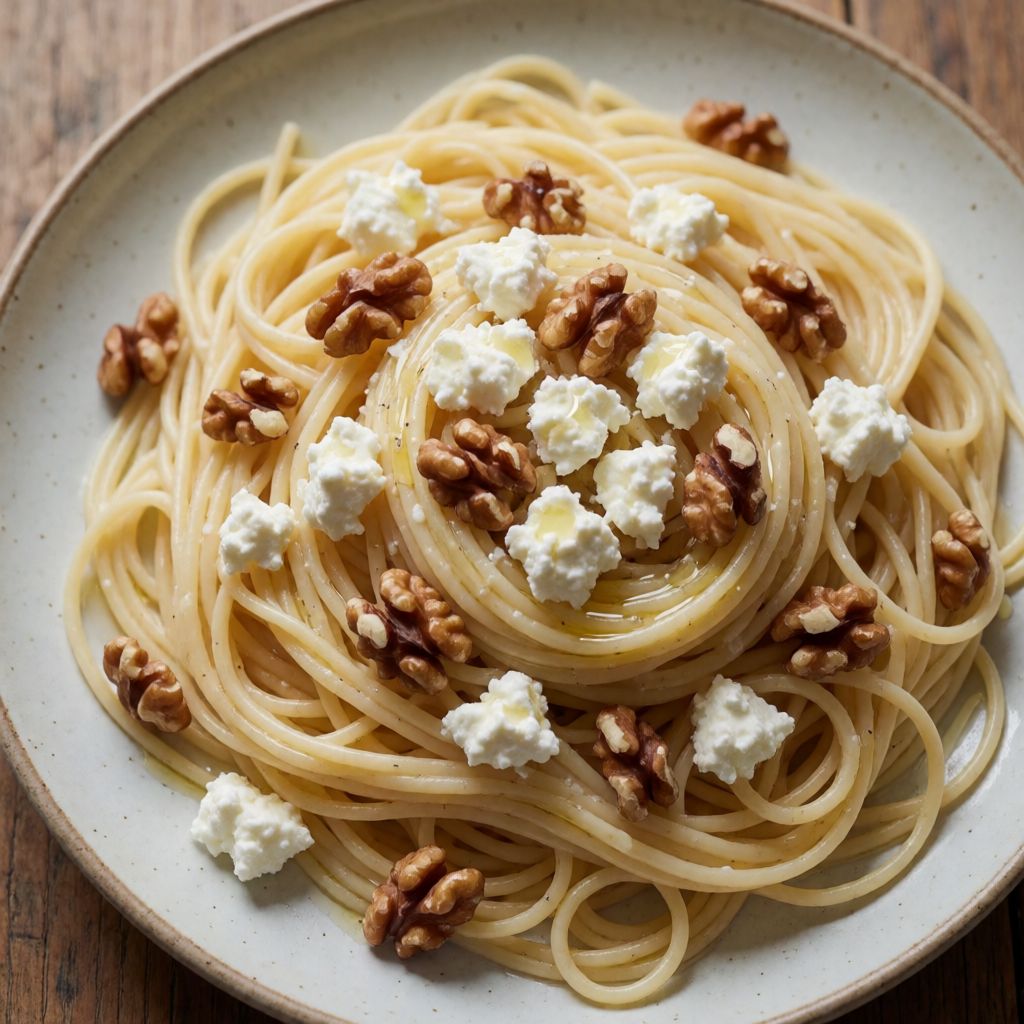
 AI photo
Spaghettini with Goat's Cheese and Walnuts
A quick pasta dish of spaghettini tossed with creamy goat's cheese, shallot and crunchy walnuts.
Labels are worked out automatically from the ingredients and can be wrong. Check the packaging if it matters to you.
Ingredients
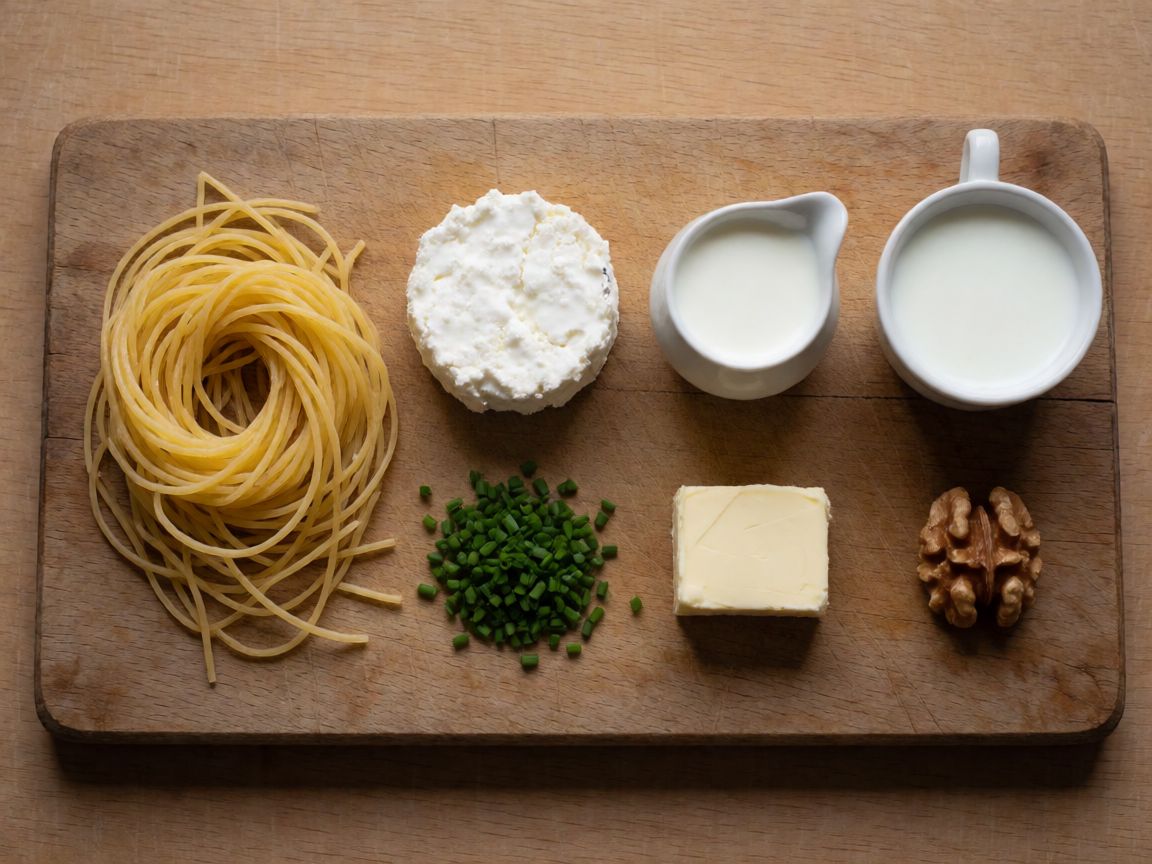
- 400 g Spaghettini
- 120 g Goat's cheese
- Olive oil to taste
- Double cream to taste
- 15 ml Milk or instead of the double cream
- Salt to taste
- Black pepper to taste
- 20 g Butter
- Chives to taste
- 20 g Chopped walnuts
- Walnuts to taste
- 1 pcs Shallot
- Grated Parmesan or Grana Padano to taste











Steps
While the spaghettini is cooking, fry the shallot in a non-stick pan with the butter and 1 tbsp olive oil.
5 minAdd the goat's cheese with the double cream (or with 15 ml milk) and let it soften.
5 minGrind in black pepper, and sprinkle over the chopped walnuts and chives.
2 minDrain the pasta al dente and tip it into the pan.
2 minToss with the grated Parmesan or Grana Padano, garnish with walnuts. Serve immediately.
1 min
This is a sauce built on a shortcut most people don't notice they're taking: instead of building an emulsion from scratch — the way you'd do with a carbonara, where egg and fat and starchy water all have to come together in careful sequence — you let fresh goat's cheese do the emulsifying for you. Goat's cheese at room-ish warmth goes soft and creamy under gentle heat without separating, because it's already an emulsion of fat and moisture held by milk proteins. Cream, or even a splash of milk, just loosens it to a coating consistency. That's the whole trick.
What decides whether it works is two things: the state of the pan when the cheese goes in, and the state of the pasta when it goes into the pan. The pan should be warm, not hard-working — goat's cheese doesn't need persuading, it needs patience and a low flame so the fat renders out slowly instead of the proteins tightening and turning grainy. And the pasta needs to arrive underdone by a minute, trailing a little of its cooking water, because that water carries dissolved starch, and starch is what turns melted cheese and butter into a sauce that clings instead of pooling.
Shallot first, fried until it goes from sharp and raw-smelling to sweet — not browned, not caramelised, just gone translucent and mellow in the butter and oil. That's the base note under the cheese, there so the whole dish doesn't just taste like one thing.
Goat's cheese: this has to be the soft, rindless log kind — the stuff sold as "soft goat's cheese" or "chèvre" in a UK supermarket, not the aged, crumbly, almost feta-like block. The soft log has enough moisture and fat still mobile in it to melt into cream under low heat. The aged kind just gets rubbery and refuses to loosen — it was never built to melt, it was built to keep. If you can't find it, a soft, mild sheep's cheese works on the same mechanism; a hard, salty blue does not — wrong structure entirely.
Double cream or milk: this is not a flavour choice, it's a viscosity choice. Cream gives you a thicker, richer coating with almost no risk of the sauce going thin and runny; milk gives you the same loosening effect but you're relying more on the pasta water's starch to hold things together, so don't skip reserving some of that water if you go the milk route. Use whichever is already open in your fridge — this is not a dish that punishes substitution here.
Butter and olive oil together, for the shallot: butter alone can catch and brown too fast over a direct flame doing real frying work; a little oil raises the point where the butter would start burning, and lets you take the shallot to "soft and sweet" without rushing it or scorching the milk solids in the butter. Any neutral oil with no smell of its own does the same job — olive oil is just what's already in most kitchens.
Shallot, not onion: shallots are milder and sweeter raw, so they get to "cooked through, no raw bite" faster and with less of the sharp sulphur smell that a regular onion throws off while it cooks. If you only have onion, use half the amount and give it longer — look for the same cue: softened, pale gold, sweet-smelling, not browned at the edges, because browning here would add a flavour this sauce isn't built to carry.
Chopped walnuts versus whole: the chopped ones go in with the cheese because their oils bleed slightly into the sauce as it warms, which is part of the flavour, not just the crunch. Some say toast them first for more flavour — no, because the sauce itself is already warm enough and long enough on the heat to wake the walnut oil up; toasting separately is an extra pan to wash for a difference you'd struggle to taste here. If walnuts aren't to hand, pecans work on the same principle — soft, oily nut, breaks down slightly under gentle heat — hazelnuts are harder and stay crunchy throughout, which changes the texture but isn't wrong, just different.
Parmesan or Grana Padano at the very end, off or barely on the heat: cheese added too early to a hot pan seizes and goes stringy or grainy, because its proteins tighten fast once the pan's heat is doing real cooking rather than just holding warmth. Tossing it through once the pasta's already in, with the heat backed off, lets it melt into the existing sauce instead of fighting it.
This feeds four as a plate of pasta on its own, or stretches further as a starter before a roast — which, fair warning, most British kitchens will want it to be, since a 400g pasta dish before a full Sunday dinner is a commitment. No real patience required here beyond letting the shallot and the cheese each take their own time rather than rushing both under high heat — this is a quick dish by design, the only ingredient asking for minutes is your attention, not the clock.