
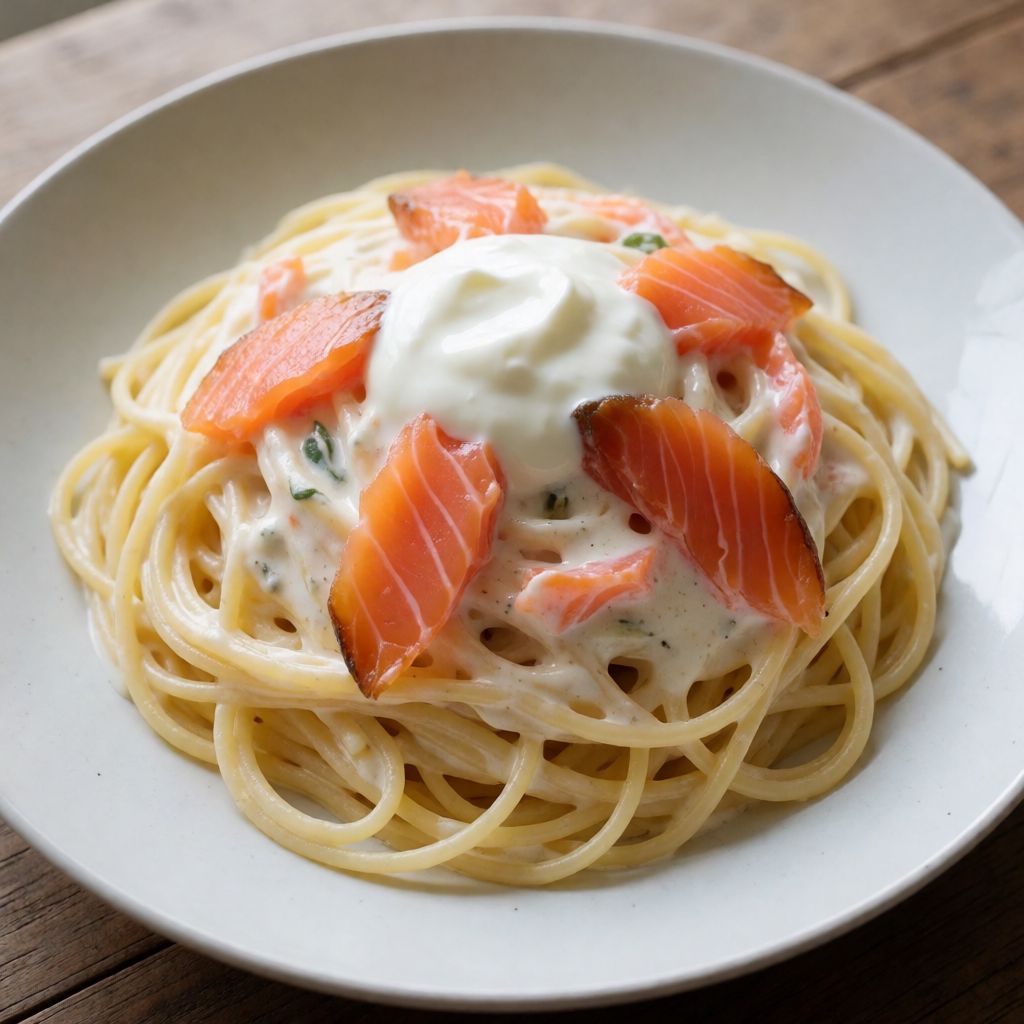
 AI photo
Spaghetti with Salmon and Sour Cream
A creamy pasta with smoked salmon, potato and sour cream, ready in no time.
Labels are worked out automatically from the ingredients and can be wrong. Check the packaging if it matters to you.
Ingredients
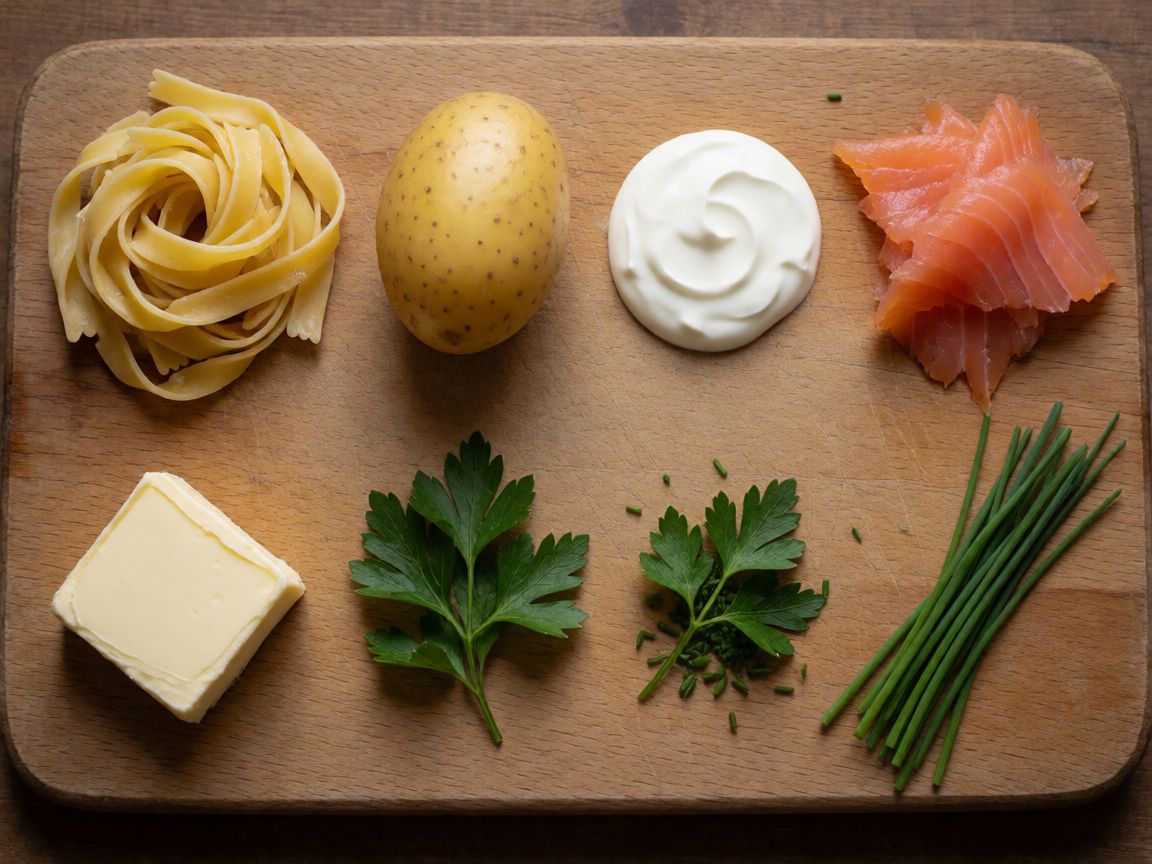
- 400 g Spaghetti
- 1 pcs Potato cut into small cubes
- 30 g Butter
- 200 ml Sour cream or double cream with lemon juice
- 200 g Smoked salmon cut into thin strips
- Salt to taste
- White pepper to taste
- Parsley to taste
- Chives to taste







Steps
Cook the spaghetti in plenty of salted water with the potato, cut into small cubes, until al dente.
Drain and transfer, together with the potato, into a pan with the butter.
Add the smoked salmon, cut into thin strips, and the sour cream, and toss well over the heat.
Season with ground white pepper, and sprinkle with parsley and chopped chives.
Serve immediately.
This is a lazy man's version of pasta with fish — nobody's cooking the salmon here, it's already smoked, already seasoned by time and wood smoke, so all you're doing is warming it through and letting it bleed its colour and salt into cream. The potato cooked in the same water as the spaghetti is the quiet trick: it's not a garnish, it's starch insurance. If your sauce breaks or sits thin, those little cubes and the starchy water around them are what pull it back together.
What decides whether this works is heat control at the very end, not skill with a knife. Sour cream curdles above a simmer — not because it's "delicate" the way recipe cards love to say, but because its proteins denature and seize into grains once the liquid gets properly hot, the same mechanism that turns a custard into scrambled eggs if you're not watching. So the pan goes off the full heat, or down to the point where the surface just trembles, before the cream goes in. Some say cream sauces "just are temperamental" — no, they're not, they're following chemistry, and chemistry you can predict.
The salmon stays off real heat too. It's cured and smoked already; cooking it further only tightens it and pushes out the oil that's carrying half its flavour. You want it to go from cold-firm to warm-soft, that's the whole journey — in it falls, a toss or two, done.
Feeds four as a main course, assuming nobody at your table treats pasta as a side to something else, which — fair warning — some people do.
Spaghetti: 400 grams for four is generous but not showing off — this is a creamy sauce, it clings, and you don't want a thin coat of sauce rattling around in a mountain of dry pasta. Salt the cooking water properly; it's the only chance the spaghetti itself gets to taste of anything, since nothing in the final toss is going to season the strand from inside.
The potato is the part people skip, thinking it's filler, and that's the real myth worth naming: "an extra starch, why bother." You cook it right alongside the pasta so it finishes soft enough that a fork goes through without resistance — the carrot-bends-not-snaps test, same idea, different vegetable. Small cubes matter here for one reason only: a domestic hob doesn't hold a rolling boil the way a restaurant burner does, so the smaller the cube, the more even the cook before your spaghetti is already past al dente and waiting.
Butter: 30 grams, and its job is to coat, not to fry — nothing browns here, there's no time and no need. Any fat with a clean, quiet flavour would do the same job; if you're out of butter, a light oil with no smell of its own works, though you lose the slight richness butter gives the sauce as it melts into the cream.
Sour cream is the backbone, and in a British kitchen it's worth saying plainly: if your shop only stocks double cream, add a squeeze of lemon juice and you've built your own sour cream, because that's genuinely what sour cream is — cream whose proteins and sugars have been gently soured, traditionally by natural culture, now usually by a controlled bacterial one. The acid in the lemon does a version of the same denaturing job, just faster and cruder. Either way, it goes into a pan that isn't roaring, for the reason already explained — above a simmer, it curdles, not because dairy is fussy by nature but because heat does something specific and irreversible to its structure.
Smoked salmon: 200 grams, cut into strips thin enough to warm through in the time it takes to toss the pasta a few times, not so thin they disintegrate into shreds. Smoking was never about flavour alone — it was preservation before refrigeration, salt and smoke doing the work a fridge does now, which is also why smoked salmon carries enough salt that you should taste before you reach for more at the end.
Parsley and chives go on last, raw, for colour and a green bite against all that cream and smoke — they're not decorative in the empty sense, they're the one fresh, sharp note in a dish that's otherwise soft textures and rich fat. And patience, here, is short but real: the whole dish lives or dies in the thirty seconds after the cream hits the pan, so don't walk away to answer the door.
·