
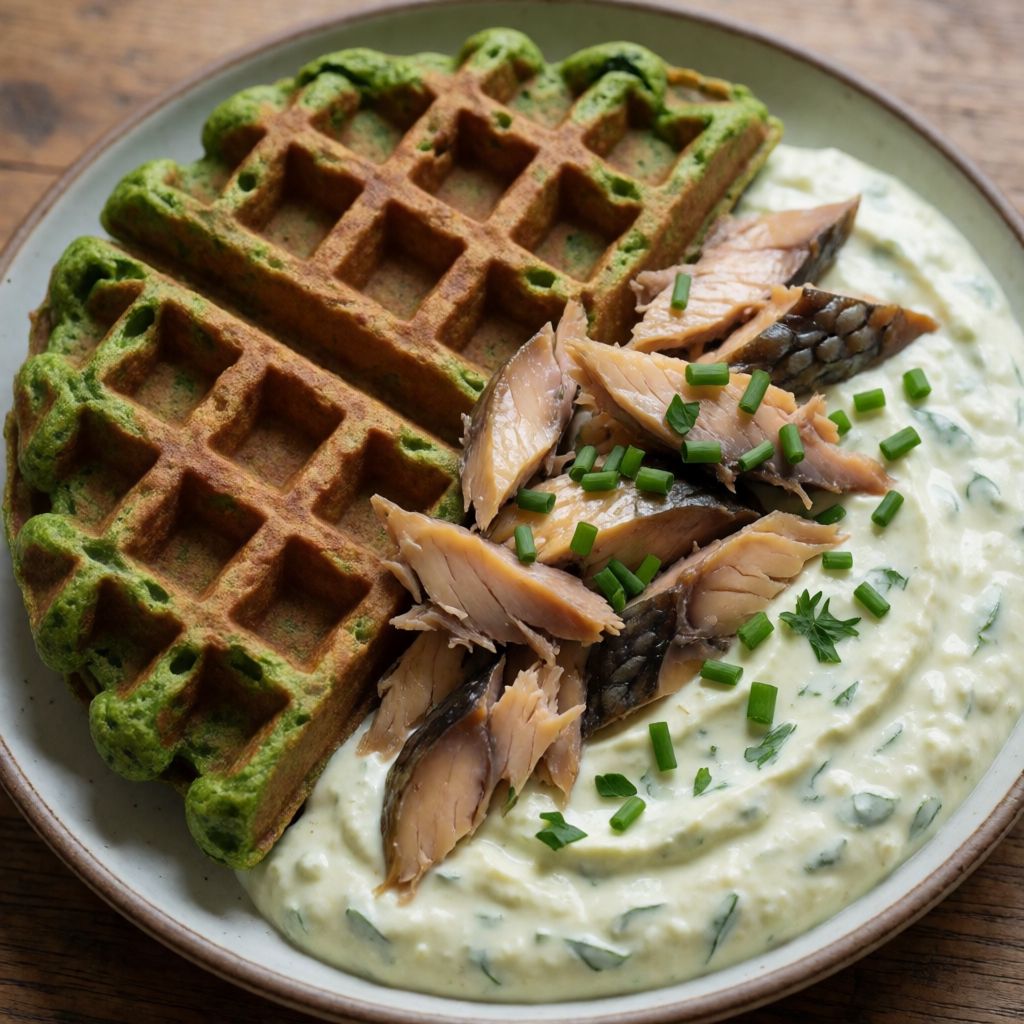
 AI photo
Spinach Waffles with Cheese Dip and Smoked Mackerel
Savoury spinach waffles topped with a creamy cheese dip, avocado, cucumber and smoked mackerel.
Labels are worked out automatically from the ingredients and can be wrong. Check the packaging if it matters to you.
Ingredients
- 300 g Cottage cheese
- ½ pcs Avocado
- 50 ml Chives finely chopped
- 50 ml Parsley finely chopped
- 1 clove Garlic
- Salt
- Black pepper freshly ground
- 150 g Plain flour
- 75 g Wholemeal flour
- 0.5 tsp Baking powder
- 125 g Spinach fresh or frozen
- 4 pcs Eggs
- 250 ml Milk
- 30 g Butter for frying
- Salt
- Black pepper freshly ground
- 75 g Rocket
- 1.5 pcs Avocado sliced
- ½ pcs Cucumber sliced
- 1 pcs Red onion finely chopped
- 200 g Smoked mackerel broken into small pieces
- 1 pcs Lemon for squeezing over



















Steps
Using a hand blender, blitz the cottage cheese, avocado, salt and pepper until creamy. Quickly stir in the chives and parsley. Chill the dip while you make the waffles.
5 minMix the plain flour, wholemeal flour and baking powder well in a bowl.
2 minWash the spinach thoroughly and put it in the blender with the rest of the ingredients, including the flour mixture.
2 minBlitz everything into a smooth, thin batter.
2 minLet the batter rest for 15 minutes so the flour can absorb some moisture and the batter thickens.
15 minSpread a little oil or butter in the waffle iron and bake the waffles until golden and cooked through.
15 minTop the waffles with the cottage cheese dip, avocado slices, cucumber, red onion and smoked mackerel, plus rocket, and squeeze over a little lemon juice.
3 min
This is a savoury waffle built as a plate, not a dessert — the batter is really just a vehicle to get something crisp and warm under something cold, creamy and salty. What decides whether it works is two things: the batter has to pour thin and bake dry inside, and the toppings have to stay properly cold and sharp against it. Lose either end of that contrast and you've just made a green pancake with fish on it.
The spinach does almost nothing for flavour — spinach on its own is mild, slightly mineral, easy to miss. What it gives you is colour and extra water. Because it goes into the blender raw (or straight from frozen, no blanching needed — some say you must blanch spinach first to 'set' the colour, but that rule is for spinach you're serving as spinach, on a plate, where you want it to stay bright under its own weight. Here it's pulped into batter with egg and milk; the colour comes from the blend, not from the leaf holding its structure), it also pads out the liquid, which is why the batter needs a rest before it goes anywhere near heat.
The real tension in this dish is temperature and texture working against each other on purpose: hot waffle, cold dip; crisp outside, soft inside; smoky, salted mackerel against sharp raw onion and a squeeze of lemon that's there to cut through the oil in both the fish and the avocado. If you eat it the moment the waffle comes off the iron and the toppings have been sitting in the fridge, you'll taste the whole point of the recipe. If everything's lukewarm, it collapses into mush with no contrast left.
Two flours, one leavening. Plain flour gives you the gluten that holds the waffle together once it hits the hot iron; wholemeal adds bran, which breaks up that structure slightly and gives a coarser bite and a nuttier taste — think of it as diluting the strength of the plain flour on purpose. Half a teaspoon of baking powder is there to lift the batter just enough that the inside stays soft rather than dense; too little and you get something closer to a thick crêpe, too much and it puffs and then collapses rubbery, because a domestic waffle iron doesn't hold heat evenly enough to set a big rise fast. If you've only got plain flour in the cupboard, use it all — the wholemeal is there for texture and a bit of virtue, not for any chemistry you can't do without.
Resting the batter for fifteen minutes isn't dead time. Flour needs time in liquid before it actually absorbs moisture — straight after blending, the batter looks thin because the starch hasn't swollen yet. Fifteen minutes later it's thicker, and that thickness is what stops the batter running out of the waffle iron the second you close the lid. Skip the rest and you'll get thin, pale, unevenly cooked waffles with gaps where the batter leaked.
The cottage cheese dip wants a hand blender, not a fork, because cottage cheese on its own is lumpy curd — you're breaking that curd down into something smooth enough to spread, and the avocado half gives it fat and body so it doesn't separate when it meets a warm waffle. Any soft, mild fresh cheese will stand in for cottage cheese here — ricotta, quark, even strained yoghurt at a push — the test is simply that it has no strong flavour of its own to fight the chives and parsley. The raw garlic clove goes in whole and gets pulverised with everything else; blended and mixed with that much fat and acid-free cheese, it mellows out rather than staying sharp — this isn't a dish where garlic needs to announce itself.
For the avocado, ripe means it gives gently under thumb pressure near the stem, not that it's soft all over — soft all over usually means it's turning. If avocados aren't at their best, a squeeze of lemon on the cut surface slows the browning while you work.
Smoked mackerel needs no cooking at all — it's already hot-smoked and fully cooked in the curing, so treat it the way you'd treat ham: broken into pieces and laid on cold or warm, never fried again, or you'll dry out what the smoking already seasoned. Any other smoked or cured oily fish — trout, or even good smoked salmon in a pinch — does the same job, because what you actually want on the plate is that oily, salty, smoky note against the clean crunch of cucumber and the raw bite of red onion, which the lemon juice at the end is there to soften slightly without cooking it.
On a UK hob, the waffle iron itself is doing the one job your kazan or a wide pan can't — two-sided, even contact heat, which is why this recipe doesn't ask you to guess at a flame. Butter in the iron, not oil alone, because butter browns and tells you with smell and colour when it's ready to work, where a neutral oil gives you no such warning; just don't overfill the wells, or the batter squeezes out and burns on the hinge before the middle sets. Four people, one batch, and the only genuinely wrong way to serve it is to let waffle and topping sit together long enough to go the same lukewarm temperature — at that point you've made a different, worse dish by accident.