
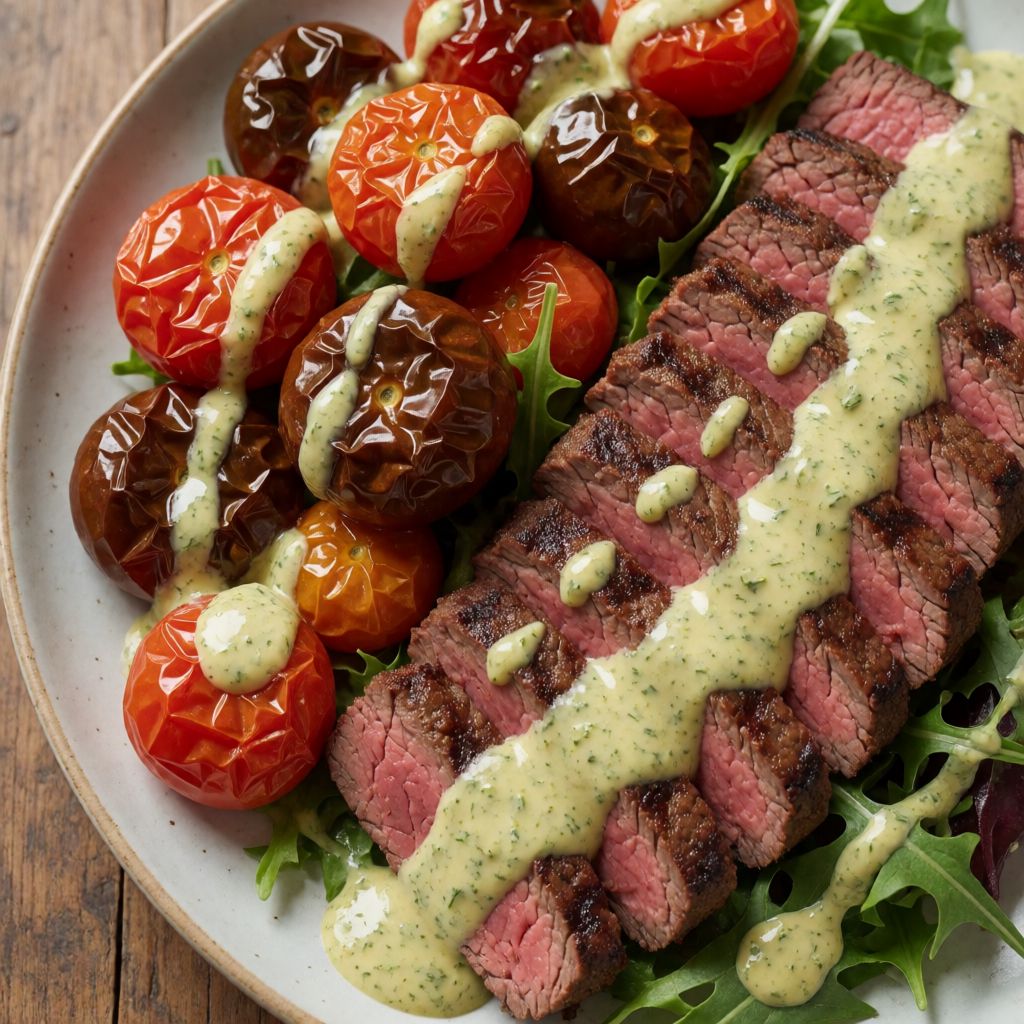
 AI photo
Steak Salad with Roasted Tomatoes and Tarragon Dressing
A hearty steak salad with sweet roasted tomatoes, peppery rocket and a creamy tarragon dressing.
Labels are worked out automatically from the ingredients and can be wrong. Check the packaging if it matters to you.
Ingredients
- 200 g Tomato halved
- 200 g Tomato halved
- 1 bunch Tarragon finely chopped
- 1 tsp Onion Powder
- 1 tbsp Mustard
- 1 pcs Lemon finely grated zest and a little juice
- 200 ml Crème Fraîche
- 2 tbsp Mayonnaise
- Salt
- Black Pepper
- 600 g Beef Steak
- 1 bunch Lettuce whole head
- 70 g Rocket
- ½ pcs Cucumber halved and sliced
- 1 pcs Red Onion thinly sliced
- 1 pcs Avocado thinly sliced
- 1 tbsp Tarragon finely chopped, for sprinkling
- 20 g Butter for frying













Steps
Place the tomatoes cut-side up on a baking tray, drizzle with olive oil and sprinkle with salt and freshly ground black pepper.
Roast the tomatoes in a fan oven preheated to 200°C for 25 minutes.
Let the tomatoes cool on the tray until just warm.
Mix all the ingredients for the tarragon dressing (crème fraîche, mayonnaise, mustard, onion powder, fresh tarragon and lemon zest), except the lemon juice, and season well with salt and pepper and a little lemon juice to taste.
Leave the dressing to rest while you prepare the rest of the dish.
Heat a frying pan, add the butter and let it sizzle.
Season the meat with salt and freshly ground black pepper and fry in the hot pan for 2-3 minutes on each side.
Rest the meat for 5 minutes on a board, then slice.
Arrange the lettuce and rocket on plates first, drizzle with a little tarragon dressing, then top with the tomatoes, cucumber, onion and avocado.
Place the meat on the plates, sprinkle with salt, freshly ground black pepper and tarragon leaves.
Drizzle with a little more dressing and serve immediately.
This is a dish built on a contradiction you have to manage, not solve: hot meat, cold dressing, warm tomatoes, and raw everything else, all on one plate at one moment. The whole thing stands or falls on timing the three temperatures to arrive together — not on any single technique being clever.
Start with the tomatoes, because they take the longest and forgive you the most. Twenty-five minutes at 200°C isn't about cooking them through — it's about collapsing the cell walls so the water that makes a raw tomato bland and watery cooks off, and what's left behind is sugar and acid concentrated into something closer to a sauce than a vegetable. Some say roasting tomatoes is for when they're out of season and tasteless — no, because even a good tomato gets better this way; raw, its sweetness is diluted by water, roasted, the water leaves and takes nothing of the sweetness with it.
The steak is the simplest part and the one people overthink. Two to three minutes a side in a pan with butter isn't a rule, it's a description of what butter foaming and browning looks like while a piece of meat sears — the real cue is the crust: when it releases from the pan without tearing, it's ready to turn. Resting it for five minutes after isn't optional softness-talk; it's the only pause that lets the juice, driven to the centre by the heat, redistribute instead of running out onto your board the second you cut it. Cut too early and you've made a very good steak into a plate of grey juice and dry meat.
Tomatoes: buy for sweetness, not size — small vine or plum tomatoes halved are more reliable here than big beef tomatoes, which carry more water relative to flesh and take longer to concentrate. If tomatoes are genuinely poor — midwinter, no flavour — a tin of good plum tomatoes halved and roasted will actually beat a bad fresh one; you're chasing sugar and structure, not the word "fresh."
Tarragon is the one herb in this dish doing a job nothing else quite does — it has an aniseed note that cuts through the richness of crème fraîche and butter the way parsley or basil simply can't. If you can't get it, chervil is the closest relative in flavour family; failing that, a small amount of fennel frond will give you the aniseed note without pretending to be tarragon. Don't reach for dried tarragon in the dressing — dried herbs in a cold, uncooked sauce taste of paper, because they need heat and time to rehydrate and release anything.
The dressing itself — crème fraîche plus a little mayonnaise — is really asking: how much fat with how much tang? Crème fraîche alone can be slightly thin and sharp; the mayonnaise rounds it out and gives it a cling that plain soured cream won't. If you've only got soured cream, use it, but expect a thinner, sharper result and maybe ease back on the lemon juice. Mustard here isn't for heat, it's an emulsifier and a flavour anchor — English mustard will push the dressing towards sharp and hot, Dijon keeps it rounder; either works, just know which effect you're choosing.
The steak cut matters less than people think for a salad like this, because it's sliced thin after resting rather than served whole — a sirloin or rump will do the job at a fraction of the cost of fillet, since you're not relying on the steak alone to carry the plate. Use any oil with no smell of its own if you're topping up the butter in the pan — a neutral vegetable or rapeseed oil, never olive oil for the sear itself, because its flavour fights the butter and its lower smoke point means it catches before the meat's crust has formed. Butter is there for two reasons: the milk solids in it brown and add a nutty note the meat alone won't give you, and butter at a UK hob's "as hot as it'll get" setting is genuinely close to ideal for a steak this thin — you don't need the ferocity of a kazan fire here, a heavy frying pan on your highest ring does the job, you're just watching the foam go from bubbling to just turning gold-brown as your cue to add the meat.
Avocado and cucumber are there for cool, wet crunch against the warm roasted tomato and hot meat — not for their own flavour, which is mild to the point of being furniture. Any ripe, unbruised avocado works; if avocados are out of your budget or your fruit bowl, a few slices of fennel or even extra cucumber will do the textural job, just without the creaminess avocado brings against the tang of the dressing.
One honest limit of the ordinary flat kitchen: you won't get the tomatoes blistering and slightly charred the way a very hot commercial oven or an open flame would give you — your fan oven at 200°C will get you soft and sweet, not smoky, and that's fine. Don't chase char you don't have the equipment for; roasted-soft is the dish this recipe is built around, not roasted-charred. And this is a dish where patience is genuinely an ingredient — rush the resting of the meat, skip the rest on the dressing, and you haven't ruined it, but you've made a lesser version of the same thing, which is its own quiet kind of waste.