
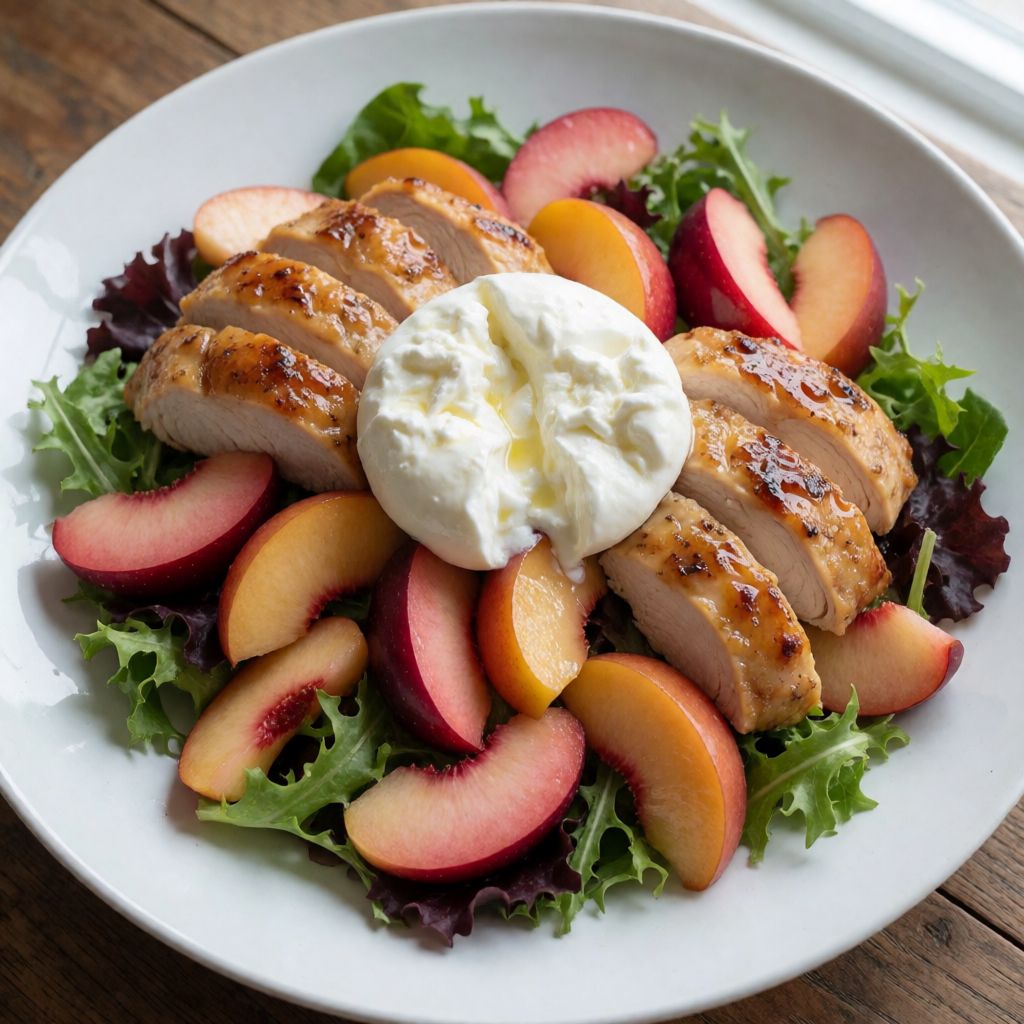
 AI photo
Stone Fruit Salad with Chicken and Burrata
A fresh salad pairing roast chicken with stone fruit, tomatoes, rocket and creamy burrata.
Labels are worked out automatically from the ingredients and can be wrong. Check the packaging if it matters to you.
Ingredients
- 400 g Chicken breast
- 2 tsp Dried thyme
- 1 pcs Lemon finely grated zest, half a lemon
- 20 g Butter
- 1 pinch Salt
- 1 pinch Black pepper freshly ground
- 2 pcs Bread slices
- 3 tbsp Olive oil
- 1 tsp Dijon mustard
- 2 tbsp Elderflower syrup
- 1 tbsp Apple cider vinegar
- 4 pcs Peach sliced
- 4 pcs Apricot sliced
- 200 g Tomato halved
- 150 g Rocket
- 30 g Pine nuts toasted
- 300 g Burrata
- 1 bunch Basil fresh











Steps
Season the chicken breast with salt, pepper, grated lemon zest and thyme, place in a greased baking dish, dot with butter and roast in an oven preheated to 200°C (fan) for about 20 minutes.
20 minCube the bread, toss with olive oil, salt and pepper, and bake in an oven preheated to 200°C (fan) for 10-12 minutes.
11 minWhisk together all the dressing ingredients with the elderflower syrup and adjust the seasoning to taste.
Arrange the peaches, apricots and tomatoes on a platter, scatter over the rocket and sliced chicken, top with croutons and pine nuts, drizzle with the dressing and serve with the burrata and basil.
This is a summer salad built on a contradiction: raw stone fruit next to roast chicken, cold burrata next to warm croutons. That contrast is the whole point, not a flaw. If every component arrives at the same temperature, you've made a chopped salad with chicken on it, which is a different and lesser dish.
What decides whether it works is restraint at three separate moments. The chicken must not dry out, the bread must not turn to gravel, and the burrata must go on last, cold, so it still has that moment of giving way under the spoon. Get those three right and the fruit and leaves barely need your attention — they're ripe or they're not, and no amount of dressing fixes underripe peaches.
Some say a "proper" salad needs everything freshly made at once. No — because the chicken and croutons both improve from resting five minutes out of the oven, and the dressing needs that same window to sit and marry the mustard with the syrup. You're not assembling in a rush; you're assembling in sequence, and the sequence is where the dish is actually made.
The fan oven at 200°C is doing two different jobs here — drying bread and cooking meat through — and it's worth knowing which is which before you start, because they fail in opposite directions.
Chicken breast is lean, which means it has almost no fat to protect it from the heat — that's why the butter sits on top rather than being mixed in, and why 200°C fan with a lid-free dish is really about surface browning while the inside just reaches safe doneness, not about building deep flavour through long cooking. The zest and thyme go on the outside because they're aromatic oils that need contact with fat and heat to release, not buried inside the meat where they'd do nothing. Doneness here isn't a clock number: press the thickest part, it should spring back rather than feel soft and wet, or the juices should run clear, not pink, when you cut in. Pull it a touch early rather than late — chicken breast carries on cooking from its own heat for a minute or two after it leaves the oven, and that's the difference between juicy and chalky.
The bread cubes are there to do a job rocket and fruit can't: give you something that resists the bite. Olive oil coats each cube so the heat crisps the surface instead of just baking it dry all the way through — a dry crouton with no oil is sawdust by the time it's crisp. Watch colour, not time: pale gold with the edges just starting to go deeper means stop, because the last stretch from gold to brown happens fast and turns bitter if you look away. Any firm, slightly stale bread works — a baguette end, a Sunday-loaf heel going hard at the back of the bread bin is actually better than fresh, because fresh bread has too much moisture to crisp properly in 10 minutes.
The dressing leans on elderflower syrup rather than honey or sugar, which tells you something about the fruit it's meant to sit next to — elderflower has a light floral note that doesn't fight peach and apricot the way honey's heavier sweetness can. If you don't have it, a light syrup — even sugar dissolved in a splash of water with a squeeze of that leftover lemon — does the sweetening job, though you lose the perfume. Dijon mustard isn't for heat here; it's an emulsifier, holding the oil and vinegar together so the dressing coats rather than separates into oily pools on the plate. Apple cider vinegar gives the acid that makes burrata and sweet fruit make sense together — without it the whole plate reads as one-note sweet.
Stone fruit is the one ingredient you can't fix with technique. Peaches and apricots need to give slightly under thumb pressure at the shoulder, not the stem end — rock-hard ones that "ripen on the counter" rarely do, they just go from hard to soft without ever getting sweet. If yours aren't there yet, a few minutes under a hot broiler or a dry pan actually helps underripe stone fruit along, caramelising what sugar there is.
Burrata is the expensive decision in this list, and the reason it goes on last, whole or barely torn, straight from the fridge, is simple: it's a bag of cream inside a mozzarella skin, and if it sits out warming up while you plate everything else, it collapses into a puddle before anyone's eaten a bite. If burrata isn't to be had or the budget doesn't stretch — it's a London price for what is, at heart, a very fresh cheese — a good buffalo mozzarella torn by hand gets you most of the way, just without the cream centre. Pine nuts toasted dry in a pan, moved constantly, go from pale to burnt in the time it takes to answer the phone — that's the one moment in this recipe where turning your back actually costs you the dish.