
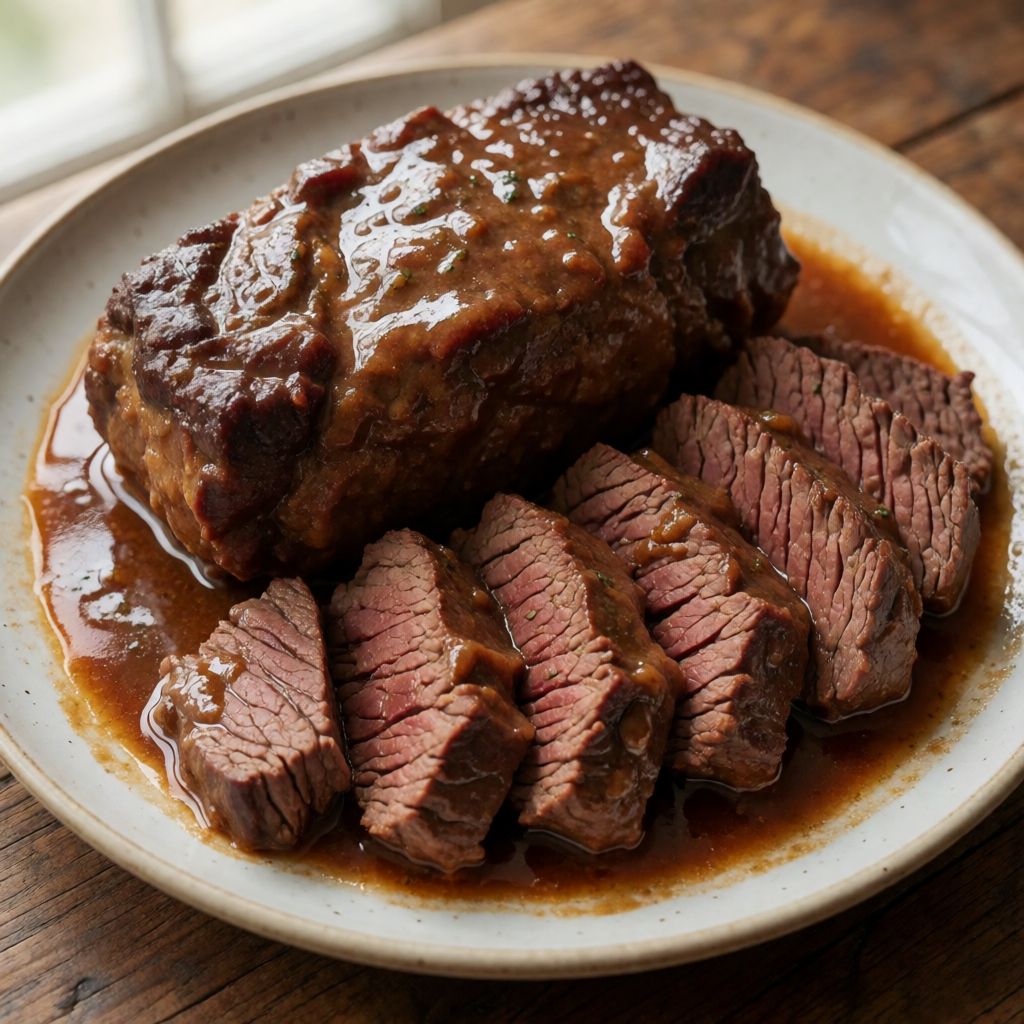
 AI photo
Beef Stracotto
A slow-braised Tuscan-style beef stew, marinated overnight in red wine and herbs, then simmered for hours in tomato passata.
Ingredients
- 1 kg Beef
- 3 l Tomato passata
- 500 ml Red wine
- Olive oil to taste
- 1 pcs Onion
- 1 pcs Carrot
- 1 pcs Celery stalk
- 2 pcs Basil
- Rosemary to taste
- Thyme to taste
- Bay leaf to taste
- Fennel seeds to taste
- Salt to taste
- Black pepper to taste














Steps
Rub the beef with salt, then coat and massage in the fragrant herbs — rosemary, thyme, bay leaf, fennel seeds and basil.
Place the meat in a pot, pour over the red wine, cover with cling film and refrigerate overnight.
Remove the meat from the marinade and brown it in olive oil together with the onion, searing on both sides.
Add the diced carrot and celery.
Pour in the marinade liquid and a cup of hot water, and braise over high heat for about 30 minutes.
30 minAdd the tomato passata and cook over low heat for about 3 hours, topping up with water from time to time.
180 minSeason with salt and black pepper to taste and serve the stracotto hot.
What was changed
Wild fennel was replaced with Fennel seeds, as it is not sold in British shops.
Stracotto means "overcooked" — and that's the whole point, not an insult. This is a Tuscan dish built on the idea that a tough, cheap cut of beef has all the flavour, it's just locked up in collagen that needs three hours to surrender. You're not cooking the meat so much as dissolving it, slowly, until the connective tissue turns to gelatine and the sauce thickens itself from the inside. No cornflour, no stock cube — the beef makes its own binder if you give it time.
What decides whether this works isn't the wine or the herbs, good as they are. It's the cut. You need something with a lot of collagen and not much of a hurry about it — chuck, shin, brisket, the cuts a Sunday roast would reject for being "too tough." That toughness is exactly the asset. A lean, tender steak cut would just dry out and shred; there's nothing in it to melt.
Some say long braising is just "slow cooking the sauce longer for more flavour." No — the sauce isn't getting more flavour from time, it's getting structure. The passata on its own would stay thin and separate, oil pooling on top. It's the beef's own gelatine, released slowly at a gentle simmer, that turns three litres of tomato into something that coats a spoon.
The overnight marinade in wine isn't about "infusing flavour" in the mystical sense — wine's acid and alcohol start breaking down surface proteins before any heat touches the meat, and the herbs rubbed in get carried along for the ride. Cling film over the pot, fridge overnight: that's refrigeration doing a food-safety job, not tradition for its own sake. If you forget and only have an hour, salt and herb it anyway — you'll lose some depth, not the dish.
Browning the meat with the onion first is the step people skip when they're impatient, and it's the one that decides whether the final sauce tastes of anything beyond tinned tomato. That crust is the Maillard reaction — proteins and sugars charring at a temperature plain simmering water never reaches. Scrape that fond off the bottom of the pan with the marinade liquid in step 5; it's not burnt-on mess, it's flavour you paid for with heat and now you're buying it back with liquid.
The carrot and celery, with the onion, are your soffritto — not seasoning so much as a flavour base that quietly dissolves into the sauce and vanishes as itself while leaving behind sweetness and body. You don't need them diced fine for looks; three hours will reduce them to nothing you can identify, which is the job, not a failure of presentation.
Three hours at a bare simmer is the actual engine of this dish. "Low heat" here means: a lazy bubble breaking the surface now and then, not a rolling boil. Boil it hard and you toughen the proteins faster than you break them down — a wide domestic pan loses liquid to evaporation quickly, so top up with water as it goes, which the recipe already tells you to do. This is also where patience is genuinely an ingredient: there's no shortcut temperature that gets you the same gelatine in 90 minutes. Collagen converts to gelatine on a clock, not a dial.
On the beef: 1kg of chuck or shin for four people is generous, and it should be — it shrinks and the sauce is doing double duty as a pasta sauce for leftovers, which is traditionally half the point of making this much. If your butcher doesn't have stracotto-specific cuts, ask for "stewing beef" or "braising steak" — same logic, cheap because it's tough, valuable because it's tough.
On the wine: 500ml of a decent, drinkable red — nothing you'd save for a special occasion, nothing corked either. No wine in the house, or avoiding alcohol? Use the same volume of stock with a splash of good vinegar for the acidity; you'll lose some complexity but keep the mechanism. Fennel seeds are the one herb people substitute badly — don't swap in aniseed liqueur, the seeds give a gentle background warmth, not a sweet punch. If you can't find them, a pinch of ground fennel or simply leave them out; the dish survives on rosemary and thyme alone.